Quick answer: Bamboo sheets are good, with one important caveat: almost every sheet set sold as "bamboo" is actually bamboo viscose, a fiber made by dissolving bamboo pulp and spinning it back out. Bamboo viscose sheets are genuinely soft, breathable, and good at moving moisture away from the skin, which makes them a strong pick for hot sleepers. What they are not is naturally antibacterial or automatically eco-friendly, and the Federal Trade Commission has fined major retailers millions of dollars for saying otherwise.
If you have spent ten minutes shopping for bamboo sheets, you have read the same paragraph fifteen times. Softer than cotton. Cooler than cotton. Naturally antibacterial. Hypoallergenic. Sustainable. Every brand says it, which is exactly why none of it helps you decide.
Here is the part almost nobody leads with, and it is the part that determines whether a set is worth your money: the word "bamboo" on a sheet label is describing where the raw material came from, not what the fabric is. Once you understand that, the honest answer to "are bamboo sheets good" gets a lot clearer, and a lot more useful.
What Are Bamboo Sheets Actually Made Of?
Bamboo sheets are almost always made of bamboo viscose, a regenerated cellulose fiber. Bamboo is a grass with short, stiff fibers, so it cannot be spun into a silky sheet the way cotton can. Manufacturers dissolve bamboo pulp in a chemical bath, then extrude the resulting solution through a spinneret to regenerate it as a soft filament. That filament is viscose (also called rayon), and it is what your sheets are woven from.
This is not a scandal. It is just chemistry, and it is the same process behind most rayon fabrics. But it does mean the finished fabric is a manufactured fiber with bamboo as its plant source, not raw bamboo.
The Federal Trade Commission is unusually direct about this. Under its Textile Rules, a fabric can only be labeled "bamboo" if it is made directly from bamboo fiber, which is rare and feels closer to linen than silk. Everything else must be labeled "rayon made from bamboo" or "viscose made from bamboo." In April 2022, the FTC and the Department of Justice announced that Kohl's agreed to pay $2.5 million and Walmart agreed to pay $3 million, a combined $5.5 million, over allegations they marketed dozens of rayon textile products as bamboo and made deceptive environmental claims about them. The FTC called it the largest civil penalty it had ever obtained in this area. It was not the first round either: back in 2009 the FTC collected $1.26 million in combined penalties from Macy's, Sears, Bed Bath & Beyond, and Leon Max over similar bamboo labeling, and it later sent warning letters to dozens more retailers.
So the first useful filter is simple. A brand that writes "bamboo viscose" on the label is telling you what you are buying. A brand that writes "100% bamboo" and stops there is either uninformed about the rules or hoping you are.

Are Bamboo Sheets Good? The Short, Honest Verdict
Bamboo viscose sheets are good sheets, and they are especially good for people who sleep warm. They are soft in a way that does not depend on thread count games, they breathe well, they drape rather than sit stiffly, and they move moisture off the skin instead of holding it against you.
They are not miracle bedding. A bamboo viscose sheet set will not kill bacteria, will not cure allergies, and will not save the planet by existing. The fabric is better than a lot of cheap cotton and roughly comparable to good cotton, with a different feel and a different set of care requirements.
The honest framing is this: you are buying a specific hand-feel and a specific thermal behavior. If those are what you want, bamboo viscose is one of the best ways to get them. If you want crisp, cool-to-the-touch, hotel-style bedding, percale cotton will make you happier.
What Bamboo Viscose Sheets Genuinely Do Well
These are the claims that hold up.
Softness that does not fade after three washes. Bamboo viscose filaments are long and smooth, so the woven surface has fewer protruding fiber ends than a short-staple cotton. That is why a decent bamboo viscose sheet feels closer to silk than to a fresh cotton percale, and why it tends to get softer rather than rougher with use.
Breathability and moisture movement. Regenerated cellulose is hygroscopic, meaning it readily absorbs and releases water vapor. In practice that means sweat gets pulled off your skin and dispersed into the fabric rather than sitting in a damp patch under your back. This is the single most common reason customers switch, and it is the claim with the most real support behind it.
Drape. Bamboo viscose is a heavy-drape fabric. It falls and conforms instead of standing up in stiff planes. Some people love this and some people find it clingy, so it is worth knowing which camp you are in before you buy.
Temperature range. The same breathability that helps in July helps in January, because a fabric that manages moisture well keeps you from getting clammy and then cold. Bamboo viscose is a reasonable year-round choice rather than a summer-only one.
What the Marketing Gets Wrong About Bamboo Sheets
Here is where a lot of shopping pages go off the rails. The claims below appear constantly, and they are the ones the FTC has specifically targeted.
| Common claim | What is actually true |
|---|---|
| Naturally antibacterial | The bamboo plant contains an antimicrobial compound, but the viscose process dissolves the plant material entirely. The FTC has taken enforcement action over antibacterial claims on rayon made from bamboo. |
| Hypoallergenic | A smooth fiber surface can be gentler on sensitive skin, and many customers report exactly that. It is not a medical property of the fabric, and it should not be sold as one. |
| Eco-friendly by default | Bamboo grows fast with little water, which is a real advantage at the farm. Turning it into viscose requires chemical processing, and the FTC penalized Kohl's and Walmart partly for eco claims that ignored this. Look for a stated closed-loop process and third-party certification instead. |
| 100% bamboo | Almost never accurate on a soft sheet. Under FTC Textile Rules the correct label is rayon or viscose made from bamboo. |
| Cooling | Directionally fair. Bamboo viscose is breathable and moves moisture, which helps hot sleepers. It is not refrigeration, and no fabric is. |
None of this makes bamboo viscose a bad fabric. It makes overclaiming a bad sign. A brand willing to say "this is bamboo viscose, here is the process, here is the certification" is usually a brand that has nothing to hide about the product itself.
What Is the Downside to Bamboo Sheets?
The real downsides of bamboo viscose sheets are care sensitivity, price, and wrinkling.
Viscose is weaker when wet. Regenerated cellulose can lose a meaningful share of its strength while saturated, which is why hot water, harsh agitation, and high dryer heat do more damage to bamboo viscose than they do to cotton. Wash cool (around 86F or 30C), skip the bleach and the fabric softener, and tumble dry on low or line dry. Care guides across the category converge on this, and lab-style wash testing in 2026 has generally used a cold cycle at 86F on a front loader with low-heat drying as the benchmark.
Price is the second downside. Bamboo viscose sets typically cost more than mid-tier cotton. Whether that is worth it depends entirely on whether you actually want the drape and the moisture handling, or whether you were sold on the antibacterial story.
Third, it wrinkles. Bamboo viscose creases readily, especially if it sits in the dryer after the cycle ends. Pull it out promptly and most of it falls out on the bed.
How to Tell a Good Bamboo Viscose Sheet Set From an Overhyped One
Five checks, in order of how much they tell you.
- Read the fiber content, not the headline. You want "bamboo viscose" or "viscose from bamboo" stated plainly. If the page only ever says "bamboo," treat that as a warning sign about everything else on the page.
- Look for GSM, not thread count. Thread count is a cotton metric and it is close to meaningless on a regenerated cellulose fabric. GSM (grams per square meter) tells you the actual weight and substance of the cloth. Sets in roughly the 120 to 150 GSM range are the ones that reviewers consistently describe as both durable and lightweight.
- Check for third-party certification. OEKO-TEX Standard 100 tells you the finished fabric has been tested for harmful substances. FSC certification speaks to the forestry and raw material sourcing. These are specific and verifiable, unlike "eco-friendly."
- Ask about the process. A closed-loop process, which recaptures and recycles the chemicals used in production rather than discharging them, is the honest version of the sustainability claim. If a brand cannot describe its process, it probably does not control it.
- Check the return window. Fabric feel is personal. A real trial period, not a 30-day return-if-unopened policy, is how you find out whether the drape suits you.
Bamboo Viscose vs Cotton: A Quick Comparison
| What you care about | Bamboo viscose | Cotton (percale) | Cotton (sateen) |
|---|---|---|---|
| Feel | Silky, fluid, heavy drape | Crisp, matte, hotel-like | Smooth, slight sheen, warmer |
| Hot sleepers | Strong: breathable, moves moisture | Strong: airy open weave | Moderate: denser, holds more heat |
| Care sensitivity | Higher: cool wash, low heat | Low: forgiving | Low to moderate |
| Wrinkling | Wrinkles readily | Wrinkles, reads as intentional | Resists wrinkles better |
| Useful spec | GSM | Thread count and ply | Thread count and ply |
There is no winner in that table. There is a match for how you sleep. If you run hot and like a fluid, skin-close feel, bamboo viscose. If you want crisp and cool-to-the-touch and you do not want to think about the laundry, percale.
Where Fabric Stops Mattering and Construction Starts
Here is the thing almost no bamboo sheet review will tell you: the best fabric in the world does not help if the top sheet ends up in a rope at the foot of the bed by 2am.
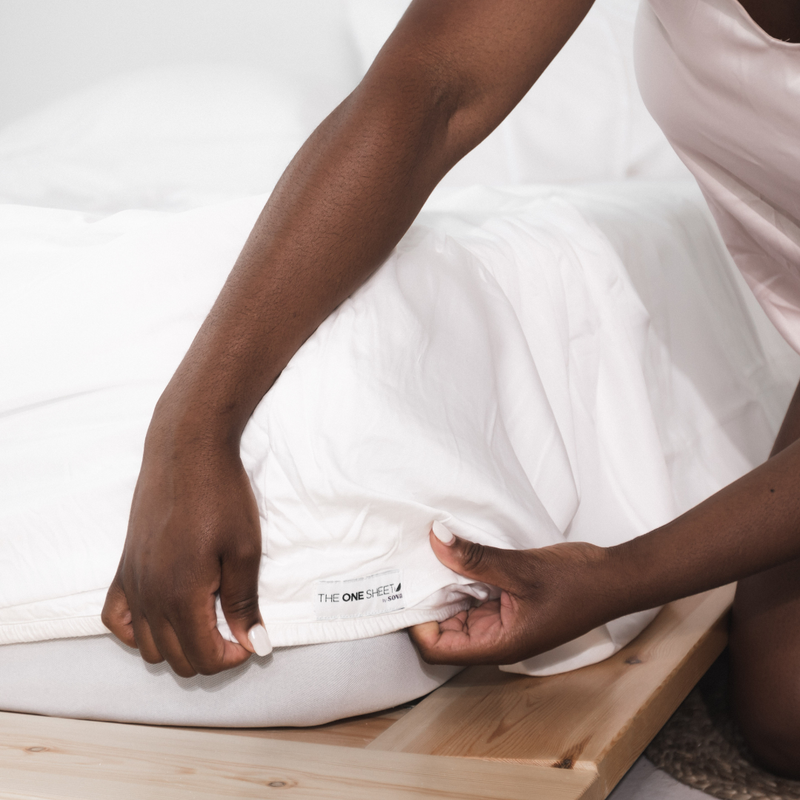
That failure is not usually a fabric problem. On the fitted side, corners pop off because of how the sheet was put on. Most people pull the pocket straight down over the tip of the mattress corner, which tents the fabric into an upside-down U and leaves the elastic gripping nothing but the point. Seat each corner flat instead, hooking the pocket over the corner and drawing it under the mattress so the deep pocket wraps the underside, and most pop-off stops immediately. Pocket depth is the second cause: a correctly seated corner still fails if the pocket is too shallow to reach under a thick mattress, and a 15 inch or deeper mattress wants a 16 to 22 inch pocket.
On the top sheet side, there is no technique that fixes it, because a flat sheet is a loose rectangle of fabric with nothing holding it anywhere. Clips, suspenders, straps, and corner grippers all work to some degree, but they are ongoing symptom management. You are adding hardware to compensate for a design that never had an anchor point.
The One Sheet takes the other approach and removes the failure point. The top sheet is permanently sewn to the fitted sheet at the foot of the bed, a connected design protected by two utility patents, so the top sheet cannot shift, bunch, or migrate to one side of the bed. It is made from organic bamboo viscose produced with a closed-loop process that recaptures and recycles process chemicals rather than discharging them, and it is OEKO-TEX Standard 100 certified with FSC certified materials. Deep pockets fit standard, thick, and adjustable mattresses.
The connected design also solves the care problem that trips up so many bamboo viscose owners. Because the set is one piece, it goes into the wash as one piece and cannot tangle into a knot around itself, which is where a lot of pilling and wear actually starts. Every order ships with a free mesh wash bag for exactly that reason: cool wash, gentle cycle, one bag, one piece, out and back on the bed.
Key Takeaways
- Almost all sheets sold as "bamboo" are bamboo viscose, a regenerated cellulose fiber made from bamboo pulp, and the FTC requires that labeling.
- Bamboo viscose sheets are genuinely soft, breathable, and good at moving moisture, which makes them a strong choice for hot sleepers.
- Antibacterial and hypoallergenic claims do not survive the viscose process, and the FTC has fined major retailers millions over bamboo labeling and eco claims.
- Judge a set by GSM (roughly 120 to 150 is a good window), stated fiber content, OEKO-TEX Standard 100 and FSC certification, and a described closed-loop process, not by thread count.
- The main downsides are care sensitivity (cool wash, low heat), price, and wrinkling.
- Fabric quality is only half the equation. A sheet that shifts off the bed every night is a construction problem, not a fiber problem.
Frequently Asked Questions
What is the downside to bamboo sheets?
The main downsides of bamboo viscose sheets are care sensitivity, price, and wrinkling. Viscose loses strength when wet, so hot water and high dryer heat cause shrinkage and wear faster than they would on cotton. Bamboo viscose sets also generally cost more than mid-tier cotton, and they crease readily if left sitting in the dryer.
Are 100% bamboo sheets worth it?
"100% bamboo" is almost never an accurate description of a soft sheet set. Under FTC Textile Rules, fabric made by dissolving bamboo pulp must be labeled rayon or viscose made from bamboo. A well-made bamboo viscose set is worth the premium if you want its specific softness and moisture handling, but a set marketed as "100% bamboo" is a signal to read the rest of the page more carefully.
Is it healthy to sleep on bamboo sheets?
Sleeping on bamboo viscose sheets is perfectly safe, and many people with sensitive skin report that the smooth fiber surface feels gentler than a coarser cotton. Bamboo viscose is not a medical product though, and claims that it is antibacterial or hypoallergenic have been the subject of FTC enforcement. Look for OEKO-TEX Standard 100 certification, which confirms the finished fabric was tested for harmful substances.
What is better for you, cotton or bamboo sheets?
Neither cotton nor bamboo viscose is universally better; they suit different sleepers. Bamboo viscose is silkier, drapes heavily, and moves moisture well, which favors hot sleepers who like a skin-close feel. Percale cotton is crisper, cooler to the touch, and far more forgiving in the laundry, which favors people who want hotel-style bedding and low maintenance.
Are bamboo sheets good for hot sleepers?
Bamboo viscose sheets are one of the better options for hot sleepers because the fiber is hygroscopic, meaning it absorbs and releases moisture readily and pulls sweat off the skin rather than trapping it. Pair that with a lower GSM in the 120 to 135 range for the most airflow.
Do bamboo viscose sheets pill?
Bamboo viscose can pill, but usually because of how it is washed rather than the fiber itself. Hot water, harsh detergent, overloading the machine, and drying on high heat all abrade the surface and raise fiber ends. Washing cool on a gentle cycle in a mesh bag, and drying on low, is what keeps the surface smooth.
Sheets are one of the few things you touch for eight hours a night, so it is worth buying the fabric you actually want rather than the one with the loudest claims. If the thing driving you crazy is not the fabric but the nightly wrestling match with a top sheet that will not stay put, The One Sheet was built for that specific problem, and there is a 100-night sleep trial to find out on your own bed.