Quick answer: Eucalyptus sheets and bamboo sheets are both regenerated cellulose fabrics rather than raw plant fibers. Eucalyptus sheets are almost always lyocell and bamboo sheets are almost always viscose, and that manufacturing difference explains most of what you feel: lyocell tends to sleep slightly crisper and drier, while bamboo viscose tends to feel softer and more fluid against the skin. Both breathe better than standard cotton, and for most sleepers the real gap between them is smaller than either category's marketing suggests.
Search "eucalyptus vs bamboo sheets" and you will get two confident, opposite answers. The eucalyptus brands will tell you eucalyptus wins on cooling and sustainability. The bamboo brands will show you lab numbers proving the opposite. Each one is selling the fiber it happens to make, and each one is telling you the true half of the story that flatters its own product.
We make The One Sheet from organic bamboo viscose, so we have a side too. We are going to tell you where eucalyptus genuinely wins anyway, where the two fabrics are close enough that the choice comes down to taste, and where the whole comparison matters less than the thing almost nobody writes about.
What are eucalyptus sheets actually made of?
Eucalyptus sheets are made from lyocell, a fiber spun from eucalyptus wood pulp rather than harvested from the tree as a usable thread. The best known version is TENCEL lyocell, produced by the Austrian company Lenzing. Wood chips are dissolved in a solvent called N-methylmorpholine N-oxide, usually shortened to NMMO, then pushed through spinnerets and set into fiber. Lenzing states that its closed-loop process recovers about 99.8 percent of that solvent and reuses it in the next batch.
So "eucalyptus" describes the tree the pulp came from. It does not describe a fabric you could weave straight off a branch. That distinction matters more than it sounds, and it is where most of the confusion in this comparison starts.
What are bamboo sheets actually made of?
Bamboo sheets are almost always bamboo viscose, sold on some labels as rayon made from bamboo. The idea is the same as lyocell: dissolve plant pulp into a solution, then regenerate it into fiber. The difference is the solvent chemistry. Conventional viscose production uses carbon disulfide, and when a mill runs an open system it can discharge those process chemicals rather than recapture them.
That is the fair criticism of the category, and it is worth stating plainly. It is also a manufacturing issue rather than a plant issue. A closed-loop process recaptures and recycles the process chemicals instead of releasing them, which is why The One Sheet's organic bamboo viscose is made that way. If you want the longer version of how the fabric is made, we wrote a full explainer on what bamboo viscose actually is.
Why can a sheet not simply be labeled "bamboo"?
Under the Textile Fiber Products Identification Act, the US Federal Trade Commission says a textile can be called bamboo only if it is made directly from bamboo fiber. Fabric produced by dissolving bamboo into viscose has to be described as "rayon made from bamboo" or "viscose made from bamboo" instead. The FTC has enforced this repeatedly. In 2022 the agency sought civil penalties of $2.5 million from Kohl's and $3 million from Walmart over bogus bamboo marketing, by far the largest penalties it has pursued in this area.
The same logic is why eucalyptus bedding is labeled lyocell rather than eucalyptus. Neither fabric is the plant. Both are the plant, dissolved and respun.
Here is the practical takeaway, and it is the single most useful thing on this page. The label tells you the process, and the process is what you are actually choosing between. A listing that says "viscose made from bamboo" or "100% lyocell" is telling you the truth about what it is. A listing that says only "100% bamboo" with no fiber term anywhere is either mislabeled or hoping you do not look, and that is a reasonable reason to be skeptical of everything else on the page.
Eucalyptus vs bamboo sheets: which one sleeps cooler?
Neither eucalyptus lyocell nor bamboo viscose is meaningfully cooler than the other in a normal bedroom. Both are absorbent cellulosic fibers that work the same way: they pull moisture off your skin and spread it across a wide surface so it can evaporate, and that evaporation is what you register as cool.
The variable that actually moves the needle is not the fiber. It is the weave and the weight. A heavy sateen in either fabric will sleep warmer than a light percale in the other, because a denser weave with more yarn crossings traps more air and offers less open surface for moisture to leave. If cooling is your priority, the weave choice is doing more work than the plant on the label, which is why we treat percale versus sateen as the more important decision and cover the whole subject in our guide to what actually keeps you cool at night.
If you want a tiebreaker anyway: lyocell is often described as feeling drier and less clingy during a heavy sweat, while bamboo viscose is often described as feeling smoother and cooler on first touch. Both descriptions are consistent with what people report, and neither is a large enough difference to override weave, weight, and room temperature.
Which one feels softer?
Bamboo viscose tends to feel softer, heavier in the hand, and more fluid, with a drape closer to silk. Eucalyptus lyocell tends to feel smoother and slightly crisper, closer to a very fine cotton percale with a cool, dry finish.
This is preference, not performance. If you like the sensation of fabric that pours over you and settles, bamboo viscose in a sateen weave is the closer match. If you like a bed that feels taut, cool, and hotel-crisp, lyocell is likely to suit you better. Nobody can tell you which of those is correct, and any article that ranks them is ranking a taste.
Which one holds up better over time?
Lyocell has a genuine edge here, and it is worth granting honestly: lyocell fiber is generally reported as stronger than viscose, particularly wet strength, which is when both fabrics are at their most vulnerable. If you are hard on your bedding and wash it often and hot, that difference is real.
It is also smaller than it sounds in practice, because pilling and thinning on either fabric are driven mostly by abrasion, heat, and finish rather than by fiber species. Hot washes, overloaded drums, high dryer heat, and sheets tumbled against zippers and towels will wear out lyocell too. We broke down the full mechanism in why bed sheets pill, and the short version is that how you wash matters more than which of these two you bought.
Which one is more sustainable?
Lyocell has the cleaner and simpler story. A closed-loop process with high solvent recovery is easy to verify and easy to explain, and Lenzing's published recovery figure is the number the whole category points at.
Bamboo viscose is not one thing, which is exactly why the category gets criticized as a whole. Conventional open-system viscose is the weakest option in this comparison. Closed-loop bamboo viscose is a different product made by a different process, and lumping the two together is the mistake most of these articles make in the eucalyptus brands' favor.
Rather than trusting an adjective, look for claims you can check. OEKO-TEX Standard 100 certification means the finished fabric was tested for a list of harmful substances. FSC certified materials means the pulp came from responsibly managed forests. A stated closed-loop process means the process chemicals are recaptured rather than discharged. The One Sheet carries all three, and we say so in those specific terms rather than with vague eco language, because those are the parts anyone can verify.
Eucalyptus lyocell vs bamboo viscose at a glance
| Eucalyptus lyocell | Bamboo viscose | |
|---|---|---|
| Source | Eucalyptus wood pulp | Bamboo pulp |
| Process | Lyocell, NMMO solvent, closed loop standard | Viscose, closed loop on better mills, open system on conventional ones |
| Typical hand | Smooth, crisp, cool and dry | Soft, fluid, silky drape |
| Cooling | Very good, driven mainly by weave | Very good, driven mainly by weave |
| Wet strength | Generally the stronger of the two | Good, more sensitive to heat and rough washing |
| Pilling risk | Low to moderate, rises with heat and abrasion | Low to moderate, rises with heat and abrasion |
| Label to look for | Lyocell, TENCEL lyocell | Viscose made from bamboo, rayon made from bamboo |
| Certifications worth checking | OEKO-TEX Standard 100, FSC | OEKO-TEX Standard 100, FSC, stated closed-loop process |

So which should you buy?
If you want the crispest, driest, most hotel-like hand and you want the simplest sustainability story to explain, buy eucalyptus lyocell. If you want the softest, most fluid feel against your skin, buy bamboo viscose, and buy it from a maker who will tell you specifically how it is processed and certified.
What you should not do is expect either fabric to be a different category of experience from the other. They are cousins. They are made the same way from different trees, they behave similarly in a real bed, and once you have chosen the weave and the weight you have already made the decision that will affect your sleep most.
The variable neither fabric fixes
Here is the part the fiber comparison never gets to. You can buy the cooler fabric, in the better weave, with every certification on the label, and still wake up at three in the morning with the top sheet twisted into a rope around your knees and a fitted corner snapped off the mattress. No fiber solves that. It is a fit and construction problem, and it is the one people actually complain about.
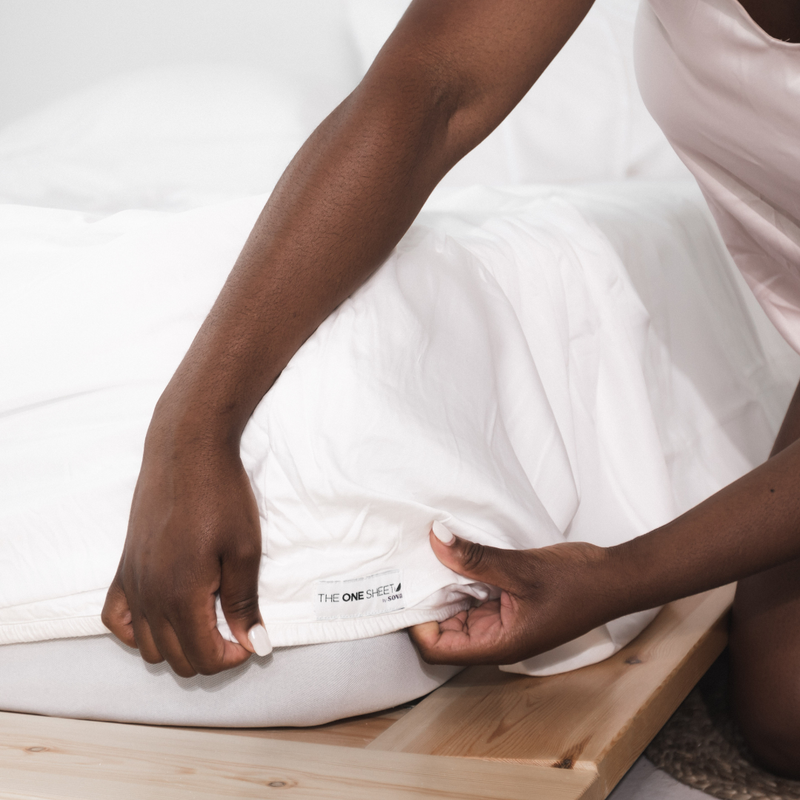
Fitted corners usually pop for a reason that has nothing to do with fabric quality. Most people put a fitted sheet on by pulling the pocket straight down over the tip of the mattress corner, which tents the fabric into an upside-down U and leaves the elastic gripping nothing but the point. The fix is to seat each corner flat: hook the pocket over the corner, then pull it under the mattress so the deep pocket wraps the underside and the elastic has something to hold. That one change solves a surprising share of pop-offs, and we walk through it step by step in how to keep a fitted sheet tight.
Pocket depth is the second cause, and it only shows up after the seating technique is right. A mattress of fifteen inches or more, especially with a topper, wants pockets in the sixteen to twenty-two inch range. Anything shallower cannot reach far enough under the mattress to hold, no matter how carefully you seat it. Our guide to deep pocket sheets covers how to measure yours.
Clips, straps, suspenders, and grippers come third. They work, and we will not pretend otherwise, but they are symptom management: you are adding hardware to hold together a design that comes apart. The One Sheet takes the other approach. The top sheet is permanently sewn to the fitted sheet at the foot of the bed, so the top sheet cannot migrate to one side, cannot get kicked to the floor, and cannot be stolen across the bed, because there is no loose edge to move. It is made from organic bamboo viscose with deep pockets for thick and adjustable mattresses, and it comes with a 100-night sleep trial so you can find out in your own bed whether the connected design is the fix.
How to wash eucalyptus and bamboo viscose sheets
Both fabrics want the same care, and both are damaged by the same things. This routine will get you years out of either one.
- Wash cold or warm on a gentle cycle. Heat is the main enemy of both fibers, and it does its damage while the fabric is wet and weakest.
- Use a mild liquid detergent, and skip the extras. No chlorine bleach, no optical brighteners, and no fabric softener, which coats the fibers and kills exactly the breathability you paid for.
- Wash sheets on their own, in a mesh bag. Zippers, hooks, and towel abrasion cause most pilling. Every One Sheet order ships with a free mesh wash bag for this reason, and because the set is connected it goes in as one piece and comes out untangled instead of wrapping itself around everything else in the drum.
- Do not overload the machine. Fabric needs room to move, and a packed drum grinds sheets against themselves.
- Tumble on low or line dry, and pull them out slightly damp. High heat is what turns a good sheet rough. Slightly damp sheets finish smooth on the bed with no ironing.
Our full routine, including stains and yellowing, is in how to wash bamboo viscose sheets.
Key takeaways
- Eucalyptus sheets are lyocell and bamboo sheets are viscose, and both are regenerated cellulose fabrics rather than raw plant fibers.
- The FTC requires bamboo-derived fabric to be labeled as viscose or rayon made from bamboo, so a listing that says only "100% bamboo" is a labeling red flag.
- Neither fabric is meaningfully cooler than the other; weave and weight drive cooling far more than the plant on the label.
- Bamboo viscose feels softer and more fluid, eucalyptus lyocell feels crisper and drier, and that difference is taste rather than performance.
- Lyocell has the simpler sustainability story, but closed-loop bamboo viscose with OEKO-TEX Standard 100 and FSC certified materials is a different product from conventional viscose.
- Fabric choice does not stop a top sheet from twisting or a fitted corner from popping off, which is a fit and construction problem.
Frequently asked questions
Which is better, bamboo or eucalyptus sheets?
Neither is better across the board. Bamboo viscose is better if you want a softer, more fluid, silk-like feel. Eucalyptus lyocell is better if you want a crisper, drier hand and the simplest sustainability story to verify. On cooling and everyday comfort the two are close enough that weave, weight, and fit will affect your sleep more than the choice between them.
Are eucalyptus sheets worth it?
Eucalyptus sheets are worth it if you like a smooth, cool, crisp hand and you want a closed-loop production process that is easy to verify. They usually cost more than conventional cotton and about the same as good bamboo viscose. They are not worth a large premium over a well-made closed-loop bamboo viscose sheet, because the performance difference in a real bed is small.
Is eucalyptus good for bed sheets?
Yes. Eucalyptus lyocell is a good bedding fabric: it is absorbent, breathable, smooth, and generally stronger than viscose when wet, which helps it survive frequent washing. Its main drawbacks are price and the same heat sensitivity that affects every cellulosic sheet.
What are the drawbacks of bamboo sheets?
The honest drawbacks of bamboo viscose sheets are these: conventional open-system viscose production can discharge process chemicals unless the mill runs a closed loop, the fabric is more sensitive to high heat and rough washing than lyocell or linen, it wrinkles more than a crisp cotton percale, and the category has a real mislabeling problem that makes it hard to tell good makers from bad ones. Buying from a maker who states its process and certifications addresses most of these.
What is the healthiest material for bed sheets?
No bedding fabric is a health product, and you should be skeptical of any sheet marketed as one. What you can check is whether the finished fabric was tested for harmful substances, which is what OEKO-TEX Standard 100 certification covers. Beyond that, a breathable fabric in a weave you find comfortable, washed regularly, is the sensible standard for any sleeper.
What are the healthiest sheets to have on your bed?
Look for a certification rather than a claim. OEKO-TEX Standard 100 tells you the finished fabric was tested against a list of harmful substances, and FSC certified materials tells you the pulp was responsibly sourced. Those are verifiable. Broad wellness claims about a fiber generally are not, and the FTC has taken action against unsupported marketing in this category before.
Is eucalyptus the same as TENCEL?
Not exactly. TENCEL is Lenzing's brand name for its lyocell and modal fibers, and TENCEL lyocell is commonly made from eucalyptus pulp. So most TENCEL lyocell is eucalyptus, but a sheet described only as "eucalyptus" may be lyocell from another producer. The fiber term on the label is the useful part.
Do eucalyptus or bamboo sheets stay on the bed better?
Neither fabric stays on the bed better than the other, because staying put is a function of pocket depth, elastic quality, and how the corner is seated, not of fiber. A sheet in either fabric will pop off a deep mattress if the pocket is too shallow or the corner was tented over the tip instead of seated flat underneath.
If the part of this that actually keeps you up is the sheet moving rather than the fiber it is made from, that is the problem The One Sheet was built to remove. The top sheet is sewn to the fitted at the foot, so there is nothing loose to twist, slide, or steal, and the 100-night sleep trial means you can test it where it counts.