Quick answer: Cooling sheets work by letting heat and moisture escape from your bed, not by making anything cold. Breathable, moisture-wicking fabrics such as organic bamboo viscose, cotton percale, and linen keep you cooler through the whole night, while cool-to-the-touch finishes mostly affect the first few minutes. No sheet actively produces cold, so the best cooling sheet is the one that stops heat from building up under your covers in the first place.
Type "cooling sheets" into Google and you get two things: product pages promising proprietary cooling technology, and roundups ranking twenty sets you have never touched. What you mostly do not get is a straight answer to the obvious question: what is actually happening under the covers, and which of these claims matter at 3 a.m.?
This guide is that answer. No rankings, no lab-coat theatrics. Just how heat behaves in a bed, which fabric properties genuinely move the needle, and how to tell a sheet that sleeps cool from a sheet that merely feels cold in the store.
Do cooling sheets really work?
Cooling sheets do work, with one honest caveat: they manage the heat your body produces, they do not create cold. A sheet has no compressor and no fan. Even Google's own buying guidance for cooling sheets notes that they are designed to manage body heat but "do not actively produce cold."
That is less disappointing than it sounds, because heat management is exactly what a hot sleeper needs. Your body wants to drop its core temperature at night; that drop is part of how your brain initiates and holds deep sleep. Sleep experts, including the Cleveland Clinic and the Sleep Foundation, put the ideal bedroom in the 60 to 68 degree Fahrenheit range, with about 65 degrees cited most often. The problem is that the microclimate under your covers runs far warmer than the room. You radiate heat and moisture all night, and your bedding either vents it or traps it.
So the real question is not "do cooling sheets work?" but "does this fabric let my body heat escape, or does it hold it against my skin?" Everything below is a way of answering that.
How do cooling sheets actually work?
Cooling sheets rely on three physical mechanisms, and knowing them makes every marketing claim easier to judge.
1. Breathability (airflow). A breathable fabric has an open enough structure that warm, humid air moves through it instead of pooling under it. This is the workhorse mechanism. It is why a crisp percale weave or a light linen sheet feels airy: heat escapes continuously, all night, with no technology involved.
2. Moisture wicking and evaporation. Evaporating sweat is your body's most powerful cooling tool. Textile researchers note that evaporation can account for up to 80 percent of the body's heat dissipation during heavy exertion, which is roughly what a night sweat is. A wicking fabric pulls moisture off your skin and spreads it across a wider surface area so it evaporates faster. Fabrics that absorb sweat and hold it, like heavy cotton sateen or thick microfiber, do the opposite: they turn damp, clammy, and warm.
3. Thermal conductivity (the cool-to-the-touch effect). Some fibers conduct heat away from your skin quickly, which registers as an instantly cold feel. This is real physics, but it is also the most oversold mechanism, which brings us to the distinction that matters most.
Cool to the touch is not the same as sleeping cool
A cool-to-the-touch sheet feels cold for the same reason bathroom tile feels cold: it conducts heat away from your skin faster than air does. That effect is strongest in the first few minutes, before the fabric warms to body temperature. Once the sheet and your skin reach equilibrium, conduction has done its job and stops helping.
Sustained cooling, the kind that matters at 3 a.m., comes from breathability and moisture wicking. Those two mechanisms keep working for as long as you are producing heat and sweat, because they move both away from you rather than briefly absorbing them.
There is one more catch worth knowing: some cool-touch effects come from chemical finishes applied to the fabric rather than from the fiber itself, and those treatments can fade after repeated washing. Structure does not wash out. A fabric that cools because of what it is, an open weave or a naturally wicking fiber, keeps cooling for its whole life.
If you remember one sentence from this guide, make it this: buy for the whole night, not the first ten minutes.

What type of sheet is most cooling?
The most cooling sheet fabrics are breathable, moisture-wicking natural or semi-natural fibers: bamboo viscose, cotton percale, linen, and Tencel lyocell. Here is how they compare on the mechanisms that count.
| Fabric | How it cools | Feel | Worth knowing |
|---|---|---|---|
| Bamboo viscose | Highly breathable and strongly moisture-wicking; smooth fibers spread sweat for fast evaporation | Silky, soft, cool drape | Look for organic bamboo viscose with OEKO-TEX Standard 100 certification |
| Cotton percale | Crisp one-over-one weave keeps the fabric open and airy | Crisp, light, hotel-style | Gets softer with washing; feels cooler than sateen |
| Linen | Hollow flax fibers move air and moisture exceptionally well | Textured, relaxed, breezy | Wrinkles are part of the look; often the priciest option |
| Tencel lyocell | Smooth, hydrophilic fibers wick moisture efficiently | Cool, drapey, almost slippery | A good pick for sensitive skin |
| Polyester microfiber | Traps heat unless specifically engineered as performance fabric | Soft but warm and clammy | The most common reason "soft" sheets sleep hot |
Independent testers keep landing in the same place. Wirecutter's hot-sleeper testing concluded that "the most reliably cool, durable, and comfortable sheets are good old cotton percale and linen," and bamboo viscose and lyocell earn similar marks for wicking. The pattern across all of them: structure and fiber beat coatings and slogans.
The thread count myth (and what to avoid)
Here is the counterintuitive part: for cooling, a lower thread count is usually better. Somewhere in the 200 to 400 range is the sweet spot most buying guides converge on. Very high thread counts pack yarns so densely that the fabric stops breathing, which is great for a heavy, cocooned feel and terrible for a hot sleeper.
Beyond chasing thread count, three things to avoid if you sleep hot:
- Tight, heavy weaves. Sateen's four-over-one weave feels buttery but holds more heat than percale's open checkerboard.
- Standard polyester and microfiber. Unless a synthetic is specifically engineered to wick (some performance fabrics are), it tends to trap both heat and moisture.
- Cooling claims with no mechanism. If a product page cannot tell you whether the effect comes from weave, fiber, or a finish, assume it is a finish and judge accordingly.
Do cooling sheets help with night sweats and menopause?
For night sweats, breathable and moisture-wicking sheets are one of the most useful passive tools you can buy, though they are a management layer, not a cure. The scale of the problem is real: The Menopause Society reports that hot flashes affect roughly 75 to 80 percent of women in menopause, and clinical reviews put the average duration of symptoms at 7 to 10 years. That is a long time to sleep on the wrong fabric.
What a wicking sheet changes is the aftermath of a night sweat. Instead of lying in a damp, clammy tangle that turns cold and then hot again, moisture gets pulled away from your skin and evaporates, so you are more likely to settle back to sleep instead of stripping the bed at 2 a.m.
The best bedding setup for menopause and night sweats layers several small wins:
- A bedroom in the 60 to 68 degree range
- Breathable, wicking sheets (bamboo viscose, percale, linen, or lyocell)
- Bedding in layers you can shed, rather than one heavy duvet
- Moisture-wicking sleepwear, for the same reason as the sheets
None of this is medical treatment, and anyone with severe symptoms deserves a real conversation with a clinician. But fabric is the part of the equation you control tonight.
Your sheets only cool you if they stay where they belong
Here is the part almost every cooling sheet guide skips: a breathable top sheet only vents heat while it is lying flat over you.
Watch what actually happens to a hot sleeper's bed. Hot sleepers toss and turn more, and every position change drags the top sheet a little further out of place. By the middle of the night the sheet has twisted into a rope, bunched into thick folds that trap pockets of heat against you, or slid off entirely, leaving you sweating directly under a duvet that breathes far worse than any sheet. The fabric did not fail. The architecture did.
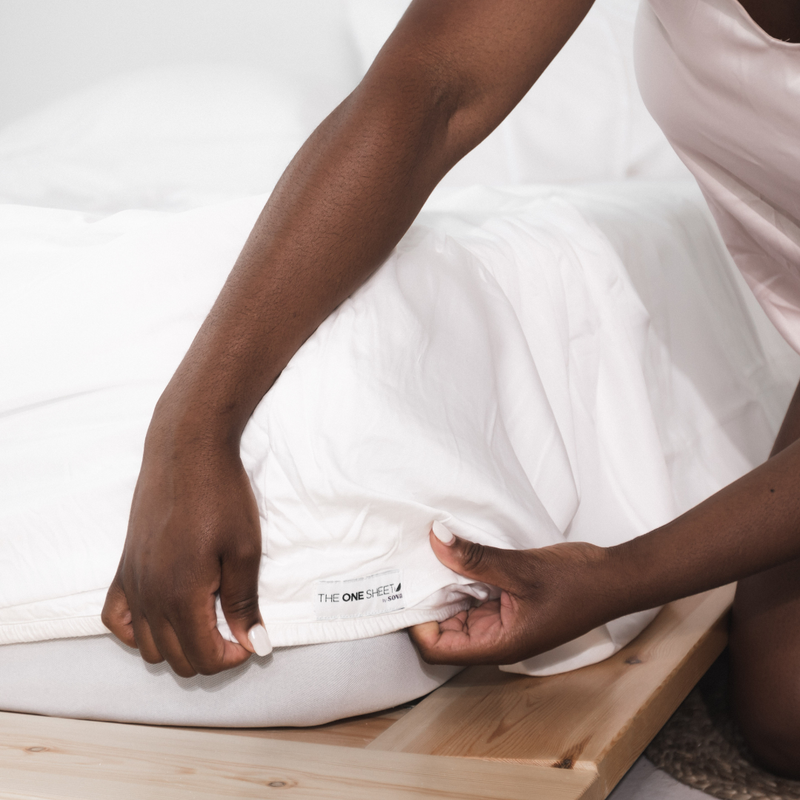
That failure point is what The One Sheet was designed to remove. The top sheet is sewn to the fitted sheet at the foot of the bed, so it physically cannot untuck, twist into folds, or end up on the floor. The single layer of organic bamboo viscose stays flat and smooth over you all night, which is exactly the position where a breathable, wicking fabric does its best work. Deep pockets keep the fitted layer seated on standard, thick, and adjustable mattresses, and the 100-night sleep trial gives you a full summer's worth of hot nights to judge it honestly. If you run hot and want the fuller comparison shopping picture, our guide to the best sheets for hot sleepers goes deeper.
One care note that matters more for cooling fabrics than most: wash them regularly. Body oils and residue gradually coat fibers and blunt their wicking. Bamboo viscose likes a gentle cold wash, and The One Sheet ships with a free mesh wash bag with every order, so the connected set washes as one piece without tangling around the rest of the load.
How to keep your whole bed cooler
Cooling sheets work best as part of a bed that is set up to shed heat. Six steps, in order of impact:
- Set the bedroom to 60 to 68 degrees. This is the single biggest lever, and it is the range sleep researchers keep pointing to.
- Choose breathable, wicking sheets. Organic bamboo viscose, cotton percale, linen, or Tencel lyocell, in a moderate thread count.
- Layer your bedding. A sheet plus a light blanket you can kick off beats one heavy duvet that gives you two temperatures: on or off.
- Check under the sheets. Solid foam mattresses and vinyl-backed protectors trap heat no matter what you put over them. A breathable protector helps more than most people expect.
- Wash sheets regularly. Clean fibers wick; coated fibers do not. Weekly is the standard advice, and it directly protects the cooling performance you paid for.
- Warm up to cool down. A warm shower an hour or two before bed pulls blood to your skin and helps your core temperature drop right on schedule.
Key takeaways
- Cooling sheets manage your body heat; nothing about them produces cold.
- Breathability and moisture wicking are the mechanisms that keep you cool all night; cool-to-the-touch is mostly a first-impression effect.
- The most cooling fabrics are bamboo viscose, cotton percale, linen, and Tencel lyocell; standard polyester microfiber is the usual culprit when soft sheets sleep hot.
- For cooling, moderate thread counts around 200 to 400 breathe better than very high ones.
- Cool-touch finishes can fade with washing; cooling that comes from fiber and weave structure does not.
- A cooling top sheet only works while it stays flat and in place, which is the structural problem The One Sheet's connected design was built to solve.
Cooling sheets FAQ
Do cooling sheets really work?
Yes, cooling sheets genuinely help hot sleepers, as long as you expect heat management rather than refrigeration. Breathable, moisture-wicking fabrics let body heat and sweat escape instead of trapping them, which keeps the microclimate under your covers closer to the cool room temperature your body wants for deep sleep.
What type of sheet is most cooling?
The most cooling sheets are made from breathable, moisture-wicking fibers: bamboo viscose, cotton percale, linen, and Tencel lyocell all test well. Weave matters too, so a crisp percale outperforms a dense sateen, and moderate thread counts breathe better than very high ones.
Do cooling sheets work for night sweats?
Cooling sheets help manage night sweats by wicking moisture off your skin and speeding evaporation, so you spend less of the night damp and clammy. They are a management tool rather than a fix for the underlying cause, but they meaningfully improve how quickly you resettle after a sweat.
What is the best bedding for menopause?
The best bedding for menopause combines a cool bedroom (60 to 68 degrees), breathable wicking sheets such as organic bamboo viscose or percale, and layered covers you can shed during a hot flash. With hot flashes affecting roughly 75 to 80 percent of women in menopause, often for years, fabric choice is a small change with a nightly payoff.
Do cooling sheets stop working over time?
Cooling that comes from a chemical cool-touch finish can fade after repeated washes. Cooling that comes from the fiber and weave itself, as with bamboo viscose, percale, linen, and lyocell, lasts the life of the sheet, especially if you wash regularly so body oils do not coat the fibers.
If your current sheets feel cold in the store and hot by midnight, the fix is structural, not technological. The One Sheet pairs breathable organic bamboo viscose with a connected design that keeps the top sheet flat, in place, and doing its job all night. The 100-night sleep trial means the hottest nights of the year get a vote.