Quick answer: To fold a fitted sheet, turn it inside out, slide one hand into each of the two corners on one short end, then bring your hands together and drop the right corner inside the left so the two corners nest. Do the same with the remaining two corners, nest all four into a single pocket, lay the sheet on a flat surface with the elastic edges facing up, tuck the curved elastic edges inward to square off a rectangle, and fold that rectangle in thirds twice. The whole thing takes about a minute once you understand that you are not fighting the elastic, you are hiding it inside itself.
Almost every guide to folding a fitted sheet is a video of somebody's hands moving fast. You watch it, you nod, you pause it, you try it, and you end up with the same lumpy parcel you started with. The steps were not wrong. What was missing was the reason the steps work.
A fitted sheet resists folding for a specific, physical reason, and once you know what that reason is, the fold stops being a magic trick and starts being obvious. This guide explains the mechanism first, then walks the method, then covers the two situations that trip people up most: king-size sheets folded solo, and sheets with elastic sewn all the way around.
Why Is a Fitted Sheet So Hard to Fold?
A fitted sheet is hard to fold because it is not a flat object. A flat sheet is a rectangle of fabric, and a rectangle has a natural flat state. A fitted sheet is a shallow box. It has four sewn corners that turn the fabric ninety degrees, and an elastic hem that pulls the entire perimeter into a closed curve. There is no position you can lay it in where it wants to be flat, because being flat is not one of its shapes.
That is by design. The fitted sheet as we know it was patented by Bertha Berman, who filed on February 13, 1957 and was granted US Patent 2,907,055 on October 6, 1959. Her innovation was sewing elastic into the corners so the sheet would grip the mattress instead of untucking every night. Every quality that makes a fitted sheet good at staying on a bed is the same quality that makes it bad at lying flat in a closet.
So the fold is not a way to flatten the box. The fold is a way to make the box disappear. When you nest all four corners inside one another, you are turning the sheet's three-dimensional structure into a single pocket, and stacking the four elastic corners on top of each other so they occupy one location instead of four. What is left is fabric that behaves like a rectangle, which you already know how to fold.
Once you see it that way, one thing follows: the corners are the whole job. Everything after the corners is just folding a rectangle in thirds.

How to Fold a Fitted Sheet, Step by Step
Give yourself a flat surface. A bed is the best one, a dining table is fine, the floor works. You need about one sheet's width of space, and it helps to stand rather than sit.
Step 1: Turn the sheet inside out and find one short end. Hold the sheet up by two corners so the elastic hem faces you. You want the two corners from the same short end, not diagonal ones. If you grab diagonal corners, nothing that follows will work, and this is the single most common place people go wrong.
Step 2: Put a hand inside each corner. Slide your right hand into the right corner and your left hand into the left corner, like putting on two mittens. Your hands are now standing in for the two mattress corners.
Step 3: Nest the first pair. Bring your hands together and fold your right hand over your left, dropping the right corner inside the left corner so the two pockets sit one inside the other. The right corner is now wearing the left corner. Hold both with your left hand.
Step 4: Collect the other two corners. Run your free hand down the long edge of the sheet until you reach the bottom two corners. Pick them up the same way, one in each hand, and nest them into each other exactly as before.
Step 5: Nest all four into one pocket. You are now holding two nested pairs, one in each hand. Bring your palms together and flip one pair over the other so all four corners live inside a single pocket. The sheet should now hang from your hand as one bundle with a long curved edge.
Step 6: Lay it down and square it off. Put the bundle on your flat surface with the nested corner pocket at one side and the elastic edges facing up. You will see two curved edges where the elastic pulls inward. Fold each curved edge in toward the middle until the whole shape reads as a straight-sided rectangle. Smooth it flat with your palm as if it were paper.
Step 7: Fold in thirds, twice. Fold the rectangle in thirds lengthwise, then in thirds again the other way. Thirds beat halves here because they hide the bulky corner stack in the middle of the parcel instead of leaving it on an outside face. The KonMari method follows the same logic, laying the sheet elastic-side up and folding in thirds.
Your finished sheet will not be perfectly crisp, and it is not supposed to be. The elastic will always pull the edges slightly round. A fitted sheet folded well looks like a tidy rectangle with soft edges, not like a folded towel.
How Do You Fold a King Size Fitted Sheet by Yourself?
A king fitted sheet is too big to hold in the air, which is why the hands-in-the-corners method falls apart the moment the sheet is large enough to drag on the floor. For a king or a California king, do the whole fold on the bed instead.
Lay the sheet flat on the mattress, elastic side up. Walk to one short end, pick up the two corners, and nest them into each other right there on the surface, then fold that end in over itself. Repeat at the other short end, then bring the two nested ends together so all four corners meet. From there, square off the elastic edges and fold in thirds as normal. The surface carries the weight so your hands do not have to, and you never have to reach above shoulder height.
The other honest option for a king is to fold it in half first and treat it as two smaller sheets. Nobody is inspecting your linen closet.
What If Your Fitted Sheet Has Elastic All the Way Around?
Fitted sheets come in two constructions, and they fold differently. Corner-only elastic means four elasticized corners with plain fabric along the sides. All-around elastic means the elastic runs the entire perimeter of the hem. Most modern fitted sheets use all-around elastic, because it grips a deep mattress better and is less likely to work loose overnight.
All-around elastic is the harder fold. With elastic around the whole hem, the perimeter is a continuous loop under tension, so the sheet has more of a bowl shape and more places for the hem to twist or bunch inside itself as you nest. Two things help. First, once the corners are nested, run your fingers around the entire elastic edge to make sure the hem is lying in one clean line rather than folded back on itself. Second, be more aggressive about folding those curved edges inward at step 6. You are not trying to make the elastic straight. You are trying to bury it.
Here is where the fold usually goes wrong, and what to do about it.
| What went wrong | Why it happened | The fix |
|---|---|---|
| The corners will not nest | You grabbed two diagonal corners instead of two from the same short end | Hold the sheet up by two corners and check that the edge between them is a short edge before you nest |
| The parcel is lumpy in the middle | The elastic hem is twisted or folded back on itself inside the pocket | Before folding, run a finger around the whole elastic edge so the hem sits in a single clean line |
| It will not hold a rectangle | The curved elastic edges were not folded inward far enough | Fold each curved edge in toward the center until both sides read straight, then smooth with your palm |
| It unfolds itself in the closet | The corner stack ended up on an outside face | Fold in thirds rather than halves so the bulk lands in the middle of the parcel |
| The whole sheet is unmanageable | It is a king or Cal King being folded in mid-air | Do the entire fold flat on the mattress instead of holding it up |
The Fold Is Only Half the Job: Putting It Back On Correctly
There is a quiet irony in learning to fold a fitted sheet: the corner you just learned to nest is the same corner most people put on the mattress wrong.
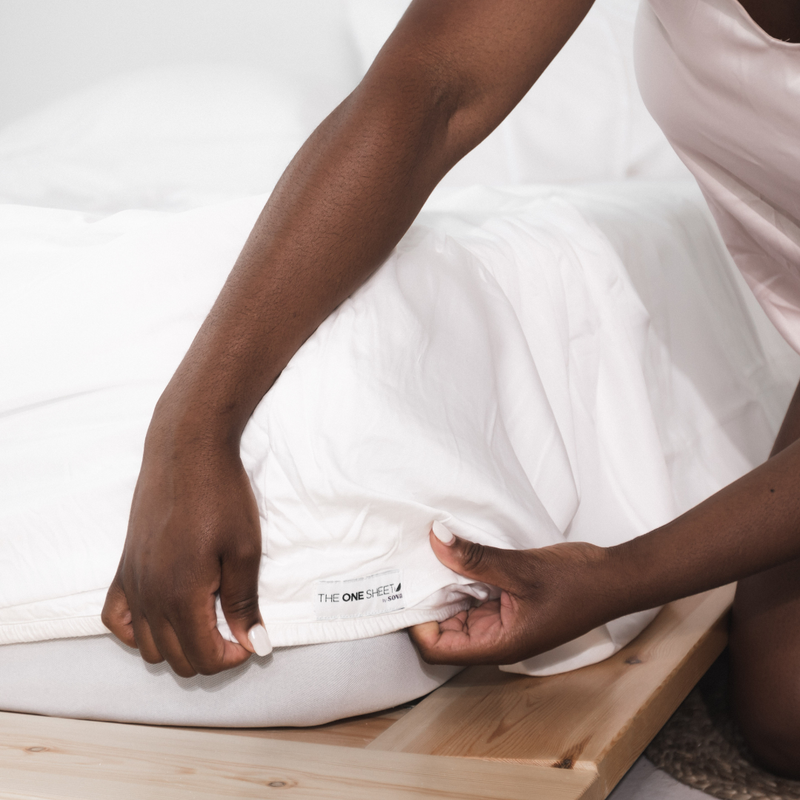
When a fitted sheet pops off in the night, the usual cause is not a bad sheet or tired elastic. It is seating technique. People take the fitted sheet's corner pocket and pull it straight down over the tip of the mattress corner. That tents the pocket into an upside-down U, so the elastic ends up gripping the point of the corner and nothing else. One roll over in the night and it walks off. The fix is to seat each corner flat: hook the pocket over the mattress corner, then pull it under the mattress so the deep pocket wraps the underside and the elastic grips the bottom face, not the tip.
Pocket depth is the second cause, and it only matters once the seating is right. A correctly seated corner still fails if the pocket is too shallow to reach under the mattress in the first place. A mattress of fifteen inches or more generally wants a pocket in the sixteen to twenty-two inch range, and adding a topper pushes that further.
Clips, suspenders, straps, and grippers all work, and they are worth using if you like them. Be clear-eyed about what they are, though. They are ongoing management of a symptom. You are adding hardware to hold a sheet in a place the sheet keeps trying to leave.
How Do You Store Folded Sheets So They Stay Folded?
A folded fitted sheet has a memory of about four days in a stack before someone digs past it and undoes your work. The fix that organizers keep returning to, and that Homes & Gardens describes as a no-cost bedding storage trick, is to store each sheet set inside one of its own pillowcases. Fold the fitted sheet, the top sheet, and one pillowcase, slide the stack into the second matching pillowcase, and fold the excess over.
It solves three problems at once. Nothing unfolds, because the parcel is contained. Nothing gets orphaned, because every piece of the set travels together. And the outside pillowcase acts as a label, so you can see the color and size without opening anything.
Why a Connected Sheet Set Changes the Folding Math
Worth saying plainly: The One Sheet does not make folding magically effortless. It is still fabric with elasticized corners, and you still nest the corners the same way described above.
What it does change is how many objects you are managing. The One Sheet is a connected system, with the top sheet permanently sewn to the fitted sheet at the foot of the bed, protected by two utility patents. That means one piece comes off the bed, one piece goes through the wash, one piece gets folded, and one piece goes back on. There is no second flat sheet to fold separately, no matching to do, and no orphaned top sheet at the bottom of the closet that belongs to a set you got rid of two years ago. The nesting fold works exactly as written: nest the four fitted corners, then fold the attached top sheet in with the rectangle.
It also changes the wash, which is where most sheet damage and most tangling actually happens. Every order ships with a free mesh wash bag, so the connected set goes through the machine as one piece in the bag rather than wrapping itself around everything else in the drum. Sheets that come out of the dryer untangled fold better, which is a small thing that adds up every week.
The sheets themselves are organic bamboo viscose, OEKO-TEX Standard 100 certified and made with FSC certified materials, with deep pockets sized for standard, thick, and adjustable mattresses. And because the top sheet cannot separate from the fitted, the shifting and bunching that sends people looking for clips in the first place is designed out rather than managed. There is a 100-night sleep trial if you want to test that on your own bed.
Key Takeaways
- A fitted sheet is hard to fold because its sewn corners and elastic hem make it a shallow box, not a rectangle, so it has no natural flat state.
- Nesting the four corners inside one another is not a trick, it is the step that collapses the sheet's three-dimensional structure into a foldable rectangle.
- Grab two corners from the same short end, never two diagonal corners, or the nest will not work.
- Fold in thirds rather than halves so the bulky corner stack ends up buried in the middle of the parcel.
- Fold a king or California king flat on the mattress instead of holding it in the air.
- The same corner you nest is the one to seat flat under the mattress, not tent straight down over the corner tip, when the sheet goes back on.
FAQ
How do you fold a fitted sheet step by step? Turn the sheet inside out, slide a hand into each of the two corners on one short end, and nest the right corner inside the left. Repeat with the other two corners, then nest both pairs into a single pocket. Lay the bundle flat with the elastic facing up, fold the curved elastic edges inward until the shape is a rectangle, and fold that rectangle in thirds twice.
How do you fold a fitted sheet by yourself? Folding a fitted sheet solo is easiest if you use a flat surface to carry the weight. Nest the two corners of one short end while the sheet lies on a bed or table, fold that end over, repeat at the other end, then square off the elastic edges and fold in thirds. Nothing about the method requires a second person.
How do you fold a king size fitted sheet? Fold a king size fitted sheet flat on the mattress rather than in mid-air. Lay it elastic side up, nest the two corners at one short end and fold that end in, repeat at the other end, bring all four nested corners together, then square the elastic edges and fold in thirds twice.
Which corners of a fitted sheet do you put together? Put together the two corners at the same short end of the fitted sheet, so the edge running between them is a short edge. Nesting diagonal corners is the most common reason the fold collapses.
How do you fold a fitted sheet with elastic all the way around? Fold it the same way, but take one extra step: after nesting the corners, run your fingers around the whole elastic hem so it lies in one clean line instead of twisting back on itself, then fold the curved edges further inward before folding in thirds. All-around elastic grips a deep mattress better than corner-only elastic, and that same tension is what makes it fold less willingly.
Does folding a fitted sheet damage the elastic? Folding a fitted sheet does not damage the elastic. Elastic in bedding degrades mainly from heat, so high dryer settings and hot washes do far more harm over time than any fold. Wash cool and dry low, and the fold is the least of the elastic's problems.
Is there a way to avoid folding a fitted sheet entirely? Yes, and plenty of people use it: strip the bed, wash the sheet, and put it straight back on. Nothing goes in the closet, so nothing needs folding. It only works if you own one set per bed, which is exactly why some households keep it that way on purpose.
If the reason your sheets keep ending up in a ball is that they never stay put in the first place, folding is the wrong problem to solve. The One Sheet connects the top sheet to the fitted at the foot so there is nothing to untuck, nothing to lose, and one piece to fold instead of two.