Quick answer: A mattress topper slides because foam and most mattress covers are smooth and low-friction, so the topper has nothing to grip. The reliable fix is a two-part one: add friction underneath the topper with a non-slip grip pad, then lock the whole stack down with a deep-pocket fitted sheet seated correctly over both the mattress and the topper. Straps, Velcro, and encasements help in stubborn cases, but friction plus a tight fitted sheet solves it for most people.
You made the bed, tucked everything in, and by morning the topper has crept a third of the way toward the footboard again. It is one of the most quietly maddening bedding problems, and it is almost never a sign that your topper is defective. A sliding topper is a physics problem, and once you understand the two forces at play, the fix gets simple and permanent.
This guide walks through why toppers slide, the fixes ranked from most to least effective, and the one anchor everyone recommends but almost nobody explains: the fitted sheet.
Why does a mattress topper slide in the first place?
A mattress topper slides for one core reason: there is almost no friction between the smooth bottom of the topper and the smooth cover of the mattress. Memory foam and most mattress covers are designed to feel sleek, and that sleekness leaves nothing for the topper to grip. Every time you roll over, your body weight shifts the low-friction layer a little further, and those small nightly nudges add up.
A few other factors make it worse:
Smooth mattress covers are the biggest culprit. As Sleep Foundation notes, many mattresses have a luxe, slick surface, and that lack of friction lets a topper slip toward the side or the foot of the bed whenever you change position. Latex toppers slide less than memory foam ones for the same reason: latex has a slightly textured, grippier surface, while memory foam is smooth and shifts more under weight.
Size mismatch matters too. A mattress topper that is larger than the mattress has extra fabric that bunches and travels, and a topper that is smaller leaves an uneven surface that slides into the gaps. The topper should match your mattress size exactly.
A missing headboard or footboard removes a natural barrier. Beds without either give the topper an open runway to migrate toward the edges. And plain old movement, tossing, turning, and getting in and out of bed, keeps nudging an unanchored topper out of place night after night.

How do you stop a mattress topper from sliding? Start with friction.
The single most repeated tip online is "use a tight fitted sheet," and it works, but it works best when you fix the friction problem first. Add grip underneath, then anchor on top. Here is the order that actually holds.
Add a non-slip grip pad (the best first move)
A thin non-slip pad placed between the mattress and the topper is the most effective single fix because it attacks the root cause. The textured rubber surface adds the friction the smooth mattress cover lacks, so the topper simply has something to hold onto. Dedicated mattress gripper pads (the open-weave rubber kind, similar to a rug pad) are breathable, washable, and trimmable to fit any mattress size. On a popular Reddit thread about sliding toppers, the top advice was blunt: "Add friction, not weight." A grip pad does exactly that.
DIY it with rubber shelf liner or a rug pad
If you would rather not buy a dedicated product, a roll of rubberized shelf liner or a spare non-slip rug pad does the same job for a few dollars. Lay it flat across the mattress, set the topper on top, and make the bed as usual. It is the same principle: a textured layer that replaces the missing friction.
The real anchor: a deep-pocket fitted sheet, seated correctly
Here is the part most articles skip. A fitted sheet is the fix everyone recommends because, stretched tight over both the mattress and the topper, its elastic acts like a clamp that holds the whole stack together. But a fitted sheet fails constantly, and when it does, people blame the sheet. The real problem is usually how the sheet is put on, and how deep its pockets are.
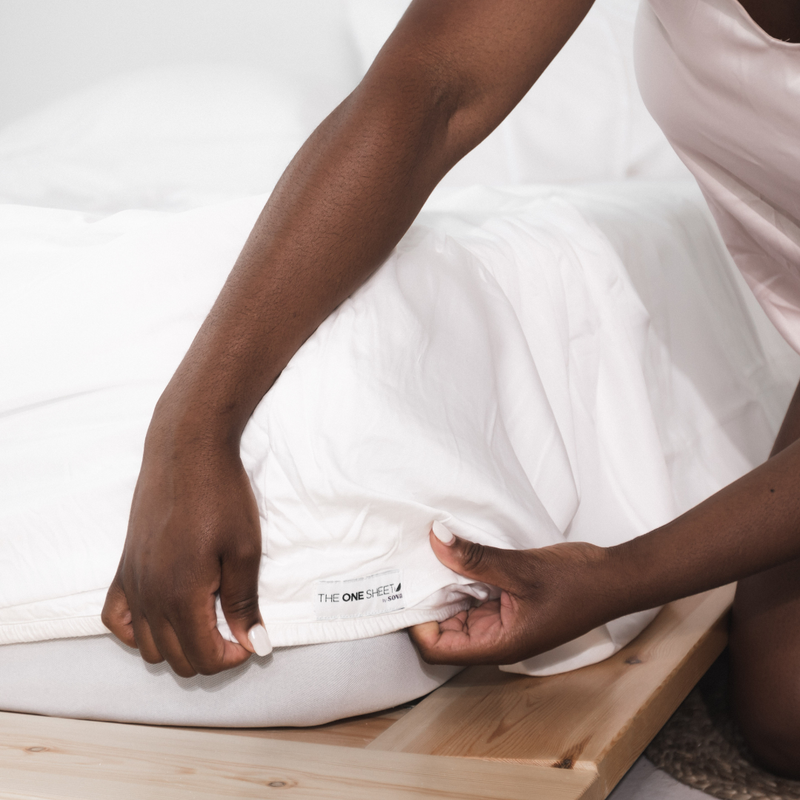
Seat each corner flat, not tented. The most common mistake is pulling the fitted-sheet pocket straight down over the tip of each corner, which tents the fabric into an upside-down U so the elastic only grips the point of the corner. That grip lets go the moment you move. The fix is to hook each pocket over the corner and pull it flat under the mattress, so the deep pocket wraps the underside of the mattress and grabs from below. A corner that is seated flat holds. A corner that is tented pops off, and takes your topper with it.
Then check pocket depth. Even a perfectly seated corner will fail if the pocket is too shallow to reach under the mattress plus the topper. A topper adds roughly two to four inches of height, so a standard 12-inch pocket that fit your bare mattress may no longer reach. A mattress and topper stack of 15 inches or more usually needs a fitted sheet with 16-to-22-inch pockets to clamp the layers together. If your sheet is straining at the corners, the pocket is the problem, not your technique.
Do those two things and a fitted sheet stops being a suggestion and starts being an anchor.
When friction and a fitted sheet aren't enough
For a heavy topper, an adjustable base, or a restless sleeper, you can add a mechanical backup. These treat the symptom rather than the cause, so use them on top of the friction-plus-sheet foundation, not instead of it.
Sheet straps and suspenders
Sheet straps (also called suspenders) clip to the corners or edges of the fitted sheet and run diagonally underneath the mattress, pulling the sheet, topper, and mattress tight together. They are cheap, adjustable, and reusable when you change the bedding. They are the most popular add-on for a reason: they turn a loose fitted sheet into a taut one without buying new sheets.
Velcro strips
Hook-and-loop (Velcro) strips can be attached to the top corners of the mattress and the matching bottom corners of the topper. Put the rough hook side on the topper and the soft loop side on the mattress, line them up, and press. It is a firm, semi-permanent hold that works well for toppers that slide the same way every night.
A zippered mattress encasement
Slipping both the mattress and the topper inside a single snug, zippered encasement wraps the two layers as one unit, so the topper cannot travel. This is a tidy option that also protects against dust and spills, though a very slick encasement can reintroduce a little slide, so pair it with a grip pad if needed.
Large safety pins are a last-resort DIY fix (five or more per side, needles pointing down, placed evenly), but with a grip pad and a properly seated deep-pocket sheet, you rarely need to put metal through your topper.
What kind of mattress topper is least likely to slide?
The toppers that stay put share a few traits: a textured or latex base rather than slick memory foam, an exact size match to the mattress, and, on some models, built-in anchor bands or elastic corner straps that hook around the mattress. If you are shopping for a new topper and sliding has been your main frustration, look for those features. But you do not need to replace a good topper to solve this. Friction plus a tight, deep-pocket fitted sheet keeps almost any topper in place.
Why the fitted sheet is the fix everyone underrates
Notice the through-line: nearly every reliable method still comes back to the fitted sheet doing the anchoring. Grip pads help it hold. Straps make it tighter. That is why the sheet you choose matters more than any accessory.
The frustrating catch is that even a great deep-pocket fitted sheet is only half the bed. The top sheet slides and bunches on its own, so you end up managing two moving pieces every morning: a topper that drifts and a top sheet that wads up at the foot. This is exactly the failure point The One Sheet by Sova is built to remove. The top sheet is permanently sewn to the fitted sheet at the foot of the bed, a patented connected design, so the made bed moves as one piece instead of three. The fitted layer clamps your mattress and topper, and the top sheet cannot migrate, twist, or get stolen across to the other side.
It is made from organic bamboo viscose, the deep pockets are built to fit standard, thick, and adjustable mattresses (including a mattress-and-topper stack), and it is backed by a 100-night sleep trial, so you can test whether "the whole bed stays put" holds true on your own topper. If a sliding topper and a wandering top sheet are both on your morning to-do list, a connected sheet that anchors the stack and keeps the top sheet in place is the tidiest fix there is.
Mattress topper anti-slide methods compared
| Method | How it works | Effort | How well it holds |
|---|---|---|---|
| Non-slip grip pad | Adds friction between mattress and topper | Low | Very good, fixes the root cause |
| Deep-pocket fitted sheet (seated flat) | Elastic clamps mattress and topper as one | Low | Very good, the core anchor |
| Sheet straps / suspenders | Pull the fitted sheet taut from underneath | Low | Good, best as a backup |
| Velcro strips | Grip corners of topper to mattress | Medium | Good, semi-permanent |
| Zippered encasement | Wraps both layers as one unit | Medium | Good, add grip if slick |
| Safety pins | Pin topper to mattress edge | Medium | Fair, last resort |
| Connected sheet system | Anchors the fitted and keeps the top sheet in place | Low | Best for a bed that stays made |
Key takeaways
- A mattress topper slides because memory foam and smooth mattress covers create almost no friction, not because the topper is faulty.
- The most effective single fix is a non-slip grip pad between the mattress and topper, because it adds the friction the surfaces lack.
- A deep-pocket fitted sheet is the main anchor, but only if each corner is seated flat under the mattress and the pocket is deep enough (often 16 to 22 inches) to clamp the mattress-plus-topper stack.
- Sheet straps, Velcro, and encasements are useful backups that treat the symptom; layer them on top of friction and a tight sheet.
- Latex or correctly sized toppers with anchor bands slide the least.
- The One Sheet by Sova removes the top-sheet half of the problem by sewing the top sheet to the fitted at the foot, so the whole made bed stays put.
Frequently asked questions
How do you get a mattress topper to stay in place?
To get a mattress topper to stay in place, add a non-slip grip pad between the mattress and the topper for friction, then stretch a deep-pocket fitted sheet tightly over both and seat each corner flat under the mattress. For extra hold, add sheet straps or Velcro at the corners.
What can hold a mattress topper in place?
A non-slip rubber grip pad, a tight deep-pocket fitted sheet, sheet straps or suspenders, Velcro strips, and a zippered mattress encasement can all hold a mattress topper in place. Friction underneath plus a snug fitted sheet on top is the most reliable combination.
How do you stop a mattress topper from sliding without buying anything?
Rubberized shelf liner or a spare non-slip rug pad placed under the topper adds friction for a few dollars, and re-seating your existing fitted sheet so every corner sits flat under the mattress often solves the slide on its own. Large safety pins are a no-cost last resort.
Do you need deep-pocket sheets for a mattress topper?
Often yes. A topper adds roughly two to four inches of height, so a standard 12-inch pocket may no longer reach under the mattress. A mattress-and-topper stack of 15 inches or more usually needs a fitted sheet with 16-to-22-inch pockets so the elastic can clamp both layers together.
What kind of mattress topper doesn't move?
Toppers with a textured or latex base, an exact size match to the mattress, or built-in anchor bands and elastic corner straps move the least. Memory foam on a smooth mattress cover slides the most because both surfaces are low-friction.
This article is for general informational purposes and is not medical advice.