Quick answer: Moisture-wicking sheets for night sweats are woven from fibers that move liquid sweat along the fiber surface and spread it across a wider area so it can evaporate, instead of soaking it up and holding it against your skin. Bamboo viscose, Tencel lyocell, linen, and engineered performance blends all do this well, while standard cotton and cheap microfiber tend to hold moisture and turn clammy. Fabric is only half the problem though: the other half is whether your bedding stays put when a sweat episode makes you thrash.
If you wake up at 3am with a damp patch under your shoulder blades and a top sheet wadded up somewhere near your knees, you have already figured out that this is not a "just buy nicer sheets" problem. You have probably also read a dozen articles that told you to buy moisture-wicking sheets and then stopped there.
That advice is correct as far as it goes. It just does not go far enough. Here is what moisture-wicking actually means at the fiber level, which fabrics genuinely do it, why 3am is the worst hour, and the part almost nobody covers: what happens to the geometry of your bed during a night sweat, and why that determines whether the fabric ever gets a chance to work.
What are moisture-wicking sheets, and how do they work?
Moisture-wicking sheets are sheets woven from fibers that transport liquid across the fabric rather than storing it inside the fiber. The mechanism is capillary action, the same physical effect that pulls water up a paper towel. Narrow channels between and along the fibers draw liquid outward, spreading a concentrated wet spot into a thin film across a much larger surface area.
That spreading is the whole trick. Evaporation happens at the surface, so a given amount of sweat spread thin across a wide area of fabric dries dramatically faster than the same sweat pooled in one dense patch. This is why the Good Housekeeping Institute frames the question in terms of how far and how fast moisture spreads, not simply how much a fabric can hold.
There is an important distinction hiding in that sentence. Absorbency and wicking are not the same property. An absorbent fabric takes water in and keeps it. A wicking fabric moves water along and lets it go. Cotton is genuinely absorbent, which is exactly why a cotton towel works and a cotton bedsheet does not: the towel is supposed to hold the water, and the sheet is supposed to get rid of it.
Why do night sweats wake you up at 3am?
Night sweats tend to peak in the small hours because your core body temperature is already at its lowest point then, and your body's thermostat is at its least responsive.
Your hypothalamus drives a circadian drop in core body temperature of roughly 1 to 2 degrees Fahrenheit across the night, reaching its minimum around 4am to 5am. Sweating is one of the tools it uses to get there. On top of that, during REM sleep, which clusters heavily in the back half of the night, normal thermoregulation is substantially suspended: you largely stop shivering and stop sweating in a controlled way, so your body temperature drifts toward the temperature of your immediate environment. Your immediate environment, at that hour, is a wad of damp fabric.
So the 3am wake-up is not random. It is the collision of the coldest point in your circadian cycle, the sleep stage where your temperature control is weakest, and several hours of accumulated moisture in your bedding.
Night sweats are also far more common than most people assume. In an Oklahoma Physicians Resource/Research Network study of 2,767 consecutive adult primary care patients, published in the Journal of the American Board of Family Medicine, 41 percent reported night sweats within the previous month, with peak prevalence between ages 41 and 55. Among women specifically, vasomotor symptoms tied to menopause, which include hot flashes and night sweats, affect roughly 60 percent of women aged 40 to 64 worldwide.
If you are dealing with this, you are not an outlier and you are not doing something wrong.
What type of sheets are best for night sweats?
The best sheets for night sweats are made from fibers that wick rather than absorb, in a weave loose enough to breathe. Here is how the common options actually behave when you sweat into them.
| Fabric | What it does with sweat | How it feels at 3am | Trade-off |
|---|---|---|---|
| Organic bamboo viscose | Wicks well and spreads moisture across a wide area to evaporate | Stays dry-feeling and cool to the touch | Needs gentle washing to keep the hand feel |
| Tencel lyocell | Strong wicking, moves moisture efficiently into the fiber structure and out | Dry and smooth, rarely clammy | Usually priced at the higher end |
| Linen | Very breathable, high airflow, dries quickly | Cool and dry, though texturally crisp | Wrinkles heavily, and the hand feel is not for everyone |
| Cotton percale | Breathes well thanks to the open plain weave | Cool at first, damp once saturated | Absorbs and holds sweat rather than releasing it |
| High-thread-count cotton sateen | Dense weave restricts airflow | Warm, then wet and heavy | Higher thread counts generally trap more heat |
| Cheap microfiber or polyester | Poor breathability, traps heat against the body | Hot and sticky | The most common regret purchase for sweaty sleepers |
| Engineered performance blends | Purpose-built to move moisture and speed evaporation | Dry, with a distinctly athletic hand feel | Feels more like activewear than bedding |
Two rules of thumb fall out of that table. First, favor regenerated cellulose fibers such as bamboo viscose and lyocell, or a genuinely open natural weave like linen or percale. Second, be skeptical of thread count. Past roughly 400, extra threads generally mean a denser weave, and a denser weave means less airflow. For night sweats, breathability beats the number on the package every time.
The International Hyperhidrosis Society gives essentially the same guidance from the clinical side: move to quick-drying bedding, avoid standard cotton, and use layers you can adjust during the night rather than one heavy cover.

Why does cotton feel wet when bamboo viscose feels dry?
Cotton feels wet during a night sweat because cotton fibers absorb moisture into their core and hold it there. The water has nowhere to go, so it sits in the fabric, in contact with your skin, cooling by conduction rather than evaporation. That is the clammy sensation: a saturated cotton sheet is essentially a cold compress you cannot get away from.
Bamboo viscose behaves differently. As a regenerated cellulose fiber, it draws moisture away from the skin surface and distributes it outward through the fabric, where the increased surface area lets it evaporate. The result is a sheet that is doing the same job your skin is trying to do, instead of working against it.
This is also why the same cotton sheets that feel perfect in October feel unbearable during a sweat episode. The fabric did not change. The amount of moisture you are asking it to handle did.
What most night-sweats advice misses: the sheet moves
Here is the part that every roundup skips.
A night sweat is not a still-life. It is a physical event. You get hot, you kick, you throw off the covers, you roll, you drag the top sheet with you, you pull it back an hour later. By 3am the top sheet is not a flat plane across the bed anymore. It is a rope of damp fabric bunched along one side, and the fitted sheet has popped off at least one corner.
That matters enormously, because wicking only works where the fabric is flat and exposed to air. Fabric that is balled up has almost no exposed surface area. A moisture-wicking sheet wadded into a knot beside your hip is, functionally, a wet towel. You paid for the fiber technology and then removed the conditions it needs to operate.
The fitted sheet failure has a specific and fixable cause, and it is usually technique rather than the sheet. Most people put a fitted sheet on by pulling the pocket straight down over the tip of the mattress corner, which tents the fabric into an upside-down U so the elastic is only gripping the point. Any lateral force, like a leg swinging across the bed at 3am, peels it right off. The fix is to seat each corner flat: hook the pocket over the corner and pull it under the mattress so the deep pocket grips the underside, not the tip.
Pocket depth is the second cause, not the first. A correctly seated corner still fails if the pocket is too shallow to reach under the mattress at all. Mattresses 15 inches and up generally want pockets in the 16 to 22 inch range, and a lot of that depth gets eaten by a topper.
Clips, suspenders, and all-around tighteners are honest symptom management. They work, in the sense that a splint works. They also add a step to every laundry day, and they do nothing at all for the top sheet, which is the layer actually touching you when you sweat.
How to set up a bed for night sweats
- Choose a wicking fiber. Organic bamboo viscose, Tencel lyocell, or linen. Skip high-thread-count sateen and cheap microfiber.
- Keep thread count moderate. Roughly 300 to 400 in a breathable weave beats 800 in a dense one for airflow.
- Seat the fitted corners flat. Hook each pocket over the corner and pull it under the mattress so the elastic grips the underside, not the corner tip.
- Check your pocket depth against your actual mattress, including any topper, before you buy.
- Layer instead of piling. Use a sheet plus a light quilt you can push away, rather than one heavy comforter you have to fully evict.
- Bring the room down. Most sleep guidance lands in the 60 to 67 degree Fahrenheit range, which supports the core temperature drop your body is already trying to make.
- Wash on a real schedule. Sweat residue and body oils build up in fibers and degrade how well they move moisture.
Where The One Sheet fits
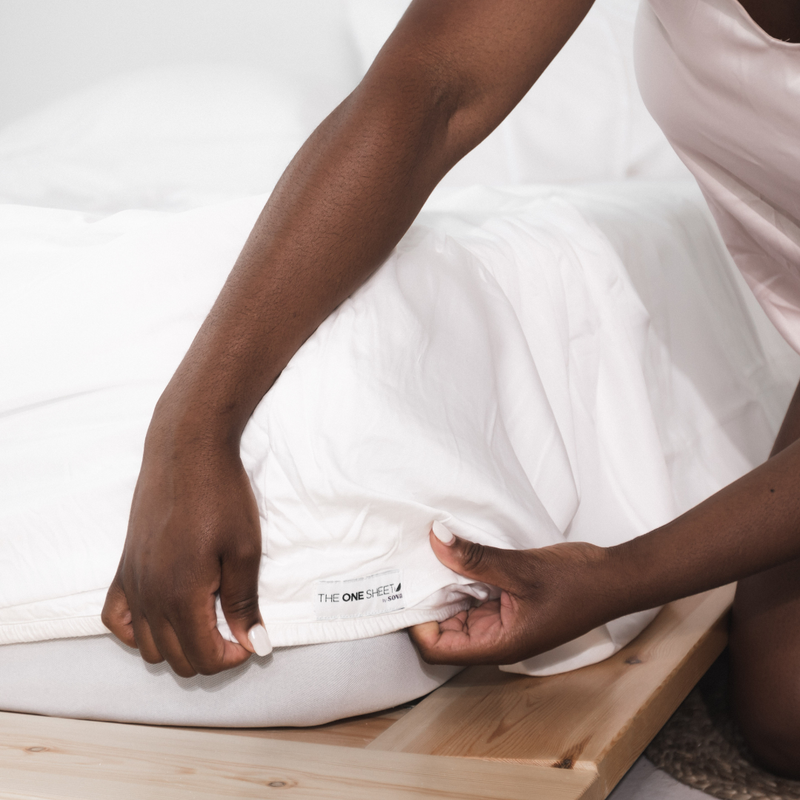
The One Sheet was built around exactly the failure described above. The top sheet is permanently sewn to the fitted sheet at the foot of the bed, which is a patented connected design. Because the two layers are one piece anchored at the foot, the top sheet cannot migrate to one side, cannot slide off the end, and cannot ball up into the damp rope that ruins the second half of the night. It stays spread flat across the bed, which is precisely the condition moisture-wicking fabric needs in order to do anything.
The fabric is organic bamboo viscose, chosen for the wicking behavior described earlier, and it is OEKO-TEX Standard 100 certified with FSC certified materials. The deep pockets are cut for thick and adjustable mattresses, so the corner seating actually holds once you seat it flat.
It is worth being straight about what this does and does not solve. The connected design is not a treatment for night sweats. It is a fix for the mechanical problem that makes night sweats worse than they need to be: bedding that abandons its position the moment you move. Customers report that the difference shows up most in the back half of the night, when a conventional set has usually come apart. The One Sheet comes with a 100-night sleep trial, which is roughly three months of real sweat episodes to judge it against.
How should you wash sheets if you sweat at night?
Wash more often than the standard advice, and wash gently.
Sweat leaves behind salts and body oils that coat the fibers and blunt their ability to move moisture. If you are sweating heavily most nights, a weekly wash is a reasonable floor, and twice weekly is not excessive. Use a mild detergent, skip fabric softener entirely, since softener deposits a coating that directly interferes with wicking, and dry on low or line dry.
One practical note specific to a connected set: The One Sheet ships with a free mesh wash bag with every order, and it earns its place here. Because the fitted and top sheets are a single connected piece, the whole set goes into the bag and washes as one unit, without wrapping itself around everything else in the drum. For anyone doing two loads of sheets a week because of night sweats, that is a meaningful reduction in friction.
What sheets can and cannot do
Sheets change what happens to your sweat. They do not change whether you sweat.
Night sweats can be driven by menopause, thyroid conditions, medications including some antidepressants, infections, sleep apnea, anxiety, alcohol, and a long list of other causes. Bedding is comfort management, not diagnosis. If your night sweats are new, drenching, or come alongside unexplained weight loss, fever, or persistent fatigue, that is a conversation for a clinician, not a shopping decision.
What the right sheets genuinely do is shorten the miserable part. Sweat that spreads and evaporates leaves you damp for minutes instead of hours, and a bed that has not come apart is one you can fall back asleep in.
Key takeaways
- Moisture-wicking sheets move sweat along the fibers and spread it out to evaporate, while absorbent fabrics like cotton take it in and hold it against your skin.
- Organic bamboo viscose, Tencel lyocell, linen, and engineered performance blends wick well; high-thread-count cotton sateen and cheap microfiber are the fabrics most likely to leave you clammy.
- Night sweats peak in the small hours because core body temperature bottoms out around 4am to 5am and thermoregulation is largely suspended during REM sleep.
- Wicking only works where fabric lies flat with air moving over it, so a top sheet that bunches into a damp rope cancels out the fiber you paid for.
- Fitted-sheet corners pop mostly because the pocket is tented over the corner tip instead of seated flat under the mattress; pocket depth is the second cause, not the first.
- Wash sweaty sheets weekly with a mild detergent and no fabric softener, since softener coats the fibers and blocks wicking.
Frequently asked questions
What type of sheets are best for night sweats?
The best sheets for night sweats are made from wicking fibers in a breathable weave: organic bamboo viscose, Tencel lyocell, or linen. These fibers move sweat away from the skin and spread it to evaporate. Avoid high-thread-count cotton sateen and inexpensive microfiber, which trap heat and hold moisture against you.
How do I stop sweating through my sheets at night?
You cannot stop the sweating through bedding alone, but you can stop it from soaking in. Switch to quick-drying, moisture-wicking sheets, drop the bedroom temperature into the 60 to 67 degree Fahrenheit range, use adjustable layers rather than one heavy comforter, and skip fabric softener so the fibers keep wicking. The International Hyperhidrosis Society recommends quick-drying bedding and adjustable layers for exactly this reason. If the sweating itself is new or severe, see a clinician.
Why do I keep waking up at 3am drenched in sweat?
You wake at 3am drenched because your core body temperature is heading toward its nightly minimum around 4am to 5am, and because REM sleep, which is concentrated in the second half of the night, largely suspends your body's normal temperature regulation. Add several hours of moisture already sitting in your bedding and that hour becomes the worst of the night.
What hormone is lacking with night sweats?
In women, night sweats are most commonly linked to declining estrogen during perimenopause and menopause, which disrupts how the hypothalamus regulates temperature. Low testosterone in men and thyroid hormone imbalances can produce night sweats as well. Hormones are only one category of cause among many, so persistent night sweats should be evaluated by a clinician rather than self-diagnosed.
What naturally stops night sweats?
No bedding change stops night sweats at the source, because the cause is physiological rather than environmental. What helps in practice is lowering the bedroom temperature, wearing loose moisture-wicking sleepwear, avoiding alcohol and spicy food close to bedtime, keeping a consistent sleep schedule, and sleeping on sheets that move moisture instead of holding it. Persistent night sweats warrant a medical evaluation.
Do moisture-wicking sheets work in winter?
Yes. Moisture-wicking sheets regulate moisture rather than actively cooling, so they keep you dry in winter without making you cold. Because damp fabric pulls heat away from the body, a sheet that stays dry often feels warmer in cold weather than an absorbent one.
Does thread count matter for night sweats?
Thread count matters, but not in the direction most packaging implies. Above roughly 400, higher thread counts usually mean a denser weave with less airflow, which traps heat. For night sweats, choose a breathable weave and a wicking fiber over a high number.
If your current sheets are handling the sweat but coming apart by 3am, the fabric is not the thing to replace. The One Sheet is organic bamboo viscose with the top sheet sewn to the fitted at the foot, so it stays flat and stays put through the part of the night when it matters most. It comes with a 100-night sleep trial.