Quick answer: The best sheets for hot sleepers are made from breathable, moisture-wicking fibers in an airy weave: crisp cotton percale, linen, organic bamboo viscose, or eucalyptus (Tencel/lyocell). For most people the fiber and weave matter far more than any "cooling technology" label, and a moderate thread count of roughly 200 to 400 sleeps cooler than a dense 600-plus weave. Skip sateen, microfiber, and flannel, which are built to trap heat.
If you sleep hot, you already know the cycle: you fall asleep fine, then wake at 3 a.m. damp, kicking the covers off and flipping to the cool side of the pillow. You are not imagining it, and you are far from alone. In an Amerisleep survey of 1,008 U.S. adults, 52% identified as hot sleepers, and 94% of those said heat wakes them at least once a night. A Gallup poll found that 57% of U.S. adults are at least occasionally too hot while trying to sleep.
The frustrating part is that "cooling sheets" are now a marketing category of their own, full of proprietary fabric names and bold promises. Most of those promises come down to a few unglamorous fundamentals. This guide walks through what actually keeps sheets cool, which materials are worth your money, and one factor that almost every hot-sleeper roundup leaves out.
Why your sheets matter when you sleep hot
Your body is supposed to cool down at night. Core body temperature drops by roughly 1 to 2°F (about 0.5 to 1°C) as you fall asleep and reaches its lowest point around 4 to 5 a.m., a shift that helps trigger and protect deep sleep. Sheets that trap heat and hold moisture work directly against that drop, so instead of cooling off, you stay warm and clammy and surface out of deep sleep.
Good sheets for hot sleepers do two jobs at once. They let air move so heat can escape, and they pull moisture off your skin so sweat evaporates instead of pooling. Everything below is really about those two jobs: breathability and moisture management.

What actually makes a sheet cool?
Two things decide how cool a sheet sleeps, and neither one is a brand name. The first is the fiber, which is what the thread is made of. The second is the weave, which is how those threads are interlaced. A breathable fiber in an open weave will outperform a "cooling" sheet built from a dense, heat-trapping construction, almost every time.
Marketing labels like "cool-to-the-touch" or "temperature regulating" describe an effect, not a method. When you shop, look past the label and check the fiber and the weave. If a product page will not tell you plainly what the sheet is made from and how it is woven, treat that as a warning sign.
The best materials for hot sleepers, compared
Here is how the most common sheet materials handle heat, what they feel like, and the tradeoff to know before you buy.
| Material | How it handles heat | Feel | Tradeoff to know |
|---|---|---|---|
| Cotton percale | Excellent airflow from a loose, breathable weave | Crisp, cool, hotel-like | Wrinkles easily; softens over time |
| Linen | Most breathable natural fiber; great in humidity | Textured, relaxed, lived-in | Stiff at first; higher price |
| Organic bamboo viscose | Smooth fiber that wicks moisture and breathes well | Silky, soft, drapey | Quality varies a lot by maker |
| Eucalyptus (Tencel/lyocell) | Strong moisture-wicking; lightweight and airy | Slippery-smooth, very light | Can feel too slick for some |
| Cotton sateen | Denser weave traps more heat | Buttery, lustrous, warm | Sleeps warmer; better for cold sleepers |
| Microfiber / polyester | Synthetic; holds heat and moisture | Cheap, soft, slick | Poor breathability; not ideal when you sweat |
| Flannel | Brushed to insulate and hold body heat | Fuzzy, cozy, warm | Built for winter, not hot sleepers |
After months of testing, the reviewers at The New York Times' Wirecutter concluded that the most reliably cool, durable, and comfortable sheets are still cotton percale and linen. Bamboo viscose and eucalyptus earn their reputation for hot sleepers because the fibers wick moisture well and feel light against the skin. The materials to avoid are the ones engineered to hold warmth: sateen, microfiber, and flannel.
Weave matters more than thread count
Thread count is the most over-marketed number in bedding. A higher number is not cooler, and it is often warmer. Past a point, packing in more threads creates a denser fabric that traps body heat instead of releasing it. For sheets that sleep cool, a moderate thread count in the range of roughly 200 to 400 generally beats a dense 600-plus sheet, according to bedding testers at Mattress Nerd.
Weave is the part worth understanding. Percale uses a simple one-over-one-under weave that leaves tiny gaps for air to pass through, which is exactly why it feels crisp and cool. Sateen uses a weave with more threads floating on the surface, which gives it that silky sheen and also makes it warmer. If you sleep hot, choose the weave first and treat thread count as a minor detail.
Why "cooling technology" sheets often disappoint
A lot of cooling sheets feel genuinely cold the moment you climb in. That first touch comes from how quickly the fabric pulls heat off your skin, sometimes measured as a Q-Max rating. The problem is that the cool-to-the-touch sensation can fade within minutes once the fabric warms to your body temperature. If the underlying fiber and weave are not breathable, the sheet then behaves like any other heat-trapping fabric for the rest of the night.
This is why so many hot sleepers feel let down by sheets that demoed beautifully in the store or in a 20-second video. A quick cooling hit is not the same as all-night breathability. Treat dramatic "instant cooling" claims as a nice bonus on top of a breathable natural fiber, never as a substitute for one.
The factor most hot-sleeper guides skip: sheets that move
Here is the variable almost no cooling-sheet roundup mentions. Hot sleepers move. When you overheat, you toss, turn, and flip the covers, and all of that motion is exactly what drags a fitted sheet loose and bunches a flat sheet into a sweaty rope by morning. A breathable sheet that has crept off the corner and twisted into a wad is not cooling anyone.
Most of the time, a fitted sheet that pops off is a fit-and-technique problem, not a fabric problem. Corners usually let go because the pocket gets pulled straight down over the tip of the mattress, tenting the elastic into an upside-down U so it only grips the very corner. The fix is to seat each corner flat: hook the pocket over the corner and pull it well under the mattress so the deep pocket wraps the underside and grips from below. The second cause is pocket depth. A correctly seated corner still fails if the pocket is too shallow for the mattress, so a thick mattress of 15 inches or more usually needs a 16 to 22 inch pocket.
Clips, straps, suspenders, and grippers can help, but they treat the symptom. They are ongoing management for a sheet that was never built to stay put, and they tend to loosen exactly when you are moving most. The only way to remove the failure point entirely is a sheet whose top layer cannot shift in the first place.
Where The One Sheet fits for hot sleepers
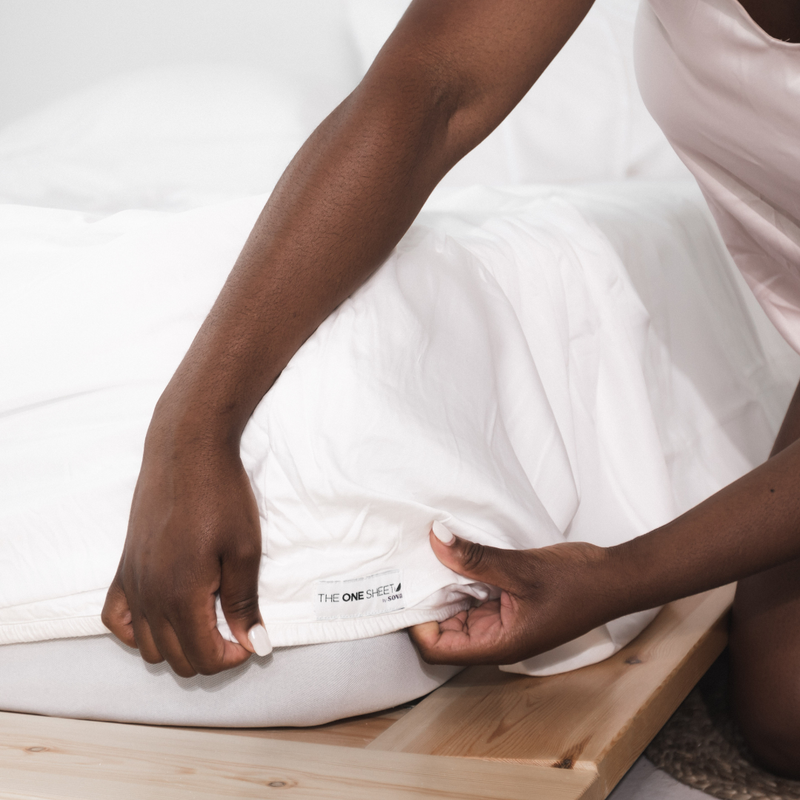
The One Sheet was built around that exact failure point. The top sheet is permanently sewn to the fitted sheet at the foot of the bed, so the top layer cannot slide off, bunch, or get kicked into a ball no matter how much you move. For someone who runs hot and tosses all night, that means the breathable layer you chose actually stays where it belongs.
It is also made from organic bamboo viscose, the smooth, moisture-wicking fiber that earns bamboo its place on every hot-sleeper list. The fabric is OEKO-TEX Standard 100 certified and uses FSC certified materials, and the deep pockets are designed to fit standard, thick, and adjustable mattresses without straining off the corners. If you are not sure it is right for you, every order comes with a 100-night sleep trial, which is plenty of warm nights to find out.
How to choose sheets for hot sleepers
You can shortcut almost every "best cooling sheets" list with five steps.
- Start with the fiber. Choose a breathable, moisture-wicking material: cotton percale, linen, organic bamboo viscose, or eucalyptus (Tencel/lyocell).
- Check the weave. Favor percale or a plainly described breathable weave over sateen. The weave affects temperature more than the brand does.
- Ignore high thread counts. Aim for roughly 200 to 400 and skip the 600-plus marketing. Denser is usually warmer.
- Rule out heat-trappers. Pass on microfiber, polyester, sateen, and flannel if you sweat at night.
- Make sure they stay put. Confirm the pocket depth fits your mattress, and prefer a design that does not let the top layer shift, so you are not remaking a twisted bed at 3 a.m.
How to keep cooling sheets cool
Breathability is partly a maintenance job. Body oils, lotions, and detergent buildup clog the spaces between fibers that let a sheet breathe, so a sheet that wicked well when new can feel stuffy after a season of heavy washing. Wash on a gentle cycle in cool or warm water, skip fabric softener and dryer sheets (they leave a coating that blocks airflow), and dry on low.
If you choose a connected set like The One Sheet, washing is simpler than it sounds, because the whole thing goes in as one piece. Every order ships with a free mesh wash bag, so the connected sheet washes together without tangling around other laundry, and that keeps the bamboo viscose breathing trip after trip.
Key takeaways
- More than half of adults sleep hot. In an Amerisleep survey, 52% identified as hot sleepers and 94% of those wake at least once a night from heat.
- Fiber and weave decide how cool a sheet sleeps, not the brand name or a "cooling" label.
- The best materials for hot sleepers are cotton percale, linen, organic bamboo viscose, and eucalyptus (Tencel/lyocell).
- A moderate thread count of roughly 200 to 400 sleeps cooler than a dense 600-plus weave.
- Avoid sateen, microfiber, and flannel, which are designed to hold heat.
- A breathable sheet only helps if it stays put. Hot sleepers move a lot, and movement is what untucks and bunches ordinary sheets.
Frequently asked questions
What material sheets are best for hot sleepers?
The best sheet materials for hot sleepers are cotton percale, linen, organic bamboo viscose, and eucalyptus (Tencel/lyocell). These fibers breathe well and wick moisture, which helps your body shed heat instead of trapping it.
Are bamboo sheets good for hot sleepers?
Yes, bamboo viscose sheets are a strong choice for hot sleepers because the fiber is smooth, lightweight, and moisture-wicking. Quality varies by maker, so look for organic bamboo viscose and verifiable certifications like OEKO-TEX Standard 100.
Is a higher thread count cooler?
No, a higher thread count is usually warmer, not cooler. Past roughly 400, the denser weave traps body heat, so most testers recommend a thread count of about 200 to 400 for hot sleepers.
Why do "cooling" sheets stop feeling cool during the night?
Many cooling sheets feel cold on first touch because they pull heat off your skin quickly, but that sensation fades once the fabric warms to your body temperature. If the fiber and weave are not breathable, the sheet then holds heat for the rest of the night.
Do cooling sheets help with night sweats?
Breathable, moisture-wicking sheets can help with night sweats by letting sweat evaporate instead of pooling against your skin. They manage moisture and heat, but they do not treat the medical causes of night sweats, so see a doctor if night sweats are sudden or severe.
A note on night sweats: if you experience sudden, frequent, or drenching night sweats, that can be a sign of an underlying health issue. Cooling sheets can make you more comfortable, but they are not a substitute for medical advice.