Quick answer: Wash bamboo viscose sheets in cold water below 86°F (30°C) on a gentle cycle with a mild liquid detergent, always on their own and never with bleach or fabric softener. Then line dry them out of direct sunlight or tumble dry on the lowest heat, removing them while still slightly damp. Every one of these rules exists because bamboo viscose is regenerated cellulose, which loses 30 to 50 percent of its strength while wet.
Most care guides for bamboo viscose sheets hand you the same list of rules. Cold water. Gentle cycle. No fabric softener. No bleach. All correct, and all presented as if they came down from a mountain.
Here is the part almost nobody explains: every one of those rules traces back to a single property of the fiber. Bamboo viscose is regenerated cellulose, and regenerated cellulose loses somewhere between 30 and 50 percent of its strength the moment it gets wet. That is not a flaw in your sheets. It is simply how the fiber behaves in water, and once you know it, the entire care routine stops being a list to memorize and starts being obvious.
This guide gives you the mechanism first, then the routine that follows from it.
How Do You Wash Bamboo Viscose Sheets?
Wash bamboo viscose sheets in cold water, below 86°F (30°C), on a gentle or delicate cycle, using a mild liquid detergent. Wash them on their own, away from towels, denim, and anything with zippers or hooks. Skip bleach and fabric softener entirely. Then either line dry them out of direct sunlight or tumble dry on the lowest heat setting, pulling them out while still slightly damp.
That is the whole routine. The rest of this article is why each piece of it matters, which is what tells you when you can bend a rule and when you really cannot.
Why Bamboo Viscose Needs Different Care Than Cotton
Cotton is a natural fiber that arrives more or less as the plant grew it. Bamboo viscose is different. The bamboo plant is broken down into pulp, dissolved, and then spun back out into fiber. That is what "regenerated cellulose" means, and it is why bamboo viscose feels the way it does: smooth, fluid, cool against skin, with a drape cotton cannot quite manage.
The tradeoff shows up in the wash. Water penetrates the amorphous regions of regenerated cellulose and loosens the bonds between cellulose molecules. Textile references consistently put the resulting strength loss at 30 to 50 percent when the fiber is wet. Cotton, for comparison, actually gets slightly stronger wet.
So a wet bamboo viscose sheet is, briefly, a delicate object. Everything that damages bamboo viscose sheets (pilling, tearing at the seams, permanent shrinkage) happens during the window when the fabric is saturated and something is applying force or heat to it. Hot water, a high-speed spin, an overloaded drum, a metal zipper on a hoodie, a hot dryer. Those are not separate hazards. They are the same hazard hitting a fiber at its weakest moment.
Every rule below is just a way of protecting that window.

What Temperature Should You Wash Bamboo Viscose Sheets?
Wash bamboo viscose sheets in cold water, below 86°F (30°C). Heat is the single biggest cause of shrinkage and fiber breakdown in bamboo viscose, and it does more damage than any other variable in your laundry room.
Worth being precise here, because a lot of care guides blur it: bamboo viscose sheets do not really shrink because of the fabric. They shrink because of heat. Manufacturers typically build in around 4 percent extra fabric to allow for the small amount of shrinkage that happens in the first wash. Stay cold and dry low, and you stay inside that allowance. Run a hot wash and a hot dryer, and you blow straight past it, permanently.
Cold water also handles the actual job fine. Modern detergents are formulated to lift body oil and sweat at cold temperatures, and cold water is easier on the fiber and cheaper to run.
| Setting | Do this | Why |
|---|---|---|
| Water temperature | Cold, below 86°F (30°C) | Heat causes shrinkage and fiber breakdown |
| Cycle | Gentle or delicate, low spin | Reduces friction and mechanical stress while wet |
| Detergent | Mild liquid, small amount | Powders can be abrasive; enzymes attack cellulose |
| Load | Sheets alone, drum no more than 3/4 full | Fabric needs room; zippers and towels cause pilling |
| Bleach | Never | Degrades the fiber and yellows it over time |
| Fabric softener | Never | Leaves a film that blocks breathability |
| Drying | Line dry, or tumble on lowest heat | Same reason as cold water: heat is the enemy |
Which Detergent Is Right for Bamboo Viscose Sheets?
Use a mild liquid detergent, and use less than you think. Two things matter more than the brand on the bottle.
First, avoid heavy enzyme formulas. Enzymes in laundry detergent are there to break down proteins and starches, but cellulase enzymes specifically target cellulose. Bamboo viscose is cellulose. Over many washes, an enzyme-heavy detergent quietly works against the fiber itself.
Second, skip powdered detergent. Powder that does not fully dissolve in cold water stays abrasive against the fabric through the whole cycle, which is exactly the friction you are trying to avoid.
Can you use Tide on bamboo viscose sheets? A conventional heavy-duty detergent like Tide, Cheer, or All will clean bamboo viscose sheets, but these are formulated aggressively for durable fabrics like cotton and synthetics, and bedding retailers such as BedVoyage specifically recommend gentler plant-based detergents for bamboo viscose linens instead. If a standard detergent is what you have, use roughly half the recommended dose and make sure it dissolves. A free-and-clear or delicate-specific liquid is the better long-term choice.
More detergent is not better, either. Excess detergent that does not rinse out leaves residue in the fibers, and residue is what makes sheets feel stiff and slightly gray after a year.
Why You Should Skip Fabric Softener and Dryer Sheets
This is the rule people break most, usually with good intentions, and it is the one that does the most avoidable damage.
Fabric softeners and dryer sheets work by depositing a thin lubricating film (typically silicone-based or cationic surfactants) onto the fibers. That film reduces friction between fibers, which is what registers as "soft." The problem is that a conventional softener film is hydrophobic. It repels water.
The trait you paid for in bamboo viscose is that it moves moisture away from your skin. A softener film sits on top of the fiber and blocks precisely that. It is well documented that fabric softener reduces absorbency in textiles, which is why the same advice applies to towels and technical fabrics. You are coating a moisture-managing fabric in something engineered to repel moisture.
The irony is that you do not need it. Bamboo viscose gets softer on its own with washing, as long as you keep residue off it. If your sheets have gone stiff, that is usually detergent or softener buildup, not the fabric giving up. Half a cup of white vinegar in the rinse (no detergent, no bleach in the same load) strips the residue and brings the hand back.
And if you want shorter dryer times without dryer sheets, a few undyed wool dryer balls do the job.
Can You Put Bamboo Viscose Sheets in the Dryer?
Yes, you can put bamboo viscose sheets in the dryer, but only on the lowest heat or air-fluff setting, and you should take them out while they are still slightly damp. Line drying out of direct sunlight is gentler still and will meaningfully extend the life of the sheets.
Two details that catch people out:
Bamboo viscose feels strange when wet. Stiff, almost like canvas. This alarms first-time owners who assume they have ruined something. They have not. The fabric returns to its normal softness once it is fully dry.
And because the fiber is weakest wet, do not haul a heavy saturated sheet out of the drum by one corner. That is how seams tear. Support the weight of the whole thing, ideally with a basket.
Pulling sheets out slightly damp and letting them finish on the bed or a rack also handles wrinkles without an iron. If you must iron, use the lowest setting on the reverse side.
How to Wash Bamboo Viscose Sheets, Step by Step
- Pre-treat any stains with a small drop of mild liquid detergent or a gentle stain remover worked in with your fingers. Do not use a chlorine-based spot treatment.
- Load the sheets on their own, with the drum no more than three-quarters full. No towels, no denim, nothing with zippers, hooks, or velcro.
- Set cold water, below 86°F (30°C), on gentle or delicate with the lowest available spin speed.
- Add a small amount of mild liquid detergent. No bleach. No fabric softener. Roughly half of what the bottle suggests.
- Remove the sheets promptly, supporting the full weight of the wet fabric rather than pulling from one corner.
- Line dry out of direct sunlight, or tumble dry on the lowest heat, removing them while still slightly damp.
How Often Should You Wash Bamboo Viscose Sheets?
Wash bamboo viscose sheets about once a week, and every three to four days if you sweat heavily, sleep with pets, or have been ill. The Cleveland Clinic and most medical guidance land on weekly, while the American Cleaning Institute allows every two weeks for lighter use.
The reasoning is not squeamishness. You shed hundreds of thousands of skin cells a night and can perspire meaningfully into the sheets while you sleep. Skin cells and body oil are food for dust mites, which thrive in warm humid bedding and produce waste that triggers allergy and asthma symptoms in sensitive people.
Bamboo viscose is breathable enough that sheets often feel fresh longer than cotton does. Feeling fresh and being clean are not the same thing. Stay on the weekly rhythm.
Why a Connected Sheet Set Changes the Laundry Routine
Here is a wash-day problem specific to bedding that no detergent solves: a normal sheet set goes into the machine as two separate pieces, and separate pieces tangle. The flat sheet wraps itself around the fitted sheet, the fitted sheet balls up into a wad, and the middle of that wad never really gets washed or dried. Then you wrestle the whole knot apart on the other end.
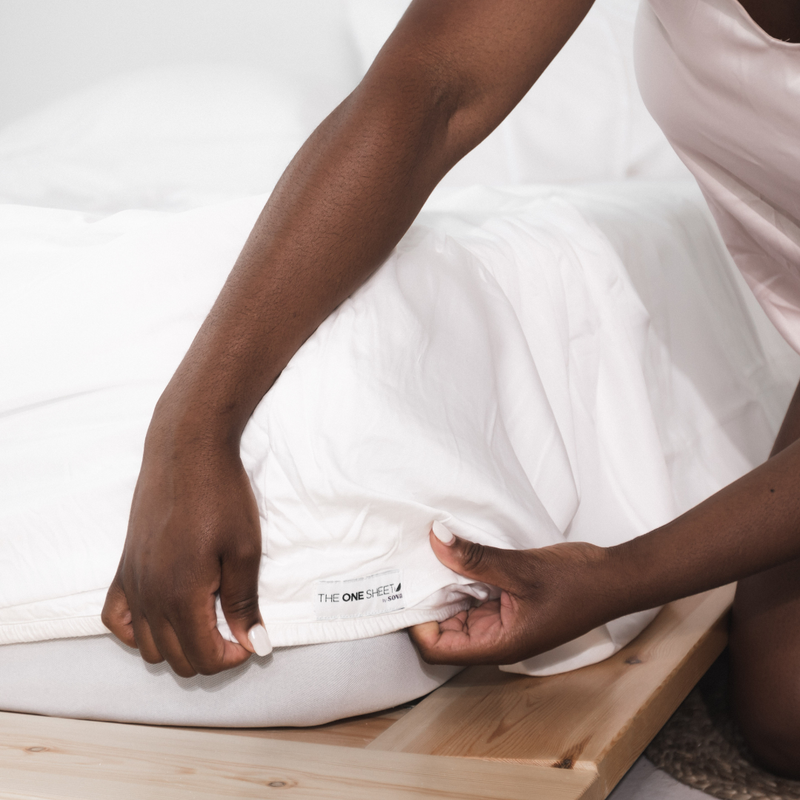
The One Sheet is built as a connected set. The top sheet is permanently sewn to the fitted sheet at the foot of the bed, which is a design meant to stop the top sheet from shifting and bunching while you sleep. It has a second effect people notice on laundry day: the set goes through the wash as one piece, so there is nothing to tangle with, and nothing to sort and re-pair coming out.
Every One Sheet ships with a free mesh wash bag for exactly this reason. The set goes in the bag, the bag goes in the machine, and the fabric is protected from snagging on the drum or on anything else in the load. It is a small thing that matters more than it sounds, because snagging is the main cause of pilling in bamboo viscose.
The One Sheet is made from organic bamboo viscose and is OEKO-TEX Standard 100 certified, made with FSC certified materials. Same care rules as any bamboo viscose sheet apply: cold, gentle, mild detergent, low heat.
What Is the Downside to Bamboo Viscose Sheets?
Worth being straight about this, since it is one of the most common questions people ask.
Bamboo viscose is more care-sensitive than cotton. It wants cold water and low heat, and it does not forgive a hot wash the way a cotton percale will. It is more prone to pilling if you wash it with abrasive fabrics. It wrinkles more readily than a heavier cotton. And it is weaker wet, so it needs to be handled rather than yanked.
In exchange you get a fabric that is noticeably cooler and smoother against skin, with a drape cotton does not have. That is the trade. For most people the care routine is a five-second decision at the machine (cold, gentle) and then never thinking about it again.
Key Takeaways
- Bamboo viscose is regenerated cellulose and loses 30 to 50 percent of its strength when wet, which is the reason behind every care rule below.
- Wash bamboo viscose sheets in cold water below 86°F (30°C) on a gentle cycle with a mild liquid detergent, always on their own.
- Heat, not the fabric, causes shrinkage. Manufacturers build in roughly 4 percent for the first wash, and staying cold keeps you inside that allowance.
- Skip fabric softener and dryer sheets permanently. They leave a water-repelling film that blocks the exact breathability you bought bamboo viscose for.
- Line dry out of direct sunlight, or tumble on the lowest heat and remove the sheets while still slightly damp.
- Wash weekly, or every three to four days if you sweat heavily or sleep with pets.
Frequently Asked Questions
Can you machine wash bamboo viscose sheets?
Yes, bamboo viscose sheets are machine washable. Use cold water below 86°F (30°C) on a gentle or delicate cycle with a low spin speed and a mild liquid detergent, and wash them separately from towels, denim, and anything with zippers or hooks.
Can you put bamboo viscose sheets in the dryer?
Yes, but only on the lowest heat or air-fluff setting, and remove them while still slightly damp to prevent wrinkles and heat damage. Line drying out of direct sunlight is gentler and will extend the life of the sheets.
What is the downside to bamboo viscose sheets?
The main downside to bamboo viscose sheets is that they are more care-sensitive than cotton. They require cold water and low heat, they can pill if washed with abrasive fabrics, they wrinkle more easily than heavy cotton, and the fiber is weaker when wet so it needs to be handled gently.
Can I use Tide on bamboo viscose sheets?
Conventional heavy-duty detergents like Tide, Cheer, and All will clean bamboo viscose sheets but are formulated aggressively for durable fabrics, and bedding specialists including BedVoyage recommend gentler plant-based liquid detergents for bamboo viscose linens instead. If you use a standard detergent, use about half the recommended amount.
Why do my bamboo viscose sheets feel stiff after washing?
Bamboo viscose sheets usually feel stiff because of detergent or fabric softener residue built up in the fibers, not because the fabric has worn out. Run them through a wash with half a cup of white vinegar in the rinse and no detergent to strip the residue. Note that bamboo viscose also feels temporarily stiff while wet and softens again once fully dry.
Do you need to wash bamboo viscose sheets before first use?
Not always. Many bamboo viscose sheets are pre-washed and pre-shrunk before they ship, so check the care tag. A first wash in cold water on gentle will not hurt them either way, and it is where the small amount of built-in shrinkage allowance (roughly 4 percent) gets used up.
Sheets that shift and bunch every night are a design problem, not a laundry problem. If you are tired of wrestling a top sheet back into place (and then wrestling it out of a knot in the washer), The One Sheet sews the top sheet to the fitted sheet so neither can happen, and it comes with a 100-night sleep trial and a free mesh wash bag.