Quick answer: RV bunk bed sheets are sized for the small, non-standard mattresses built into camper bunks, so a regular twin set almost never fits right. The three most common RV bunk mattress sizes are 28 by 75 inches, 30 by 75 inches, and 34 by 75 inches, and most bunk mattresses are only about 4 to 5 inches thick. Measure your actual bunk platform first, then match the sheet to that size and a shallow pocket depth so it does not fold up or slide off.
If you have ever wrestled a "twin" sheet onto an RV bunk and watched it ball up under your kid at 11 p.m., you already know the frustration. The good news is that the problem is almost always the fit, not you. Once you understand the sizing, the thin-mattress issue, and the one reason top sheets never stay put in a bunk, buying the right set gets simple.
What size sheets fit RV bunk beds?
RV bunk sheets fit best when they match the bunk's exact mattress dimensions, which are smaller and narrower than a home twin. Across the most common campers and travel trailers, RV bunk mattresses run roughly 28 to 34 inches wide and 72 to 75 inches long, with a few stretching to 80 inches. The single most common sizes are 28 by 75, 30 by 75, and 34 by 75 inches.
A standard home twin, by comparison, is 38 by 75 inches, which is why a twin fitted sheet on a 30-inch bunk has 8 extra inches of fabric to bunch up. The fix is not a bigger or smaller "close enough" sheet. It is measuring your bunk platform (width, length, and mattress thickness) and buying to those numbers.
| RV bunk size (W x L) | Where you see it | Home-twin comparison |
|---|---|---|
| 28 x 75 in | Narrow single bunks | Narrower than a twin |
| 30 x 75 in | Very common bunk width | 8 in narrower than a twin |
| 34 x 75 in | Wider roomy bunks | 4 in narrower than a twin |
| 30 x 80 in | Longer bunks | Twin XL length, narrower width |
| RV Queen (short) 60 x 74-75 in | Main rear bedroom bed | Shorter than a home queen |
Sizes vary by brand and model, so always confirm against your own tape measure before ordering.
What size mattress is in an RV bunk bed?
An RV bunk mattress is a thin, lightweight foam pad, typically around 4 to 5 inches thick, though some run thinner and premium bunks can reach 8 inches or more. Manufacturers keep bunk mattresses thin and small on purpose: a full-height home mattress is too tall for the bunk opening, too heavy for a motorhome, and simply too big for the frame.
That thinness is the detail most sheet buyers miss. A pocket built for a 10 to 14 inch home mattress has nowhere to grip on a 4 inch pad, so all that extra elastic and fabric pools underneath and pushes the pad up in the middle.
Why don't regular twin sheets fit RV bunk beds?
Regular twin sheets fail on RV bunks for two reasons at once: wrong dimensions and wrong pocket depth. First, the footprint is off. A 38-inch-wide twin sheet on a 28 to 34 inch bunk leaves loose fabric that wrinkles and slides. Second, and more importantly, home fitted sheets are built with deep pockets. To hold a corner, sheet makers add roughly 5 inches of fabric beyond the mattress height, so a sheet for a 10-inch mattress is cut about 15 inches deep. Put that same 15-inch pocket on a 4-inch bunk pad and the corners have nothing to hug. The sheet lifts off, folds over, and takes the pad with it.
This is exactly what RV owners describe in camper forums and Facebook groups: "We tried a fitted sheet but it just folded up the mattress," and "I bought a full-size set and it's still too big." The sheet is not defective. It was designed for a different bed.

Do RV beds need special sheets?
Yes. RV bunk beds almost always need bunk-specific or custom-cut sheets because the mattresses are non-standard in both size and thickness. The main bed in the rear bedroom is non-standard too: an RV Queen (often called a "short queen") is usually about 60 by 74 to 75 inches, several inches shorter than a home queen, and RV King sizes run around 72 by 75 or 72 by 80 inches. Buying a home-store queen or king for these beds leads to the same loose, sliding fit.
Over-cab and L-shaped bunks add one more wrinkle. Because the mattress may be angled or notched to clear a wheel well or cabinet, some owners buy custom cut-corner sheets sewn in a "U" shape to wrap the odd geometry. If your bunk is not a clean rectangle, measure the cutout and look for a made-to-fit option.
How to keep RV bunk sheets on the thin mattress
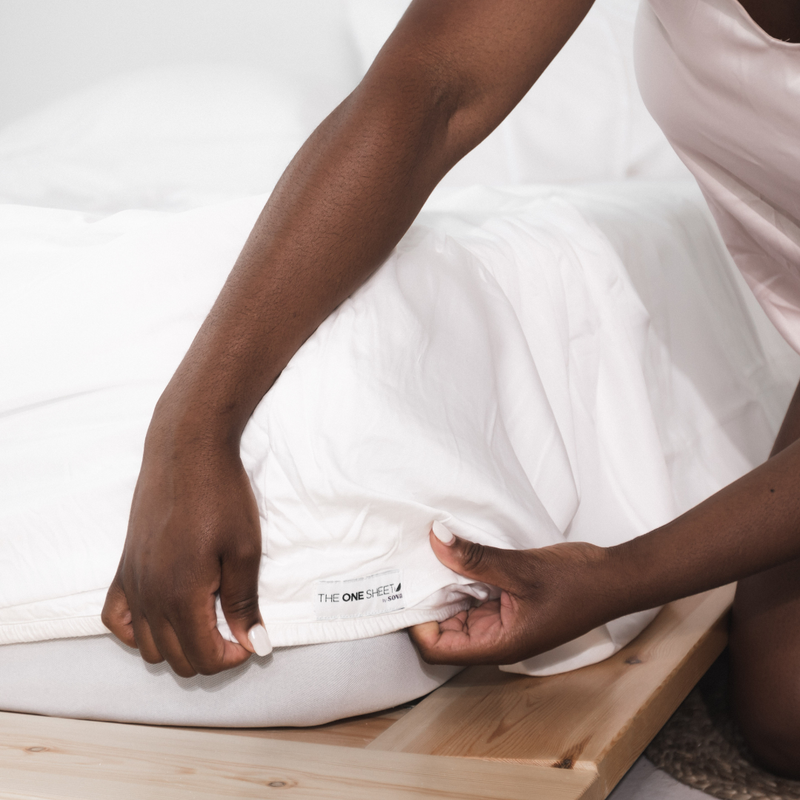
Even the right-size sheet can pop off if you put it on wrong, so start with technique. Corners lift most often because people pull the pocket straight down over the corner tip, tenting it into an upside-down U so the elastic only grips the very point of the mattress. Instead, seat each corner flat: hook the pocket over the corner and pull it under the pad so the pocket wraps the underside, not just the tip. On a thin bunk pad this matters even more, because there is so little depth for the elastic to catch.
After technique, pocket depth is the second cause. Match the sheet's pocket to a thin mattress. A shallow-pocket or bunk-specific sheet grips a 4 to 5 inch pad far better than a deep-pocket home sheet ever will. Accessories like sheet suspenders, clips, and elastic straps can help on a stubborn bunk, but be honest with yourself about what they are: ongoing symptom management for a sheet that was not built to stay.
The hardest part to keep on is the top sheet. A loose flat sheet on a narrow, thin bunk slides off within minutes, which is why many RV families skip the top sheet entirely or fight with it every trip. The real failure point is that the top sheet and fitted sheet are two separate pieces that can drift apart. Remove that gap and the problem disappears.
The One Sheet: a stay-put option for your RV's main bed
That is the idea behind The One Sheet by Sova. It is a connected sheet system where the top sheet is permanently sewn to the fitted sheet at the foot of the bed, so the top sheet cannot slide off, bunch, or get kicked into a ball while you drive down a bumpy highway. For the main RV bed, that connected design removes the exact failure point that makes RV bedding so annoying: two pieces that never stay together.
A few reasons it suits life on the road. It is made from organic bamboo viscose that is soft and breathable for warm campgrounds, it is OEKO-TEX Standard 100 certified and uses FSC certified materials, and its deep pockets are built to grip thick and adjustable mattresses (useful if your rear bed sits taller than a bunk). Because the whole set is connected, it also washes as one piece in the free mesh wash bag that ships with every order, which is a small mercy when your only laundry option is a cramped campground machine. And every order comes with a 100-night sleep trial, so you can test it through a few trips.
One honest note: The One Sheet is made in standard residential sizes, so for a very small 28 to 34 inch bunk you will still want a true bunk-sized sheet. Think of the connected set as the fix for your camper's main bed, and bunk-specific sheets for the kids' bunks.
What to look for when buying RV bunk sheets
Before you buy, run through a quick checklist. Confirm the exact bunk width, length, and mattress thickness with a tape measure. Match the sheet size to those numbers rather than rounding to a home size. Choose a shallow or bunk-specific pocket for thin pads. Prefer breathable, easy-care fabric that survives frequent washing. And if the bunk is angled or L-shaped, look for a cut-corner or custom option.
Key takeaways
- The most common RV bunk mattress sizes are 28 by 75, 30 by 75, and 34 by 75 inches, narrower than a home twin's 38 by 75.
- RV bunk mattresses are thin, usually about 4 to 5 inches, so deep-pocket home sheets fold up instead of gripping.
- Regular twin sheets fail for two reasons at once: wrong dimensions and pockets built for tall mattresses.
- Seat each corner flat and pull the pocket under the pad; do not tent it over the corner tip.
- The main RV bed is non-standard too (RV Queen short, RV King), and a connected system like The One Sheet keeps the top sheet from sliding off on the road.
- Always measure your specific bunk before ordering, since sizes vary by brand and floor plan.
Frequently asked questions
What size sheets fit RV bunk beds?
RV bunk sheets should match the bunk's exact mattress, most commonly 28 by 75, 30 by 75, or 34 by 75 inches. Widths generally run 28 to 34 inches and lengths 72 to 75 inches, with some bunks reaching 80 inches. Measure your platform before buying.
What size mattress is in an RV bunk bed?
An RV bunk mattress is a thin foam pad, usually about 4 to 5 inches thick and 28 to 34 inches wide, kept small and light to fit the bunk opening and keep the RV's weight down.
Do RV beds need special sheets?
Yes. RV bunk and main beds are non-standard in size and thickness, so home-store twin, queen, and king sheets rarely fit well. Bunk-specific sheets and RV-sized main-bed sheets give a snug fit.
Why does my RV fitted sheet keep coming off?
Usually the pocket is too deep for a thin bunk pad, or the corner was tented over the tip instead of seated flat under the mattress. Match the pocket to a thin mattress and seat each corner under the pad.
Where can I buy RV bunk bed sheets?
Bunk-sized sheets are sold by RV bedding specialists, camping retailers, and online marketplaces. For your camper's main bed, a connected stay-put set like The One Sheet keeps the top sheet in place while you travel.
Loose, sliding RV bedding is a fit problem, not a you problem. Measure your bunks, buy to those numbers, and for the main bed, let a connected set do the work of staying put. If a top sheet that never slides off sounds like the upgrade your camper needs, take a look at The One Sheet below.