Quick answer: To keep a fitted sheet tight, seat each corner flat rather than tenting it over the corner tip, match your pocket depth to your mattress within about two inches, and stop drying the sheet on high heat. A fitted sheet goes loose because the fabric is not under tension across the mattress, not because it needs another clip. Straps and grippers can add tension back, but they treat the symptom rather than the cause.
There is a difference between a fitted sheet that comes off the bed and one that stays on but never looks right. The second is more common and more annoying. It hangs on all night, yet by morning the surface is rippled and the sides sag.
Almost every guide answers this with hardware: clips, suspenders, safety pins, a perimeter drawstring. Those work the way a splint works. They are not the reason your sheet is loose. A fitted sheet is only tight when the elastic hem is pulled underneath the mattress on all four sides, putting the fabric across the top under even tension. Get that right and most beds go taut with no accessories at all.
Why does a fitted sheet go loose even when it stays on the bed?
A fitted sheet is a tension system, not an attachment system. The elastic hem is supposed to sit underneath the mattress, gripping the underside, so the fabric stretched across the sleeping surface has something to pull against on every side. When that grip is even, the top surface goes tight and stays tight.
Loose sheets almost always trace back to one of three failures, and they are worth checking in this order:
- The corners are seated wrong, so the elastic is holding on at four points instead of wrapping the underside.
- The pocket depth does not match the mattress, in either direction. Too shallow and the elastic never reaches under. Too deep and there is slack no amount of pulling will remove.
- The elastic has lost its recovery, usually from dryer heat, so it stretches but no longer pulls back.
Accessories can compensate for all three. None of them fix any of the three.
How do you seat a fitted sheet corner so it actually pulls tight?
This is the fix most people never hear, and it costs nothing.
The common mistake is to hold the fitted sheet's corner pocket open and pull it straight down over the point of the mattress, like putting a hat on. That tents the pocket into an upside-down U. The elastic ends up gripping the corner tip only, the fabric on the top surface has nothing pulling it sideways, and the sheet reads as loose from the moment you finish making the bed.
Seat it flat instead:
- Start with the hardest corner, usually the one against a wall or in a tight corner of the room. It is the corner you have the least leverage on later.
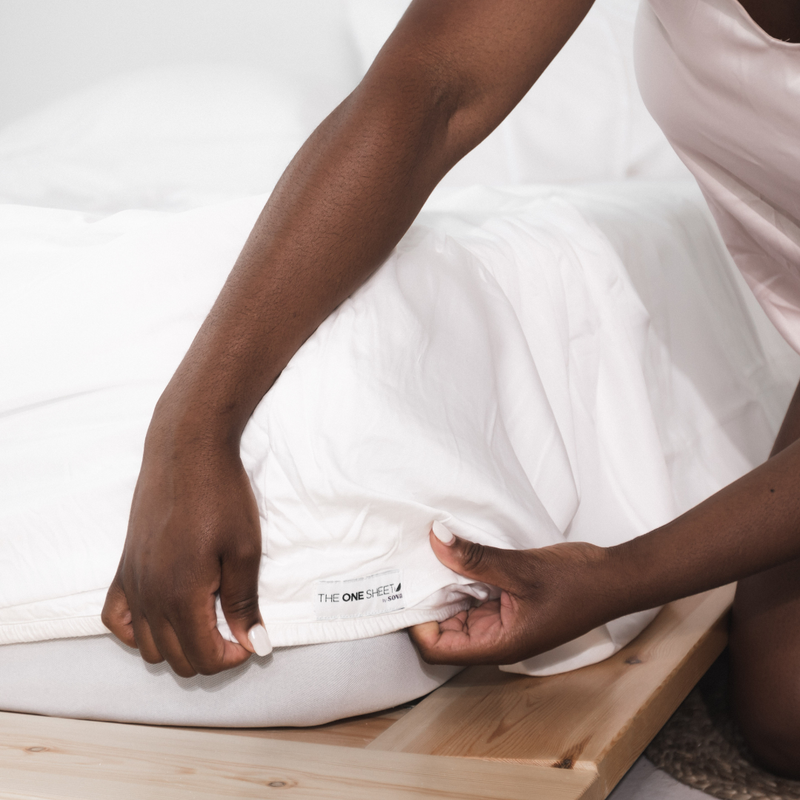
- Hook the pocket over the mattress corner, then push the pocket seam down past the corner and pull the elastic hem underneath the mattress so the pocket wraps the underside rather than capping the point.
- Move to the diagonally opposite corner next, not the neighboring one. Working diagonally balances the tension across the whole sheet instead of pushing all the slack into one end.
- Do the remaining two corners, then run a hand along each side and tug the elastic hem further under the mattress until the top surface is smooth.
- Check the sides, not just the corners. If the elastic on the long sides is sitting at the mattress edge rather than underneath it, the sheet will loosen within a night.
A correctly seated corner has fabric visible underneath the mattress, not just at the side. If you lift the mattress edge and the elastic is barely tucked under, the sheet is being held on by friction, and friction loses to a sleeping human.

Is your pocket depth wrong in the direction nobody checks?
Everyone knows a pocket can be too shallow. A 9 inch pocket on a 14 inch hybrid will never reach under the mattress, and no technique saves it.
The less obvious failure is a pocket that is too deep. Extra deep sheets get sold as the safe choice, so people buy 18 or 20 inch pockets for a 10 inch mattress and end up with several inches of spare fabric bunched underneath. The elastic has nothing to grip against, the fabric on top has slack built into it, and the sheet feels baggy no matter how carefully you seat the corners. If your sheet is loose and you already bought "extra deep," this is very likely your problem.
Measure the mattress from the top surface straight down to the bottom edge, including any topper, then match it against the standard pocket ranges. Aim for a pocket roughly two to three inches deeper than the mattress, not eight.
| Mattress depth | Pocket type | Pocket depth | Typical mattress |
|---|---|---|---|
| 7 to 10 inches | Standard | 7 to 10 inches | Older innerspring, thin foam, bunk and RV mattresses |
| 11 to 15 inches | Deep pocket | 11 to 15 inches | Most modern hybrids and memory foam |
| 16 to 22 inches | Extra deep pocket | 16 to 22 inches | Pillow tops, or a thick mattress plus a topper |
Hybrid mattresses commonly run 12 to 14 inches today, and pillow top models often reach 16 to 18 inches, which is why sheets bought for an older bed frequently fail on a newer one. If you want the longer version of this, we covered it in our guide to deep pocket sheets.
Why does a fitted sheet get looser after a few months?
Because the elastic is dying, and your dryer is usually the cause.
The stretch in nearly every fitted sheet comes from elastane, also sold as spandex. It is a polyurethane fiber that works by stretching and then pulling itself back into alignment, and heat is what breaks that second half. Textile engineering research published by Austin Publishing Group on spandex breakage in woven garments points to high temperatures in the wash bath and the dryer as a primary cause of failure. The fiber keeps stretching. It just stops snapping back.
This is why a sheet can feel fine in month one and slack in month six with nothing visible having changed. The hem still looks intact. The elastic inside it has lost its recovery.
What helps:
- Wash warm or cool, never hot. Hot water starts the damage the dryer finishes.
- Tumble dry on low and take the sheet out slightly damp. The last ten minutes in a hot drum do a disproportionate share of the harm.
- Skip the fabric softener. It coats the fibers and accelerates the loss of recovery.
- Wash sheets in a bag if they tangle. A sheet that spends the cycle wound into a rope takes more mechanical stress at the hem.
None of this restores elastic that is already gone. It buys a much longer window before it goes.
How do hotels keep their sheets so tight?
They cheat. Hotels largely do not use fitted sheets at all.
As Mental Floss and Reader's Digest have both reported, most hotels dress beds with flat sheets and hospital corners, the 45 degree envelope fold borrowed from hospitals long before the elasticated fitted sheet arrived in the 1950s. Flat sheets are easier to launder, fold, and store at scale, and they survive the daily hot water wash hotel linens go through. That same daily hot wash would destroy fitted sheet elastic quickly, which is exactly the failure described above.
So the honest answer is that hotel technique does not transfer to your bed. You are not going to iron your sheets and re-tuck four hospital corners every morning, and if you did, you would be tucking a flat sheet rather than solving anything about your fitted one. Take the useful part, which is tension applied evenly on all four sides, and ignore the rest.
Which sheet tighteners actually work?
If you have seated the corners properly, matched the depth, and the elastic is still tired, a tightener is a reasonable purchase. They are not equal, and the difference is where they apply tension.
- Perimeter drawstring systems clip along the full elastic hem and cinch the whole perimeter under the mattress at once. Architectural Digest's write-up of one popular version describes attaching eight clips along the elastic edge, positioned about 12 inches from the corner seams. This gets closest to fixing the real problem, because it recreates even tension around the entire hem.
- Corner straps and suspenders clip diagonally under the mattress. They pull hard at four points, which beats nothing, but point tension is what a badly seated corner already gives you. They help most on sheets whose elastic has gone slack.
- Non-slip grippers and rug pads add friction under the mattress corners. Friction is not tension. They stop a sheet sliding but will not make a baggy sheet taut.
- Safety pins work, and will eventually put holes in the hem. Fine as a stopgap, poor as a plan.
Ranked honestly: fix the seating first, the depth second, replace worn sheets third, buy hardware fourth. Most people work that list backwards.
Where The One Sheet fits into this
The One Sheet does not repeal physics. You still seat the fitted corners flat and you still want the right pocket depth. What it removes is the other half of the problem.
On a conventional bed, much of the nightly untidiness is not the fitted sheet at all. It is the top sheet drifting, bunching, and pulling out from the foot. The One Sheet's top sheet is permanently sewn to the fitted sheet at the foot of the bed, a patented connected design, so the two layers cannot separate and there is nothing at the foot to re-tuck each morning. The deep pockets are cut for standard, thick, and adjustable mattresses, which addresses the depth cause on the beds most likely to hit it.
It is made from organic bamboo viscose, certified to OEKO-TEX Standard 100 and made with FSC certified materials, and every order ships with a free mesh wash bag. That matters more than it sounds for the elastic question above: the connected set goes into the bag and washes as one piece instead of winding into a rope around the drum, which means less mechanical stress at the hem and elastic that stays springy longer.
There is a 100-night sleep trial, so you can find out on your own mattress whether the connected design is the fix you have been buying accessories for.
Key takeaways
- A fitted sheet is loose because the fabric is not under even tension, not because it needs more hardware.
- Seat each corner flat by hooking the pocket over the corner and pulling the elastic hem underneath the mattress, rather than tenting the pocket down over the corner tip.
- Work corners diagonally, starting with the hardest one, so the slack is distributed instead of pushed to one end.
- A pocket that is too deep causes just as much bagginess as one that is too shallow. Aim for two to three inches deeper than your measured mattress.
- Dryer heat, not age, is what usually kills fitted sheet elastic. Wash warm, dry low, skip the softener.
- Perimeter drawstring tighteners help most because they recreate tension around the whole hem. Grippers only add friction.
FAQ
How do hotels keep their sheets so tight?
Hotels mostly avoid fitted sheets entirely. They use flat sheets folded into hospital corners, a technique that predates the fitted sheet's arrival in the 1950s, because flat sheets are easier to launder at scale and survive the daily hot water washing that would quickly destroy fitted sheet elastic. The transferable lesson is even tension on all four sides, not the tucking method itself.
How do I stop a fitted sheet from moving?
Seat every corner flat so the elastic hem wraps under the mattress instead of capping the corner tip, then confirm the pocket depth is within two to three inches of your mattress depth. If it still shifts, the elastic has likely lost its recovery, and a perimeter drawstring tightener or a replacement sheet is the next step.
Why does my fitted sheet keep coming loose?
Three causes, in order of how often they are responsible: corners seated over the tip rather than under the mattress, a pocket depth mismatched to the mattress in either direction, and elastic that has lost its snap-back from repeated high heat drying. Check them in that order before buying anything.
How do you make fitted sheets tighter without sewing?
Reseat the corners properly, add a perimeter drawstring system that cinches the entire elastic hem under the mattress, or clip corner straps diagonally underneath. Reseating costs nothing and solves most cases. The hardware is for sheets whose elastic is already worn.
How do I keep my bed sheets tight all night?
Seat the corners flat with the elastic pulled well under the mattress, use a pocket depth matched to your mattress, and keep the elastic healthy by drying on low heat. For a top sheet that will not stay put, a connected design removes the failure point, since the top sheet cannot untuck from a foot it is sewn to.
Why do people put a water bottle under a hotel bed?
This one is unrelated to bedding. It is a travel security habit, and the bottle goes against the door rather than under the bed, so it makes noise if the door opens. It has nothing to do with keeping sheets tight and appears here only because both questions come from the same hotel room tricks cluster.
Does thread count affect how tight a fitted sheet stays?
Not meaningfully. Tightness comes from the elastic hem, the pocket depth, and how the corners are seated. Thread count affects hand feel and, at very high numbers, breathability. A high thread count sheet with a shallow pocket will still sag.
The bottom line
A tight fitted sheet is a tension problem with a five minute fix, and a shopping list only when that fix does not hold. Reseat your corners flat and diagonally, measure your mattress and match the pocket, and stop cooking the elastic on high heat. If the top sheet is the half that never behaves, that is a design problem rather than a technique problem, and it is the one The One Sheet was built to solve.