Quick answer: A fitted sheet is the bottom layer with elasticized corners that wrap around the mattress to protect it and stay in place. A flat sheet is a plain rectangle of fabric that lies on top of you, between your body and the comforter, and it has no elastic. The fitted sheet does the structural job of covering the mattress, while the flat sheet does the hygienic job of keeping your blanket or duvet clean. Most beds use both, but the two pieces solve different problems and fail in different ways.
If you have ever stood at a linen closet trying to work out why one sheet is shaped like a fabric box and the other is a plain rectangle, you already understand the core of this comparison. A flat sheet and a fitted sheet look similar folded, but they were designed to do two entirely different jobs. Knowing which job is which makes it obvious what you actually need, why hotels set their beds the way they do, and why one of these two pieces is far more likely to drive you crazy at 2 a.m.
What is a fitted sheet?
A fitted sheet is the bottom sheet that goes directly over the mattress, and its defining feature is elastic sewn into the corners (and often all the way around the hem) so it grips the mattress and stays put. The corners are sewn into pockets shaped to slip over the mattress edges, which is what gives a fitted sheet its box-like shape when it is off the bed. Its main jobs are to create a smooth sleeping surface and to protect the mattress from body oils, sweat, and skin cells, since it sits between you and the mattress all night.
The trade-off for that secure fit is that a fitted sheet has to roughly match your mattress in both length and depth. A pocket that is too shallow will not reach under a thick mattress, and one that is far too deep will bunch. That shape is also the reason a fitted sheet is famously awkward to fold, because it has no flat state to fold into.
What is a flat sheet?
A flat sheet is a large rectangle of fabric with finished, hemmed edges and no elastic, used as the top layer between the sleeper and the comforter or duvet. Because it is just a rectangle, a flat sheet is versatile. You can tuck it under the mattress at the foot and sides for a crisp look, leave it loose, use it as a light summer cover on its own, or in a pinch even use it as a bottom sheet. It is also the easiest bedding piece to launder, press, and fold, since there is no elastic to fight.
The flat sheet's real purpose is hygiene and comfort. It puts a washable barrier between your body and the heavier bedding above, so the comforter or duvet stays cleaner for longer. A flat sheet is what lets you wash the layer that touches your skin every week without laundering a bulky comforter every time.
Flat sheet vs fitted sheet: the core differences
The fastest way to see the difference is side by side. A fitted sheet is structural and stays on the mattress; a flat sheet is a loose top layer you can use however you like.
| Feature | Flat sheet | Fitted sheet |
|---|---|---|
| Shape | Plain rectangle, hemmed edges | Box shape with elasticized corners |
| Where it goes | On top of you, under the comforter | Directly over the mattress |
| Main job | Keeps the comforter clean, adds comfort | Covers and protects the mattress |
| Elastic | None | Corners, often all the way around |
| Sizing | Forgiving, one size covers a range | Must match mattress length and depth |
| Folding | Easy, folds flat | Awkward, no flat state |
| Stays put? | Not attached, can slide | Grips the mattress, but can pop off corners |
Do you need both a flat sheet and a fitted sheet?
You need a fitted sheet, and a flat sheet is optional. A fitted sheet is close to non-negotiable because something has to cover and protect the mattress and give you a smooth surface to sleep on. A flat sheet is genuinely a matter of preference: it adds a washable layer and a bit of temperature control, but if you use a duvet with a cover that you wash regularly, you can skip the flat sheet without any hygiene penalty, because the duvet cover is doing that barrier job instead.
That is exactly why the "do I need both" question splits people so cleanly. If you sleep under a comforter or blanket that is a pain to wash often, a flat sheet earns its place. If you sleep under a washable duvet cover, the flat sheet becomes redundant.
Why don't people use flat sheets anymore?
Younger sleepers are dropping the flat sheet in large numbers, mostly for convenience and because a washable duvet cover already covers the hygiene job. According to a Casper top sheet survey, only about 26 percent of 18-to-34-year-olds regularly used a top sheet, and a 2023 YouGov survey found that nearly 40 percent of adults under 35 no longer use one at all. The same Casper survey found 58 percent of Americans still consider a top sheet essential, with roughly two-thirds of people aged 55 and older in that camp, so this is very much a generational split.
The reasoning from the flat-sheet skippers is consistent: if you change and wash your duvet cover regularly, a separate top sheet feels like an extra thing to launder, wrestle back into place, and fold. Older generations tend to counter that a top sheet feels cooler in summer and keeps the comforter fresh between deeper washes. Both camps are right for their own routines, which is why this is preference, not a rule.
Do hotels use flat sheets or fitted sheets?
Hotels use both, and they lean heavily on flat sheets on top because a flat sheet is cheaper and faster to launder than a duvet cover. A flat sheet used as a barrier layer keeps the heavier duvet or blanket clean, so housekeeping can swap and wash just that thin top layer between guests instead of laundering bulky bedding every stay. Flat sheets also have no elastic, so commercial laundries can press, iron, and stack them in bulk, and they wear more slowly under constant washing.
There is a presentation reason too. A crisply tucked flat sheet gives the lower half of the bed that squared-off, structured look people associate with a well-made hotel bed. So the hotel habit is really about laundry economics and a sharp finish, not about the flat sheet being objectively better for your bed at home.
Why your fitted sheet keeps popping off the corners
If one of these two sheets is going to frustrate you, it is almost always the fitted sheet, and the usual cause is how the corner was seated, not a defect in the sheet. People tend to pull the fitted-sheet pocket straight down over the tip of the mattress corner, which tents the fabric into an upside-down U so the elastic only grips the very point of the corner. The moment you move, that shallow grip slips off. The fix is to seat each corner flat: hook the pocket over the corner and pull it under the mattress so the deep pocket wraps the underside, not just the tip.
Pocket depth is the second cause. Even a correctly seated corner will fail if the pocket is too shallow to reach under a deep mattress. A mattress 15 inches or thicker generally needs a pocket in the 16-to-22-inch range, so a sheet built for a standard mattress will keep letting go on a pillow-top or a topper-stacked bed.
Everything else sold to fix this, such as sheet clips, suspenders, straps, and all-around grippers, treats the symptom rather than the cause. They can help, but they are ongoing management: one more thing to attach, check, and reattach every laundry day. Worth knowing before you buy a drawer full of clips to solve a problem that is partly about technique and partly about the sheet being two separate pieces that were never joined.

Where The One Sheet fits into the flat-versus-fitted question
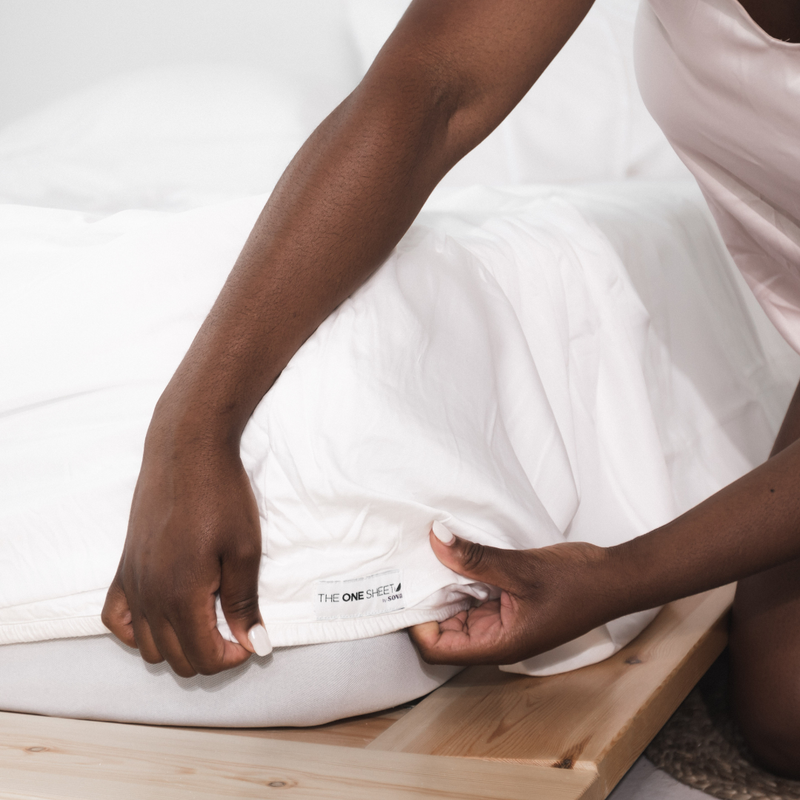
The whole flat-versus-fitted debate exists because a bed is normally made of two loose pieces that behave independently. The fitted sheet can pop off a corner, and the top layer can shift, bunch, or get kicked to the foot, because nothing connects them. The One Sheet by Sova removes that gap by sewing the top sheet permanently to the fitted sheet at the foot of the bed, a patented connected design. The top layer is anchored where it used to come loose, so it cannot slide off or migrate to one side, and there is no separate flat sheet to wrestle back into place each morning.
That connected design also carries real benefits for the two failure points above. The One Sheet uses deep pockets that fit standard, thick, and adjustable mattresses, which addresses the pocket-depth cause of corner pop-off directly. It is made from organic bamboo viscose, is OEKO-TEX Standard 100 certified and made with FSC certified materials, and comes with a 100-night sleep trial so you can test it on your own bed.
There is a practical laundry upside too. Because the set is connected, it washes as one piece and cannot tangle or separate in the machine, and every order ships with a free mesh wash bag so the whole thing goes through the wash together and comes out ready to put back on. If your gripe with the two-sheet system was matching, folding, and untangling, that is the part the connected design quietly fixes.
Key takeaways
- A fitted sheet has elasticized corners, covers and protects the mattress, and must match your mattress length and depth.
- A flat sheet is a plain rectangle with no elastic that keeps your comforter clean and is easy to launder and fold.
- You always need a fitted sheet; a flat sheet is optional if you already use a washable duvet cover.
- Younger sleepers are skipping the flat sheet in large numbers, while most people over 55 still consider it essential.
- Hotels favor flat sheets on top because they are cheaper and faster to launder than a duvet cover and give a crisp finish.
- Most fitted-sheet pop-off is a corner-seating technique problem first and a pocket-depth problem second, not just a sheet defect.
Frequently asked questions
Is a flat sheet better than a fitted sheet?
Neither is better; they do different jobs. A fitted sheet covers and protects the mattress, and a flat sheet keeps your comforter clean and adds comfort on top. A typical bed uses both, and which one you can skip depends on whether you already wash a duvet cover regularly.
Do I need both a fitted and a flat sheet?
You need a fitted sheet, and a flat sheet is optional. If you sleep under a washable duvet cover, you can skip the flat sheet without a hygiene downside, because the cover is the washable barrier. If your comforter is hard to wash often, a flat sheet is worth keeping.
Why don't people use flat sheets anymore?
Many younger sleepers skip the flat sheet for convenience and because a regularly washed duvet cover already keeps the bedding clean. Surveys show fewer than a third of 18-to-34-year-olds regularly use a top sheet, while most people over 55 still consider it essential.
Do hotels use flat sheets or fitted sheets?
Hotels use both. They rely on a flat sheet as the top layer because it is cheaper and faster to launder than a duvet cover, easier to press in bulk, and it gives the crisp, squared-off look associated with a well-made hotel bed.
Why does my fitted sheet keep coming off the corners?
The most common reason is seating the corner over just the tip of the mattress so the elastic grips only the point. Seat each corner flat so the pocket wraps under the mattress. If it still slips, your pocket is probably too shallow for the mattress depth.
The flat sheet versus fitted sheet question is really about two separate pieces trying to do two separate jobs. If the part that annoys you is the shifting, bunching, and popping off that comes from those pieces being loose, a connected set like The One Sheet is the version that removes the failure point instead of managing it.