Quick answer: A good thread count for sheets is roughly 200 to 600, and the real sweet spot for most cotton sheets is 300 to 500. Anything advertised above 600 or 700 is usually marketing, not quality, because there is a physical limit to how many single threads fit in a square inch. Thread count only measures cotton and other woven staple fabrics. It does not apply to bamboo viscose, which is judged by fabric weight and fiber quality instead.
Thread count is the number everyone checks and the number the bedding industry has spent decades gaming. Walk down any sheet aisle and you will see "1000 thread count" and "1500 thread count" stamped on packaging like a quality score, as if bigger is always better. It is not. The truth is simpler, more useful, and a little annoying: past a certain point, a higher thread count tells you almost nothing about how a sheet will feel or how long it will last.
Here is what a good thread count actually is, why the giant numbers are misleading, and what to look at instead.
What does thread count actually mean?
Thread count is the number of threads woven into one square inch of fabric, counting both directions. It adds the vertical threads, called the warp, to the horizontal threads, called the weft. A sheet with 150 warp threads and 150 weft threads per square inch has a thread count of 300.
That is the whole definition. It is a measure of density, not quality, not softness, and not durability. A high number can come from good, fine, tightly woven yarn, or it can come from cheap tricks. The number on the label cannot tell you which.
So what is a good thread count for sheets?
A good thread count for sheets falls between about 200 and 600, and the range that consistently performs best for 100% cotton is 300 to 500. When Good Housekeeping's Textiles Lab tested seven cotton sateen sets from 200 to 1,000 thread count, the 300 to 500 range came out on top. The 500 set scored highest in the lab, with the 300 and 400 sets close behind, while the 200 and 1,000 sets scored lowest. In a separate round with 35 home testers, the 400 thread count set won for its smooth, balanced feel.
The right range also shifts with the weave. Percale, a crisp, cool, plain weave, feels best in a lower band because it is not meant to be dense. Sateen, a silkier weave with more threads on the surface, reads well a little higher. Long-staple cottons like Egyptian, Pima, and Supima sit comfortably in the middle-to-upper part of the range.
| Sheet type | Good thread count range | What it feels like |
|---|---|---|
| Percale cotton | 200 to 400 | Crisp, cool, hotel-sheet feel |
| Sateen cotton | 300 to 600 | Smooth, silky, slight sheen |
| Egyptian or Pima cotton | 300 to 600 | Soft, strong, long-lasting |
| Anything labeled 800 and up | Treat with suspicion | Usually inflated, not softer |
| Bamboo viscose | Thread count does not apply | Judged by fabric weight (GSM) |
If a set falls in these ranges and is made from a fiber you trust, the exact number barely matters. A well-made 300 thread count percale will outperform a poorly made 800 thread count sheet every time.
Why a higher thread count is not better
Once you understand the physical ceiling, the giant numbers fall apart. There is only so much room in a square inch of fabric. Because of loom and yarn limits, it is genuinely hard to weave more than roughly 400 to 500 single-ply threads into a square inch. So how does a package claim 1,000 or 1,500?
The trick is multi-ply yarn. Manufacturers twist two or three thinner, often lower-quality threads together, then count each strand separately. A two-ply 300 thread count sheet gets relabeled as "600 thread count," and a three-ply version becomes "900," even though the fabric does not feel or perform any better. It is creative math designed to justify a higher price.
The gap can be enormous. Consumer Reports once had an independent textile lab count the threads in a set of queen sheets sold with a stated thread count of 1,200. The lab counted 416 threads per inch, about 35% of what the label claimed. The number on the box was not a small exaggeration. It was mostly fiction.
There is a real cost to chasing the big number, too. Packing in extra plies of cheaper cotton can make a sheet heavier, warmer, and less breathable, which is the opposite of what most people want. A sheet that traps heat is a problem you feel every night.

What thread count sheets do luxury hotels use?
Luxury hotels generally use single-ply, long-staple cotton in a lower thread count than shoppers expect, often a percale around 200 to 300 or a sateen around 300. The crispness and durability come from the quality of the cotton and the weave, not from a headline number. Those sheets survive industrial laundering hundreds of times because the fiber and construction are good, which is exactly the point: below the marketing, hotels buy fiber quality, not thread count.
Does thread count matter for bamboo viscose sheets?
Thread count does not meaningfully apply to bamboo viscose sheets, so a thread count printed on a bamboo set is close to meaningless. Bamboo viscose fibers are spun much finer and smoother than typical cotton, so the whole thread-counting system breaks down. A bamboo viscose sheet at a modest count can feel softer than a cotton sheet at 800, because the softness comes from the fiber, not the density.
For bamboo viscose and other non-cotton fabrics, the more honest measure is GSM, or grams per square meter, which is simply the weight of the fabric. GSM is much harder to game than thread count, and it tells you whether a sheet is light and airy or dense and substantial. If you are shopping bamboo viscose and a brand leads with a huge thread count, that is a sign they are borrowing cotton's marketing playbook rather than describing their own fabric honestly.
How to choose a good sheet without getting fooled by the number
The number on the front is the last thing to check, not the first. Here is a simple order of operations.
- Start with the fiber. Choose a fiber you actually want against your skin: long-staple cotton for a crisp or classic feel, or organic bamboo viscose for a naturally soft, breathable, temperature-friendly feel.
- Pick the weave for how you sleep. Percale sleeps cool and crisp. Sateen sleeps smooth and a touch warmer. Bamboo viscose drapes soft and breathable.
- Look for single-ply. If a listing says single-ply, the thread count is honest. If it hides ply or brags about 1,000-plus, be skeptical.
- Sanity-check the number against the ranges above. Inside 200 to 600 is normal. Far above that is a red flag, not a badge.
- Weigh the whole package. Certifications, return policy, and construction tell you more about long-term quality than any single count.
What actually makes a sheet feel good
If thread count is only one ingredient, what are the others? Four things matter more than the count itself. Fiber type and staple length come first, because long, fine fibers spin into smoother, stronger yarn. Weave comes next, since percale and sateen feel completely different at the same count. Ply matters, because single-ply almost always beats multi-ply. And finishing, the washing and treatment a fabric gets at the mill, decides how soft a sheet feels out of the bag and how it holds up after a year of washes.
Thread count is real, but it is one line in a longer story. Judge a sheet by all five and the marketing number loses its power over you.
Where The One Sheet fits
The One Sheet is made from organic bamboo viscose, which is exactly the kind of fabric where thread count stops being the right question. Instead of chasing an inflated number, the fabric is chosen for how it actually performs: naturally soft, breathable, and easy on temperature-sensitive sleepers. It is OEKO-TEX Standard 100 certified and made with FSC certified materials, which are verifiable facts about the fabric, not a number printed on a box to impress you.
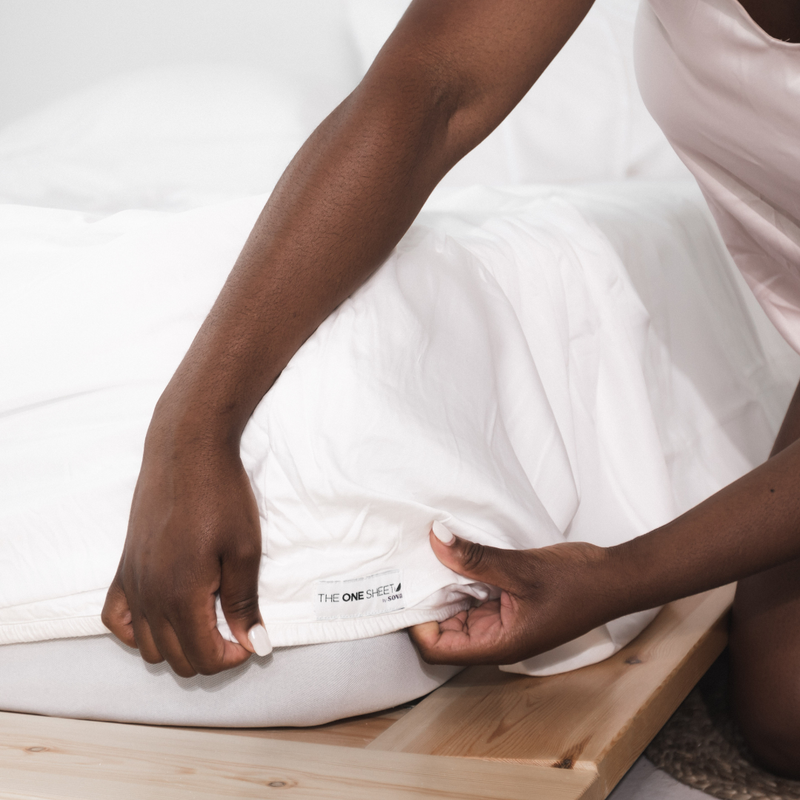
The One Sheet is also built differently in a way that matters for longevity. The top sheet is permanently sewn to the fitted sheet at the foot of the bed, so the set stays together and washes as one connected piece. Every order ships with a free mesh wash bag, and the connected set goes into it and through the wash without tangling, twisting, or snagging on zippers, which is one of the quiet reasons sheets pill and wear out early. Gentler laundering means the fabric keeps feeling the way it did on night one for longer. And because it comes with a 100-night sleep trial, you get to judge it the only way that actually counts, which is by sleeping on it, not by reading a thread count.
Key takeaways
- A good thread count for sheets is about 200 to 600, and 300 to 500 is the reliable sweet spot for cotton.
- Higher is not better past that point. Numbers like 1,000 and 1,500 are usually inflated with multi-ply yarn.
- There is a physical limit near 400 to 500 single-ply threads per square inch, so a huge count is a red flag, not a feature.
- Luxury hotels use single-ply long-staple cotton at modest counts, proving fiber quality beats the headline number.
- Thread count does not apply to bamboo viscose sheets, which are better judged by fabric weight (GSM) and fiber quality.
- Fiber, weave, ply, and finishing tell you more about how a sheet feels and lasts than the count on the label.
Frequently asked questions
Is 800 thread count better than 600?
Not usually. Both numbers are already at or past the point where thread count stops improving a sheet, and an 800 count is often reached with multi-ply yarn rather than better fabric. A single-ply 300 to 500 thread count sheet from good cotton typically feels better than an inflated 800.
Is a 1500 thread count good?
No. A genuine 1,500 single-ply thread count is not physically practical, since it is hard to fit more than about 400 to 500 single threads in a square inch. A 1,500 label almost always means multi-ply counting, which inflates the number without improving softness or durability.
What thread count sheets do 5-star hotels use?
Most luxury hotels use single-ply, long-staple cotton, often a percale around 200 to 300 or a sateen around 300. The crisp, durable, luxurious feel comes from the quality of the cotton and the weave, not from a high thread count.
Is 400 thread count Egyptian cotton good?
Yes. For genuine long-staple Egyptian cotton, roughly 400 to 600 is an excellent range that balances softness, breathability, and durability. A real single-ply 400 thread count Egyptian cotton sheet is high quality, as long as the "Egyptian cotton" claim is authentic.
Is 1000 thread count too much?
Generally, yes. A 1,000 thread count almost always relies on multi-ply yarn or creative counting, and it can make a sheet heavier and less breathable. You are usually paying more for a bigger number, not a better sheet.
What is a good thread count for bamboo sheets?
Thread count is not the right measure for bamboo viscose sheets. The fibers are too fine for the system to mean much, so a bamboo set can feel softer at a low count than cotton does at a high one. Look at fabric weight (GSM), fiber quality, and certifications instead.
Chasing a bigger number is how the industry gets you to overpay. If you would rather skip the thread-count game entirely and choose a sheet by how it actually feels and lasts, that is exactly what The One Sheet is built for.