Quick answer: A fitted sheet keeps coming off mostly because of how it is put on, not because it is defective. When you pull the pocket straight down over the tip of the mattress corner, the elastic tents into an upside-down U and grips only the point, so it peels off the moment you move. Seat each corner flat by hooking the pocket under the mattress, make sure the pocket is deep enough for your mattress height, and replace elastic that has gone slack. If the sheet still will not stay, the design itself is usually the failure point.
If you make your bed neatly at night and wake up with a bare mattress corner staring at you, you are not doing anything wrong on purpose. Fitted sheets pop off for a small number of very specific reasons, and almost all of them are fixable once you know what is actually happening at the corner. Here is the full diagnosis, in order of how common each cause is, plus the fixes that hold and the ones that only buy you a few nights.
Why does a fitted sheet keep coming off?
A fitted sheet keeps coming off because the elastic pocket at each corner is not seated under the mattress the way it was designed to be. Most people pull the corner of the sheet straight down over the tip of the mattress, which tents the fabric into an upside-down U. In that position the elastic is only hugging the very point of the corner, so any movement during the night lets it ride up and snap off. A correctly seated corner wraps under the mattress, where the deep pocket grips the underside and has nothing to peel away from.
That seating problem is the number one cause, and it is worth fixing first because it costs nothing. After that come pocket depth, worn-out elastic, and the wrong size or a slick mattress surface. Work through them in that order.

The four real reasons your fitted sheet won't stay on
1. You are seating the corners wrong (the biggest cause)
Picture the corner of your mattress as a blunt point. If you grab the sheet pocket and yank it down over that point, the elastic ends up strung across the tip like a tented cap. It looks on until you roll over, and then it lifts off because it was never holding the sides. This is a technique problem that even expensive sheets cannot solve on their own.
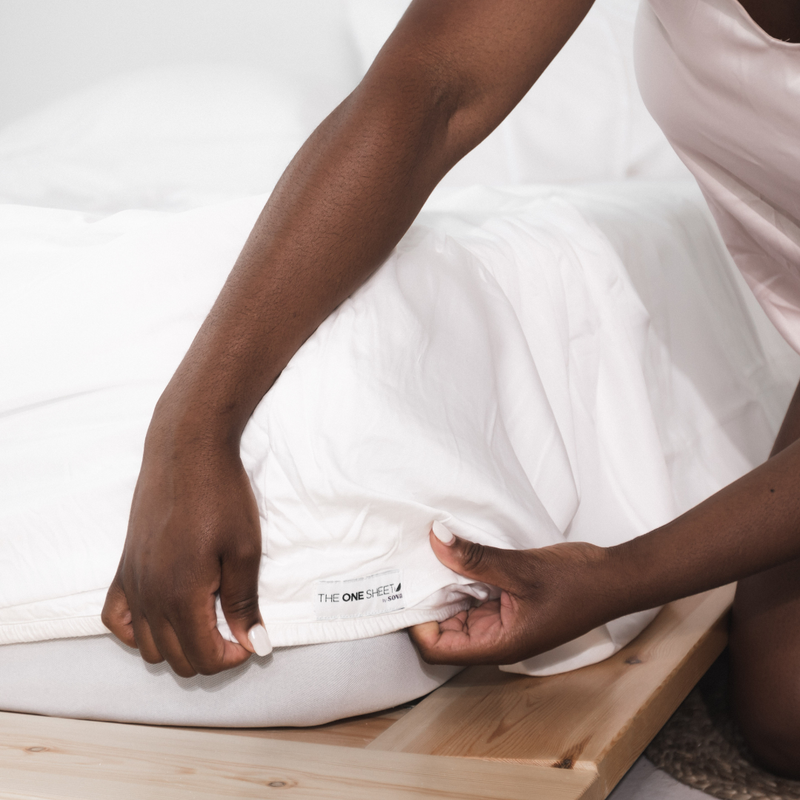
The fix is to change the direction of the pull. Hook the pocket over the corner, then reach under the mattress and pull the elastic edge down and inward so it wraps the underside. When the pocket is seated flat under the mattress, the deep part of the pocket grips the underside and the sheet has no leverage to climb back up the corner. Do this on all four corners and start with the two hardest-to-reach ones first.
2. The pocket is too shallow for your mattress
Even a perfectly seated corner will fail if the pocket physically cannot reach under a tall mattress. Mattresses have gotten deeper. A standard mattress averaged about 10 to 12 inches back in 2015, while today's hybrids commonly run 12 to 14 inches and pillow-top models often reach 16 to 18 inches. If you have added a mattress topper, you can add another 2 to 4 inches on top of that.
Sheet pockets are sold in three rough tiers, and the labels are not regulated, so measure before you trust the word "deep."
| Pocket type | Pocket depth | Fits |
|---|---|---|
| Standard | 7 to 11 inches | Thin, older, or base-only mattresses |
| Deep | 12 to 15 inches | Most modern hybrids and pillow-tops without a topper |
| Extra-deep | 16 to 22 inches | Thick pillow-tops, or any mattress with a topper stacked on |
The reliable rule is to pick a pocket that is at least 2 to 3 inches deeper than your total mattress height, measured with the topper and protector included. That extra margin is what lets the elastic tuck under and stay under. Because "deep pocket" is unregulated and some brands slap it on a 12-inch pocket, always verify the actual inches.
3. The elastic is worn out
Elastic is a polymer, and high heat is its enemy. Repeated hot dryer cycles break down the polymer chains and cause them to lose their coiled structure, which shows up as permanent sag and looseness that no amount of stretching brings back. Once the "bite" is gone, the pocket simply slides up the smooth sides of the mattress no matter how well you seat it.
If your sheet used to stay and now does not, tired elastic is the likely culprit. You cannot restore it, but you can slow the decline on your next set: wash in cool or warm water, dry on low heat, and pull sheets out slightly damp rather than baking them on high. Air-drying is gentler still.
4. The size is wrong, or the surface is slick
An oversized fitted sheet has too much slack, so it bunches and slides off, while an undersized one pops back off the second you seat the last corner. Match the sheet to your actual mattress size, not the label on the box you no longer have.
Surface matters too. Memory foam and vinyl mattress protectors are smooth and low-friction, so a sheet has less to hold onto and creeps more easily. This is why the same sheet that behaves on an innerspring can misbehave on a foam bed.
How do I put a fitted sheet on so it stays?
Putting a fitted sheet on so it stays takes about a minute and comes down to seating the corners under the mattress instead of over the tips. Follow these four steps.
- Identify the corners. Most fitted sheets have the deeper seams on the short ends. Line those up with the head and foot of the mattress so the pockets sit where they are meant to.
- Seat the two far corners first. Hook each far pocket over the mattress corner, then pull the elastic edge down and under so it wraps the underside. Do the hard-to-reach corners before you are leaning across the bed.
- Wrap the near corners under, not over. Repeat on the two near corners, pulling down and inward so the elastic grips beneath the mattress rather than tenting across the tip.
- Smooth and check the sides. Run your hand along each side to pull the pocket fully under. If a corner still looks tented, lift it and reseat it flat before moving on.
If you have followed all four steps and the corners still ride up within a night or two, the problem has moved past technique and into the sheet's design or condition.
Do sheet straps, clips, and grippers actually work?
Sheet straps, clips, and grippers do work, but they manage the symptom rather than remove the cause. They add an external clamp to a sheet that keeps trying to climb the corner, so they help right up until one lets go or the elastic underneath gives out. They are a reasonable stopgap, and it is worth being honest about what each one does and does not do.
| Accessory | What it does | The catch |
|---|---|---|
| Suspender straps | Clip corner-to-corner or criss-cross under the mattress to pull the sheet taut | Have to be unclipped for every wash and can pop loose if a clip slips |
| Corner grippers | Small clamps that bite the sheet at each corner | Only as strong as the grip; can pinch through thin fabric over time |
| Non-slip pads | Textured mats or rubber rug corners under the sheet to add friction | Address the surface, not the pocket; can shift on their own |
| Safety pins | Pin the corner directly to a fabric mattress | Puts holes in the sheet and the mattress cover |
None of these are wrong. If you already own a set you love, straps are the most reliable of the bunch. But every one of them is a patch on top of a sheet that is still fighting to come off, which means you are re-clipping and re-tightening for as long as you own it.
The one fix that removes the failure point
Every cause above traces back to the same weak spot: the fitted sheet is a separate piece that has to grip the mattress on its own, and the top sheet is another loose piece on top of it. The One Sheet was designed to remove that weak spot instead of clamping over it. The top sheet is permanently sewn to the fitted sheet at the foot of the bed, a patented connected design, so the two layers move together and there is no free top-sheet edge to kick loose. The fitted layer still has deep pockets that fit standard, thick, and adjustable mattresses, which handles the pocket-depth cause the moment you unbox it.
It is made from organic bamboo viscose, a smooth, breathable fiber, and it is OEKO-TEX Standard 100 certified with FSC certified materials. Because worn elastic and hot-dryer wear are part of why sheets stop staying put, the care matters, and every order ships with a free mesh wash bag so the connected set washes as one piece without tangling or stretching against the rest of your load. It comes with a 100-night sleep trial, so you can find out on your own bed whether removing the failure point beats managing it.
Key takeaways
- The most common reason a fitted sheet keeps coming off is a seating mistake: pulling the pocket over the corner tip in an upside-down U instead of wrapping it flat under the mattress.
- Pocket depth is the second cause; pick a pocket at least 2 to 3 inches deeper than your total mattress height, and remember "deep pocket" labels are unregulated.
- High dryer heat permanently breaks down elastic, so a sheet that used to stay may simply have worn-out corners.
- Wrong size and slick surfaces like memory foam or vinyl protectors make any sheet creep more easily.
- Straps, clips, and grippers manage the symptom; a connected design like The One Sheet removes the free edge that fails in the first place.
Frequently asked questions
Why does my fitted sheet keep coming off when I sleep?
Your fitted sheet comes off when you sleep because movement lifts a corner that was seated over the tip of the mattress rather than wrapped under it, and because a pocket that is too shallow or an elastic that has lost its stretch cannot hold against that movement. Reseat the corners flat under the mattress and check that the pocket is deep enough for your mattress height.
How do I keep my fitted sheet from coming off?
To keep a fitted sheet from coming off, seat each corner under the mattress instead of over the tip, use a pocket at least 2 to 3 inches deeper than your total mattress height, replace elastic that has gone slack, and match the sheet to your exact mattress size. Straps and grippers can add temporary hold, but they do not fix a shallow pocket or dead elastic.
Why does my fitted sheet never fit?
A fitted sheet never seems to fit when its pocket depth does not match your mattress, which is common now that hybrids and pillow-tops run 14 to 18 inches or more. A pocket that is too shallow cannot reach under the mattress, and one that is too large leaves slack that bunches, so measure your mattress with any topper included before buying.
What can I do about my fitted sheet coming off of my mattress?
You can reseat the corners flat under the mattress, upgrade to a correctly sized deep or extra-deep pocket, wash on cool and dry on low to protect the elastic, or add suspender straps as a stopgap. If the sheet still will not stay, a connected sheet system removes the loose edges that keep failing rather than clamping over them.
Does pocket depth really matter that much?
Pocket depth matters more than almost anything else after seating technique, because a pocket that cannot physically reach under your mattress will always ride up no matter how carefully you tuck it. Measure your mattress plus any topper and protector, then choose a pocket 2 to 3 inches deeper than that total.