Quick answer: Bamboo viscose sheets feel silky and cool and pull moisture off your skin quickly, which makes them a strong pick for hot sleepers and anyone who runs warm at night. Cotton sheets feel crisp and familiar, hold up to heavy washing, and get softer over time. Neither is "better" across the board. The right choice depends on how you sleep, and on one thing most comparisons skip: whether the sheet actually stays on the bed.
If you have ever stood in the bedding aisle (or scrolled twelve browser tabs) trying to decide between bamboo viscose and cotton sheets, you already know the comparison gets repetitive fast. Every guide says roughly the same thing: bamboo viscose is silky, cotton is crisp, pick one. This guide goes a step further. It covers how each material actually performs night to night, where the popular claims get oversold, and the structural question that decides whether you wake up tangled in a sheet that has crept off the corners.
A quick note on names before we start. What stores label "bamboo sheets" are almost always made from bamboo viscose, a fabric created by dissolving bamboo pulp and spinning it into a soft fiber. That distinction matters for both feel and sustainability, and we will come back to it.
What is the difference between bamboo viscose and cotton sheets?
Bamboo viscose and cotton are both plant-based fibers, but they behave differently against your skin. Bamboo viscose is spun into a fine, smooth fiber that drapes heavily and feels slick, closer to a high-thread-count sateen. Cotton is a fluffier natural fiber whose feel depends heavily on how it is woven, from crisp percale to silkier sateen.
The practical differences come down to four things: how the sheet feels, how it handles temperature and moisture, how it ages, and how it is made. The sections below take each in turn, then a side-by-side table sums it up.
How do bamboo viscose sheets feel and perform?
Bamboo viscose sheets are known for a silky, fluid hand that sits lightly on the body. The fiber is naturally smooth, so the sheets feel soft even at a moderate thread count rather than needing a very high one to feel luxurious.
Where bamboo viscose stands out most is moisture and temperature. The fiber wicks moisture off the skin and releases it quickly, so the sheet tends to feel cool and dry rather than damp. That is why bamboo viscose shows up again and again in "best sheets for hot sleepers" roundups. The tradeoff is care: bamboo viscose prefers gentler treatment, cold or warm water, and a low-heat or line dry to keep it smooth and prevent pilling. It also wrinkles a little more readily than a treated cotton.
How do cotton sheets feel and perform?
Cotton sheets feel classic, breathable, and a touch crisp, and their exact character is set by the weave. Percale is cool and matte with a hotel-bed snap; sateen is smoother and has a soft sheen. Cotton is famously low maintenance, tolerates hot washes and dryers, and many cotton sheets get softer the more you launder them.
Cotton's weakness is moisture behavior. It is breathable, but it absorbs sweat and holds onto it rather than wicking it away, so a cotton sheet can feel damp if you run hot. Quality also varies widely with fiber length. Long-staple and Egyptian cotton resist pilling and last longer, while cheaper short-staple cotton pills and thins faster. As Cozy Earth, a bamboo-bedding maker, puts it, Egyptian cotton generally needs a higher thread count to feel as soft as viscose from bamboo does at a lower one.

Bamboo viscose vs cotton sheets: side-by-side comparison
Here is the short version of everything above, side by side. Use it as a quick gut check, then read on for the use cases where one clearly wins.
| Factor | Bamboo Viscose | Cotton |
|---|---|---|
| Feel | Silky, fluid, drapes heavily | Crisp (percale) to smooth (sateen) |
| Temperature | Cool, actively wicks moisture | Breathable, but absorbs and holds moisture |
| Best for | Hot sleepers, warm rooms, silky-feel fans | Crisp-bed fans, year-round all-rounders |
| Durability | Durable with gentle care | Very durable, tolerates hot washes |
| Care | Cold or warm wash, low heat or line dry | Easygoing, machine wash and dry |
| Softens over time | Soft from the start | Gets softer with each wash |
| Wrinkles | A bit more | Less, especially if treated |
Which is better for hot sleepers and night sweats?
For hot sleepers, bamboo viscose usually has the edge because it moves moisture away from the skin instead of soaking it up. A cotton sheet breathes well, but once it absorbs perspiration it can feel clammy until it dries.
It helps to keep the actual numbers honest here. The popular claim that you sweat a liter every night is overstated. An average healthy adult loses closer to 200 milliliters of water over eight hours of sleep, and you sweat far more once the room climbs above roughly 85 degrees. So the bigger lever is your sleep environment, with the sheet as a meaningful assist. If you wake up warm and damp, a moisture-wicking bamboo viscose sheet is the smarter starting point, paired with a cooler room.
Which is better for sensitive skin?
You will see bamboo sheets described everywhere as "hypoallergenic" and "antimicrobial." Treat those words with some caution, because they are often marketing shorthand rather than tested claims, and the finished-fabric performance depends on how the sheet is made and certified.
What we can say plainly: many people with sensitive or easily irritated skin report that the smooth, low-friction surface of bamboo viscose feels gentler than a coarser cotton. The more verifiable signal to look for is certification. A sheet certified to OEKO-TEX Standard 100 has been tested against more than 1,000 harmful substances, with stricter limits the more skin contact the product has, which is exactly the case for bedding you sleep against all night. That certification tells you more about what is not in the fabric than any "natural" label does.
Are bamboo viscose sheets sustainable?
This is where the honest answer matters. Bamboo grows fast and needs little water or pesticide, which is a genuine environmental plus. But turning that plant into soft fabric means dissolving the pulp into viscose, and that chemical process can use harsh solvents if it is not well managed. "Plant-based" alone does not guarantee a clean product.
So look past the raw material to the certifications. Sheets made from organic bamboo viscose with OEKO-TEX Standard 100 certification and FSC certified raw materials give you verifiable checkpoints: tested for harmful substances in the finished fabric, and sourced from responsibly managed forests. Cotton has its own footprint too, and conventional cotton is a thirsty, pesticide-heavy crop unless it is grown organically. Neither fiber is automatically the green choice. The certifications are what separate marketing from substance.
Does thread count actually matter?
Less than the box implies. Thread count measures threads per square inch, but it only compares fairly within the same fiber and weave. A bamboo viscose sheet feels soft at a moderate count because the fiber itself is fine and smooth, while cotton often leans on a higher thread count to reach a similar softness. A sky-high number on a cheap cotton sheet can even mean thin, multi-ply threads padding the count rather than better fabric. Judge the fiber, the weave, and the certifications first, and treat thread count as a tiebreaker.
The question both materials skip: does the sheet stay on the bed?
Here is the part the bamboo-vs-cotton debate almost always leaves out. You can buy the silkiest bamboo viscose or the finest long-staple cotton and still wake up fighting a top sheet that has bunched into a rope and a fitted sheet that has popped off the corner.
That corner pop is usually a design and technique problem, not a fabric problem. Most fitted sheets come off because the pocket gets pulled straight down over the corner tip, tenting it into an upside-down U so the elastic only grips the very point of the mattress. Seated correctly, the pocket should hook over the corner and pull flat underneath, so the deep pocket wraps the underside and holds. Pocket depth is the second culprit: a 15-inch-plus mattress needs a 16 to 22 inch pocket or even a well-seated corner will slip. Clips, straps, and grippers can help, but they treat the symptom rather than the cause.
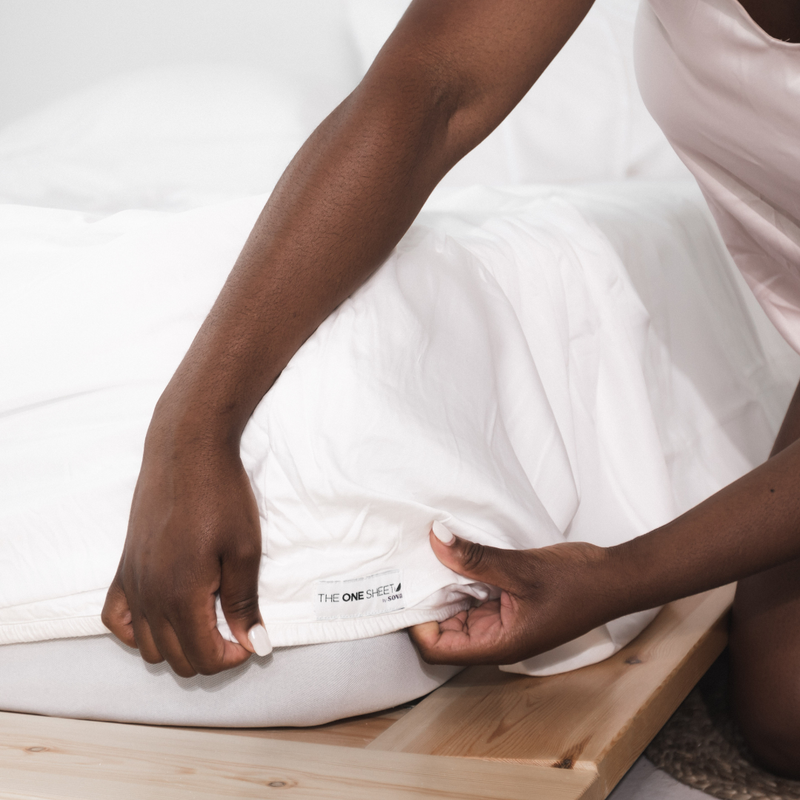
The One Sheet takes a different route. Its top sheet is permanently sewn to the fitted sheet at the foot of the bed, a patented connected design that removes the failure point instead of fighting it. The top sheet cannot slide off, bunch, or get stolen across the bed, because it is structurally anchored. And you do not have to trade comfort for it: The One Sheet is made from organic bamboo viscose, so you get that cool, silky, moisture-wicking feel in a sheet that also stays put. It is OEKO-TEX Standard 100 certified, ships with deep pockets that fit standard, thick, and adjustable mattresses, and comes with a 100-night sleep trial so you can test it on your own bed.
How do you care for bamboo viscose sheets so they last?
Bamboo viscose rewards a gentle routine. Wash in cold or warm water on a normal or delicate cycle, skip the bleach and fabric softener, and dry on low heat or line dry to keep the fibers smooth and reduce pilling. Washing a connected set is simpler than it sounds: because the top and fitted sheet are joined, there is no second flat sheet to wrestle, and there is no risk of the two pieces twisting around each other in the drum.
The One Sheet ships with a free mesh wash bag in every order for exactly this reason. The connected set goes in the bag and washes as one piece without tangling or snagging on zippers and hooks, which is one of the quiet ways a connected sheet stays looking new longer than a loose two-sheet set.
Key takeaways
- Bamboo viscose sheets feel silky and cool and wick moisture, making them a strong pick for hot sleepers; cotton feels crisp, is low maintenance, and softens with washing.
- "Bamboo sheets" are almost always bamboo viscose, a fiber spun from dissolved bamboo pulp.
- For sensitive skin, the smooth surface of bamboo viscose feels gentler to many people, but OEKO-TEX Standard 100 certification is the more verifiable signal than any "natural" claim.
- Neither fiber is automatically sustainable; organic bamboo viscose with OEKO-TEX Standard 100 and FSC certified materials gives you real checkpoints.
- Thread count matters less than fiber, weave, and certification.
- Material choice does not fix a sheet that slides off the bed; a connected design like The One Sheet removes that failure point.
Frequently asked questions
What is the downside to bamboo viscose sheets?
The main tradeoffs are care and wrinkling. Bamboo viscose prefers gentler washing and low-heat or line drying to prevent pilling, and it creases a little more than a treated cotton. The viscose manufacturing process can also use harsh chemicals if it is not well managed, which is why OEKO-TEX Standard 100 certification on the finished fabric is worth looking for.
What are the healthiest sheets to have on your bed?
The healthiest sheets are ones independently tested for harmful substances and kept clean. Look for OEKO-TEX Standard 100 certification, which screens the finished fabric against more than 1,000 harmful substances, and wash your sheets weekly. Both organic bamboo viscose and organic cotton can meet that bar; the certification matters more than the fiber name.
Are bamboo viscose sheets good for hot flashes?
Many people who deal with hot flashes and night sweats prefer bamboo viscose because it wicks moisture off the skin and feels cool and dry rather than damp. Pair the sheets with a cooler room, since environment temperature drives night sweating more than the sheet alone.
Do bamboo viscose sheets help with eczema?
Some people with eczema report that the smooth, low-friction surface of bamboo viscose irritates sensitive skin less than a coarser fabric. That is a comfort observation, not a medical claim, so if you have a skin condition, choose an OEKO-TEX Standard 100 certified sheet and check with your dermatologist.
What sheets do five-star hotels use?
Most luxury hotels use crisp, long-staple cotton in a percale or sateen weave for that signature hotel-bed feel and because cotton stands up to constant industrial laundering. At home, where you control the wash, silky bamboo viscose is a popular alternative for people who want a cooler, softer feel.
Still deciding? If your real frustration is a top sheet that never stays put no matter how nice the fabric is, that is a design problem, not a fiber problem. See how The One Sheet keeps the whole bed in place, in cool organic bamboo viscose, backed by a 100-night sleep trial.