Quick answer: The best sheets for night sweats are made from breathable, fast-drying natural fibers that pull moisture off your skin and release it quickly, so you are not left lying in a cold, damp sheet. Organic bamboo viscose, cotton percale, linen, and Tencel eucalyptus lyocell all handle heavy sweat far better than microfiber or polyester, which trap it against you. Just as important and almost always ignored: the sheet has to stay put, because a sheet that shifts off during a sweat episode leaves you on the bare, clammy mattress.
Most "best sheets for night sweats" lists are really cooling-sheet roundups aimed at people who simply run warm. Night sweats are a different problem. If you have woken up with your bedding soaked through, you already know the issue is not just temperature. It is the sheer volume of moisture, where it goes, and how fast it clears. This guide starts with what night sweats actually are, then ranks materials by how they move sweat rather than how cool they feel in the store.
What causes night sweats?
Night sweats are episodes of heavy sweating during sleep that soak your sleepwear and bedding, and they happen even when the bedroom is a comfortable temperature. They are not the same as running slightly warm under a thick comforter. According to the Cleveland Clinic, true night sweats are your body producing far more sweat than it needs to regulate temperature, and they have many possible triggers.
The single most common cause is hormonal. During the menopause transition, night sweats and hot flashes are a vasomotor response to fluctuating hormones. Research summarized by The Menopause Society and a systematic review in the Journal of the American Board of Family Medicine puts the prevalence high: up to about 80 percent of women experience hot flashes and night sweats during the menopause transition, and these symptoms last a mean of roughly 7 to 10 years. Perimenopause often brings them on years before menopause itself.
Hormones are not the only cause. The Cleveland Clinic lists anxiety and stress, certain medications (including some antidepressants), infections, low blood sugar, alcohol, and hyperhidrosis among the triggers. The American Academy of Dermatology defines hyperhidrosis as sweating beyond what the body needs for temperature regulation, which can mean drenched sheets with no hormonal cause at all. If your night sweats are new, severe, or come with other symptoms, that is worth a conversation with a doctor. The right bedding manages the symptom. It does not treat the cause.
Why do your sheets make night sweats worse?
Your sheets can turn a manageable warm night into a soaked one because of how the fabric handles moisture and heat. To fall asleep, your core body temperature has to drop. Sleep researchers have found that core temperature falls by roughly 1 to 2 degrees Fahrenheit in the evening to trigger sleep onset, and it stays low through the night to protect deep sleep. A sheet that traps heat and holds sweat against your skin works directly against that drop.
Here is the part the cooling-sheet roundups miss. A sheet can feel cool to the touch and still be terrible for night sweats. Cool-to-the-touch is a surface sensation. What matters during a sweat episode is whether the fabric moves the moisture away and dries quickly, or holds it as a cold, wet film. Once a sheet is saturated and cannot dry, it goes clammy, your skin cannot cool by evaporation, and you wake up. That wet-then-cold cycle is what jolts people awake at 3 a.m., not the heat alone.
Fiber choice decides how much water a fabric can absorb and release. Polyester holds only about 0.4 percent of its weight in moisture, and cotton holds around 7 percent. That gap is why a polyester or microfiber sheet leaves sweat sitting on your skin while a natural-fiber sheet pulls it in and lets it evaporate. For night sweats specifically, absorbency plus fast dry-back matters more than any "cooling" marketing on the package.

What should you look for in sheets for night sweats?
For night sweats, judge a sheet on four things: the fiber, the weave, the weight, and, the one nobody mentions, the fit.
Fiber sets the ceiling. Natural and plant-based fibers (organic bamboo viscose, cotton, linen, Tencel eucalyptus lyocell) absorb and release moisture. Synthetics (polyester, microfiber, nylon) mostly do not. Weave sets the airflow. A percale weave is crisp and breathable with lots of air moving through it. A dense sateen or a high thread count above roughly 400 packs the yarns tighter and traps more heat, which is the opposite of what a night-sweat sufferer wants. Weight, measured in thread count or GSM, matters too. Lighter sheets dry faster, and flannel or jersey knit, while cozy, hold heat and moisture.
Then there is fit, which every cooling roundup ignores and which is decisive during a sweat episode. If your sheet slides, bunches, or pops off the mattress corner while you are damp and moving, you end up pressed against the bare mattress or a wet, wadded pile of fabric. A breathable sheet only helps if it is actually against you and flat when you need it. More on that below.
Which sheet materials are best for night sweats?
Here is how the common sheet materials handle heavy sweat, ranked by how well they move and release moisture rather than by how cool they feel for the first minute.
| Material | How it handles night-sweat moisture | Best for |
|---|---|---|
| Organic bamboo viscose | Highly absorbent and breathable, with a smooth drape that does not cling when damp; wicks moisture and dries faster than cotton | Heavy sweaters who want soft plus fast dry-back |
| Cotton percale | Crisp, matte, very breathable; absorbs well (around 7 percent moisture regain) but dries slower than bamboo viscose or linen | Sweaters who like a cool, crisp hotel feel |
| Linen | Extremely breathable with a loose weave and high airflow; absorbs a lot of moisture and dries quickly; textured, not silky | Hot, heavy sweaters who do not mind a rustic hand |
| Tencel eucalyptus lyocell | Smooth and moisture-wicking, dries quickly; performance-fabric feel from a plant fiber | Sweaters who want silky plus quick-dry |
| Microfiber / polyester | Holds about 0.4 percent moisture, so sweat sits as a film; low airflow, cheap and durable but clammy when wet | Not recommended for night sweats |
| Flannel / jersey knit | Cozy and warm; traps heat and holds moisture | Cold sleepers, not sweaters |
The through-line: plant and natural fibers manage a sweat episode. Synthetics survive the laundry but leave the moisture on you. Bamboo viscose earns the top spot here because it pairs a soft, non-clingy hand with genuine absorbency and quicker dry-back than cotton, which is exactly the combination a night-sweat sufferer needs. If you want to go deeper on how the fabric behaves, see our guides on whether bamboo viscose is cooling and bamboo viscose versus cotton.
What sheet materials should you avoid for night sweats?
Avoid microfiber, polyester, and other synthetics if you get night sweats. They hold almost no moisture (polyester about 0.4 percent), so sweat pools on your skin as a film instead of being absorbed and evaporated, and their tight synthetic weave restricts airflow. They are cheap and hard-wearing, which is why they fill the "cooling sheets" category on marketplaces, but wet synthetic against skin is precisely the clammy sensation that wakes you up.
Also skip flannel, jersey knit, and heavy sateen or very high thread counts if sweat is your issue. Flannel and jersey are built to trap warmth. A dense sateen or a thread count much above 400 packs the weave tight and holds heat. Warm and cozy is the wrong goal when the problem is that you are already too warm and too wet.
The fit problem night-sweat sufferers overlook
Every roundup argues about fabric. Almost none talk about what happens to the sheet while you are actually sweating and moving. During a night-sweat episode you toss, kick, and reposition, and a standard flat sheet slides around, bunches, and ends up on the floor. A fitted sheet can pop off a corner at the same time, which leaves you sweating directly onto the bare mattress.
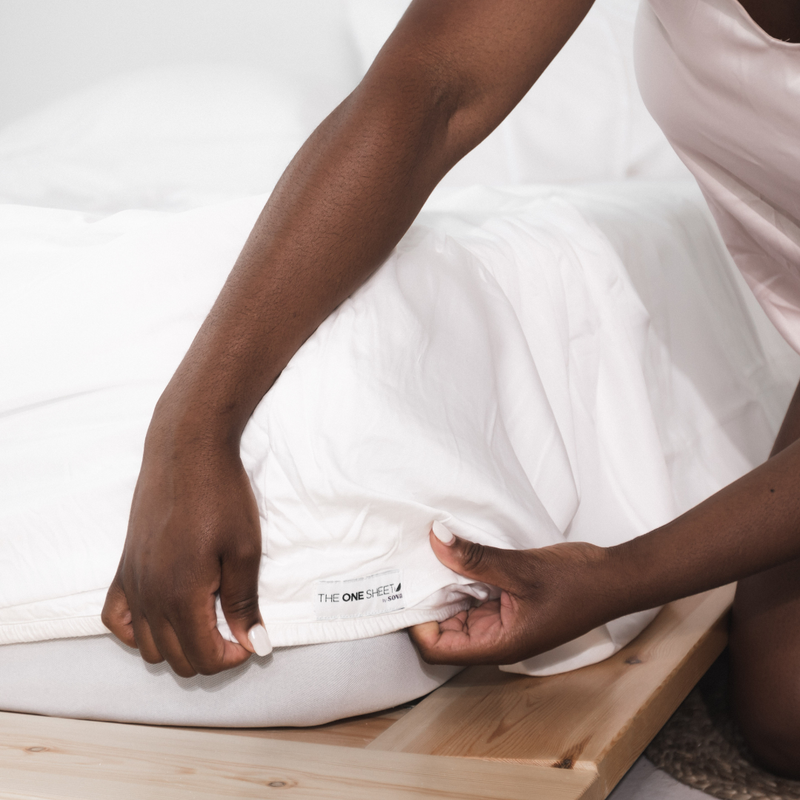
That corner pop-off is usually a seating problem before it is a sheet problem. Most people pull the fitted-sheet pocket straight down over the tip of the mattress corner, tenting it into an upside-down U so the elastic only grips the point. The fix is to seat each corner flat: hook the pocket over the corner and pull it under the mattress so the deep pocket wraps the underside. The second cause is pocket depth. A correctly seated corner still fails if the pocket is too shallow for a deep mattress, so a 15-inch-plus mattress wants pockets in the 16-to-22-inch range. Clips, suspenders, and grippers can help, but they are ongoing symptom management. They fight the problem rather than remove it.
This is where the design of The One Sheet is genuinely relevant to night sweats. The One Sheet is a connected system: the top sheet is permanently sewn to the fitted sheet at the foot of the bed, so the layer you sweat into cannot shift off, bunch to one side, or leave you on the bare mattress in the middle of an episode. It is made from breathable organic bamboo viscose, which brings the absorbency and quicker dry-back that matter most for heavy sweat, and its deep pockets fit thick and adjustable mattresses. The fabric is OEKO-TEX Standard 100 certified and made with FSC certified materials, and every set comes with a 100-night sleep trial. The point is not that a sheet cures night sweats. It is that a breathable sheet only helps when it stays put and stays against you.
How do you keep night sweats from soaking your bed?
You can cut how much a night sweat disrupts your sleep with a simple, repeatable routine. None of it treats the underlying cause, but together these steps keep the moisture moving and give you a faster reset.
- Set the room cooler. Aim for a bedroom around the mid-60s Fahrenheit so your core temperature can make its natural evening drop.
- Sleep on breathable, fast-drying natural sheets. Choose organic bamboo viscose, cotton percale, linen, or Tencel over microfiber or polyester.
- Wear moisture-wicking, loose sleepwear, or sleep light. Heavy synthetic pajamas trap sweat the same way synthetic sheets do.
- Layer your bedding so you can shed. A light top layer you can throw off beats one heavy comforter you cannot adjust mid-night.
- Wash your sheets often, and keep a dry spare set within reach for a fast 3 a.m. change.
That last step is a real chore for anyone with night sweats, because you are laundering bedding constantly. It is also where a connected sheet quietly helps. Because the top and fitted sheets of The One Sheet are one piece, the whole set goes into the free mesh wash bag that ships with every order and washes as a single piece, so there is no separate flat sheet to tangle, knot, or lose in the machine. Frequent washing is easier when it is one item in a bag instead of a pile of separates.
Key takeaways
- Night sweats are heavy sweating during sleep, most often driven by hormones (up to about 80 percent of women during the menopause transition, per The Menopause Society), and also by stress, medications, infections, and hyperhidrosis.
- Cool-to-the-touch is not the same as dry. For night sweats, prioritize fabrics that absorb and release moisture fast.
- Best materials: organic bamboo viscose, cotton percale, linen, and Tencel eucalyptus lyocell. Bamboo viscose leads for soft plus quick dry-back.
- Avoid microfiber and polyester (they hold about 0.4 percent moisture versus roughly 7 percent for cotton), plus flannel, jersey, and very high thread counts.
- Fit matters as much as fabric: a sheet that shifts or pops off leaves you on the bare mattress mid-episode. Seat fitted corners flat and use deep enough pockets.
- The One Sheet keeps the breathable layer anchored (connected design), uses organic bamboo viscose, fits deep mattresses, and washes as one piece in its free mesh wash bag.
Frequently asked questions
Do bamboo sheets really help with night sweats?
Bamboo viscose sheets help with night sweats because the fiber is breathable and absorbent and dries faster than cotton, so it moves sweat off your skin and releases it instead of holding it as a damp film. It will not stop the sweating itself, but it manages the moisture better than synthetics like microfiber or polyester.
How do I stop sweating through my sheets at night?
To stop sweating through your sheets, cool the bedroom to the mid-60s Fahrenheit, switch to breathable natural sheets such as organic bamboo viscose, linen, or cotton percale, wear loose moisture-wicking sleepwear, and layer bedding so you can shed it. Keeping a dry spare set nearby makes a middle-of-the-night change fast.
What is the best material to stop night sweats?
The best sheet materials for night sweats are breathable, fast-drying natural fibers: organic bamboo viscose, linen, cotton percale, and Tencel eucalyptus lyocell. These absorb sweat and dry quickly, unlike microfiber and polyester, which trap moisture against your skin.
Are bamboo sheets or cotton better for night sweats?
Both are far better than synthetics, but bamboo viscose typically has an edge for night sweats because it is highly absorbent and dries faster than cotton while feeling smooth and non-clingy when damp. Cotton percale is a strong crisp-feeling alternative that breathes very well but dries a little slower.
Can the right sheets help with menopause night sweats?
The right sheets can make menopause night sweats easier to live with by moving moisture off your skin and drying quickly, which shortens the wet-then-cold spell that wakes you up. Breathable organic bamboo viscose is a common choice. Sheets manage the symptom, so pair them with medical guidance if hot flashes and night sweats are disrupting your sleep.
If you sweat at night because you simply sleep hot rather than from a medical cause, our companion guide on the best sheets for sweaty sleepers covers the general cooling side in more detail.
If night sweats keep leaving you in a damp, shifted sheet, The One Sheet gives you a breathable organic bamboo viscose layer that stays anchored where you need it, all night, backed by a 100-night sleep trial.