Quick answer: The best sheets that stay on the bed combine three things: deep elastic pockets sized 2 to 3 inches deeper than your mattress, elastic that wraps all the way around (not just the corners), and a fabric with enough grip to resist sliding. The most reliable option removes the failure point entirely: a connected sheet system, where the top sheet is sewn to the fitted sheet so it physically cannot shift, bunch, or get kicked off.
If you searched for the best sheets that stay on the bed, you have probably already tried the usual fixes and watched them fail by morning. The frustrating part is that most "best sheets" roundups rank picks on softness and cooling, then barely mention whether the sheet actually stays put. This guide does the opposite. Below is what genuinely keeps sheets on the mattress, the five things to check before you buy, the types of stay-put sheets ranked by how they solve the problem, and an honest look at whether clips and grippers are worth it.
What makes sheets stay on the bed?
Before you shop, it helps to know why sheets come off in the first place, because the cause points straight to the fix. There are four factors that decide whether a sheet holds, and they matter in this order.
Corner seating technique comes first. The single most common reason a fitted sheet pops off is not the sheet, it is how it was put on. People pull the fitted sheet pocket straight down over the corner tip, which tents the fabric into an upside-down U so the elastic only grips the very point of the mattress. The fix is to seat each corner flat: hook the pocket over the corner and pull it down and under so the deep pocket wraps the underside of the mattress. A correctly seated corner grips the mattress from below, where gravity and your body weight help hold it. Get this right and a surprising number of "bad" sheets suddenly behave.
Pocket depth is the second cause. Even a perfectly seated corner will fail if the pocket is too shallow to reach under a thick mattress. Industry sizing guides put it simply: standard fitted sheets fit mattresses up to about 12 inches, deep-pocket sheets fit up to 15 inches, and extra-deep pockets handle 16 to 22 inches. A widely repeated rule from bedding retailers is to choose a pocket 2 to 3 inches deeper than your mattress is tall. So a 15-inch mattress wants a 17 to 18 inch pocket. Pillow-top and hybrid mattresses are taller than people expect, which is why so many off-the-shelf sheets ride up the sides and let go.
Elastic placement is the third factor. Sheets with elastic that runs the full way around the perimeter hold far better than sheets with elastic only at the four corners. Full 360-degree elastic keeps tension along every edge, so the sheet cannot creep up one side during the night. When you read a product page, look for "all-around elastic" or "elastic all around," not just "elasticized corners."
Fabric grip is the fourth factor. Some fabrics simply slide more than others. Bedsure's own care guide describes the tell: if the same corner keeps popping, it is a fit or elastic issue, but if the whole sheet shifts and bunches toward the middle without the corners letting go, the problem is friction. That happens when the fabric is too slippery or the mattress protector underneath is too smooth. Cotton and cotton blends grip better than slick microfiber or satin finishes, and a textured surface under the fitted sheet adds friction that helps everything stay put.
The 5 things that decide whether sheets stay put
Use this checklist to judge any sheet before you buy. The best sheets that stay on the bed score well on all five.
| What to check | What to look for | Why it matters |
|---|---|---|
| Pocket depth | 2 to 3 inches deeper than your mattress height | A pocket too shallow rides up and lets go at the corners |
| Elastic style | All-around (360-degree) elastic, not corner-only | Keeps even tension on every edge through the night |
| Fabric grip | Cotton, cotton blend, or bamboo viscose over slick microfiber | Lower-friction fabrics slide and bunch toward the middle |
| Mattress fit | Sized for standard, deep, or adjustable as needed | Adjustable and thick mattresses need deeper, stretchier pockets |
| The top sheet | A connected design, or a plan to keep it from migrating | The top sheet is the layer that shifts most and steals covers |
Notice the last row. Almost every guide stops at the fitted sheet and forgets the top sheet, which is the layer that actually does the most wandering. A top sheet that twists, balls up, and slides off the bed is its own nightly problem, and no amount of corner-seating fixes it.
The best types of sheets that stay on the bed, ranked by how they solve it
There is no single brand that is "best" for everyone, but there are clearly better and worse approaches to the staying-on problem. Here they are, ordered from the most complete solution to the most piecemeal.
1. Connected sheet systems (the top sheet cannot move)
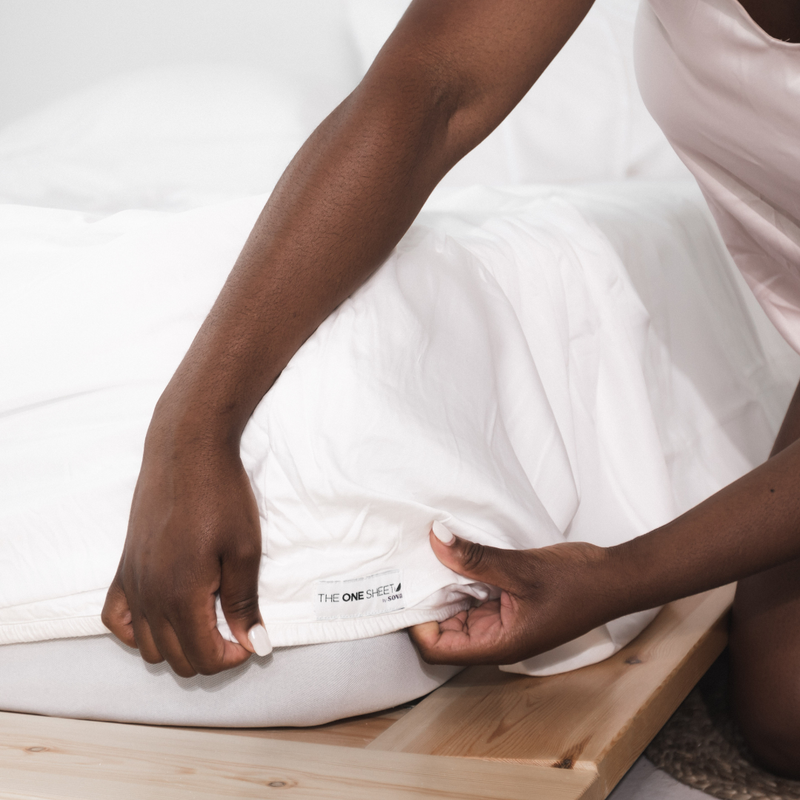
A connected sheet system attacks the problem at the root. Instead of trying to make a loose top sheet behave, the top sheet is permanently sewn to the fitted sheet at the foot of the bed, so it physically cannot shift, bunch to one side, get kicked onto the floor, or be stolen by a partner. The One Sheet by Sova is built this way, with two utility patents on the connected design. You still get a normal fitted sheet with deep pockets for the mattress, but the top sheet is no longer a free piece of fabric waiting to migrate. This is the only approach on the list that removes the failure point rather than managing it.
2. All-around-elastic, deep-pocket fitted sheets
The best conventional fitted sheets use 360-degree elastic and deep, reinforced pockets. They will not solve a wandering top sheet, but for the fitted layer alone they hold well, especially if you match the pocket depth to your mattress and seat the corners properly. This is the baseline upgrade from cheap corner-only sheets.
3. Anti-shift "stay on" fitted sheets
Some brands engineer fitted sheets specifically to stay on tall and adjustable mattresses, with extra-stretchy fabric and deep pockets rated to 15 inches or more. One Bed's Stay On Fitted Sheets are a well-known example in this category. They are a solid fitted-sheet fix, but like all fitted-only products, they leave the top sheet unaddressed.
4. Zip-on systems
A zip-on system, like QuickZip, uses a permanent fitted base with a top layer that zips on and off. This makes changing the bed faster and keeps the base anchored, which helps the fitted layer stay put. It is a clever structural answer for the bottom sheet, though it adds hardware and still treats the top sheet separately.
5. Standard sheets plus gripper accessories
The most piecemeal route is a regular sheet set held down with clips, suspenders, straps, or corner bands, the approach brands like DreamFit lean into with no-slip bands. These can work, but they are managing a symptom rather than fixing the cause, and you have to keep buying, attaching, and re-attaching them. More on that below.

Why does my fitted sheet keep coming off?
A fitted sheet keeps coming off for one of two reasons, and which one it is tells you exactly what to do. If the same corner pops off again and again, you have a fit or seating problem: the pocket is either too shallow for your mattress or it was pulled over the corner tip instead of seated flat underneath. If the whole sheet slides and bunches toward the middle of the bed while the corners hold, you have a friction problem from slippery fabric or a too-smooth mattress protector. The first is solved with a deeper pocket and better corner technique. The second is solved with a grippier fabric or a textured layer underneath.
Do clips, suspenders, and grippers actually work?
Sheet clips, suspenders, straps, and corner grippers do work, in the narrow sense that they add tension and can keep a corner down for a while. But they are honest only as ongoing symptom management, not a cure. You are adding hardware to fight a sheet that was not built to stay put, and you have to reattach them every time you wash and remake the bed. They also do nothing for the top sheet, which is usually the bigger culprit. If you have a sheet you otherwise love, a set of grippers is a reasonable patch. If you are buying new sheets anyway, it makes more sense to choose a design that stays put on its own.
The sheets that physically cannot shift
If the goal is sheets that genuinely stay on the bed without nightly babysitting, the most direct answer is a design where shifting is structurally impossible. The One Sheet by Sova is a connected sheet system: the top sheet is sewn to the fitted sheet at the foot of the bed, so the top sheet cannot bunch, twist off to one side, slide onto the floor, or get stolen by the person next to you. The fitted layer still has deep pockets that fit standard, thick, and adjustable mattresses, so it handles the corner-pop problem too.
It is made from organic bamboo viscose, which is soft and breathable with enough grip to resist the slide that slick microfiber sheets are prone to. The fabric is OEKO-TEX Standard 100 certified and made with FSC certified materials, and every set comes with a 100-night sleep trial so you can test it on your own bed through real laundry cycles before deciding.
There is a practical care detail that matters for longevity, too. Because the sheets are connected, washing them is where a lot of people expect a tangle. The One Sheet ships with a free mesh wash bag with every order, and the connected set goes in as one piece so it washes and dries without wrapping around itself or other laundry. Sheets that stay neat in the wash hold their fit longer, which is part of staying on the bed for the long run.
How to make any sheets stay on better tonight
Even before new sheets arrive, you can improve almost any set with a few minutes of technique. Follow these steps.
- Check your pocket depth against your mattress. Measure your mattress height, then confirm the sheet's pocket is at least 2 to 3 inches deeper. If it is not, that set will always struggle.
- Seat the corners flat, not over the tip. Hook each pocket over the mattress corner and pull it down and under so the deep pocket wraps the underside, rather than tenting over the point.
- Add friction underneath. A textured mattress protector or pad under a slick sheet gives the fabric something to hold onto and stops the mid-bed slide.
- Pull diagonally, then smooth. After all four corners are seated, tug gently on opposite diagonal corners to even out tension, then run your hands across the surface to chase out wrinkles.
- Deal with the top sheet directly. If your top sheet migrates every night, tucking it tighter rarely lasts. A connected design is the only fix that keeps it anchored for good.
Key takeaways
- The best sheets that stay on the bed score well on pocket depth, all-around elastic, fabric grip, and the right mattress fit.
- Most fitted-sheet pop-offs come from poor corner seating or a pocket that is too shallow, not from a defective sheet.
- A pocket 2 to 3 inches deeper than your mattress, with full 360-degree elastic, is the conventional sweet spot.
- Clips and grippers manage the symptom but never address the top sheet, which is the layer that wanders most.
- A connected sheet system like The One Sheet removes the failure point entirely by sewing the top sheet to the fitted sheet.
Frequently asked questions
How do I keep my bed sheets from coming off?
To keep bed sheets from coming off, match the fitted sheet's pocket depth to your mattress, seat each corner flat under the mattress instead of over the tip, and add friction underneath with a textured protector if the fabric is slippery. For sheets that stay on without any of that effort, choose a connected design where the top sheet is sewn to the fitted sheet so it cannot shift.
Why do my sheets never stay on my bed?
Sheets usually never stay on the bed for one of two reasons: the pocket is too shallow or seated incorrectly, so the corners pop, or the fabric is too slippery, so the whole sheet slides toward the middle. Identifying which problem you have, corners versus mid-bed sliding, tells you whether you need a deeper pocket or a grippier fabric.
What kind of sheets stay tight on the mattress?
Sheets that stay tight on the mattress have deep pockets sized for your mattress height and elastic that wraps all the way around the edge, not just the corners. Cotton, cotton blends, and bamboo viscose grip better than slick microfiber, and connected sheet systems stay tightest of all because the top sheet is anchored to the fitted sheet.
Are deep-pocket sheets better for staying on?
Deep-pocket sheets are better for staying on if your mattress is thick, because a pocket that reaches well under the mattress grips the underside where it holds best. For a 15-inch mattress, a 17 to 18 inch pocket is the target. A pocket that is too deep for a thin mattress, however, can leave loose fabric that bunches.
Do bamboo viscose sheets stay on the bed?
Bamboo viscose sheets stay on the bed well when they have deep pockets and all-around elastic, because the fabric has more grip than slick microfiber. The One Sheet by Sova uses organic bamboo viscose in a connected design, so both the fitted and top layers stay put.
If you are tired of remaking the bed every morning, The One Sheet was built for exactly this problem. The top sheet is sewn to the fitted sheet, the pockets are deep enough for thick and adjustable mattresses, and the 100-night sleep trial lets you find out on your own bed whether sheets that simply stay put change how your mornings feel.