Quick answer: A fitted sheet pops off an adjustable bed for two reasons: the corner is seated wrong (the pocket is tented straight down over the corner tip instead of hooked flat under the mattress), and the pocket is too shallow for how far the base flexes. Seat each corner flat and wrapped under the mattress, use sheets with pockets at least 2 to 4 inches deeper than your mattress, and raise the head and foot before you make the bed. Straps, bands, and clips manage the symptom. A connected sheet system removes the failure point entirely.
An adjustable base is supposed to make sleep easier. Then you raise the head, the mattress flexes, and by morning the fitted sheet has crept off two corners and balled up under your knees. It feels like the sheet is defective. Usually it is not. The way the corner is put on, and the depth of the pocket, are doing almost all of the damage. This guide fixes both, in the order that actually matters, and covers the anchoring gadgets honestly so you know which ones are worth it.
Why won't my sheets stay on my adjustable bed?
Sheets stay on an adjustable bed the same way they stay on any bed, by gripping the underside of the mattress. An adjustable base just tests that grip harder. Every time the head or foot lifts, the mattress bends and its corners change shape, tugging on the sheet. A grip that was only borderline on a flat bed gets broken loose a little more with every position change until the corner lets go.
Two things decide whether the grip holds.
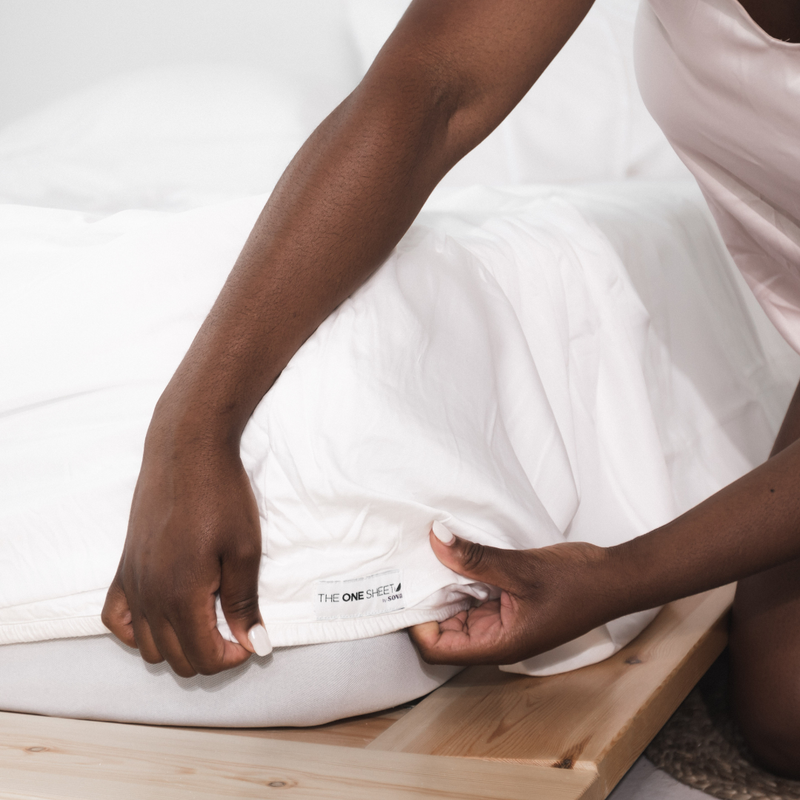
The first is how the corner is seated, and it is the step most people get wrong. When a fitted sheet keeps coming off, the usual cause is that the pocket was pulled straight down over the point of the mattress corner, tenting the elastic into an upside-down U so it only grips the very tip. That is a hook waiting to slip. On an adjustable base, the flexing pops it off in a night or two. The fix is to seat the corner flat, hooking the pocket around the corner and pulling it well under the mattress so the deep pocket wraps the underside.
The second is pocket depth. A correctly seated corner still fails if the pocket is too shallow to reach under a deep or flexing mattress. Adjustable-bed mattresses are often thick, and the base's movement effectively demands even more reach. If the pocket barely covers the side, there is nothing gripping the underside to lose in the first place.
Straps, bands, and clips come after those two. They add outside tension to hold a marginal grip in place, which is why they help. They also do not fix the underlying cause, which is why you keep re-doing them.
First, seat every corner flat (the step most people skip)
Before you buy anything, re-make the bed correctly. This alone solves a surprising share of adjustable-bed sheet trouble.
- Find a short end of the fitted sheet and identify the deeper pocket corners (some sheets label them).
- Hook the first corner over the mattress corner so the seam sits at the edge, not stretched down the point.
- Pull the pocket down and then well under the mattress, so the elastic and extra fabric wrap the underside rather than clinging to the tip.
- Repeat diagonally to the opposite corner, then the remaining two, smoothing the elastic under the mattress each time.
- Run your hand around the underside edge. If you can feel firm fabric gripping the bottom of the mattress on all four sides, the sheet is seated. If it feels like it is only holding the side, pull more fabric under.
Seated this way, the grip comes from the underside of the mattress, which is exactly where the base's flexing cannot easily peel it off.
Get the pocket depth right for your mattress
Standard fitted sheets are built for mattresses up to roughly 12 to 14 inches. Deep-pocket sheets generally run 15 to 22 inches, and extra-deep options go further for very thick builds. A simple rule from sheet-sizing guides: subtract about 2 inches from the stated pocket depth to find the tallest mattress it fits well. So a 16-inch pocket suits a mattress around 14 inches or less.
For an adjustable bed, size up rather than down. You want a few inches of pocket to spare so fabric still wraps the underside when the base bends. Measure your mattress height first (include any topper), then match it to the pocket you need.
| Mattress height (with topper) | Pocket depth to buy | Why |
|---|---|---|
| Up to 12 in | Standard, 12 to 14 in | Enough reach to wrap the underside |
| 12 to 15 in | Deep pocket, 15 to 18 in | Covers the side and grips the bottom with margin |
| 15 to 18 in | Deep pocket, 18 to 20 in | Thick or hybrid mattresses on a flexing base |
| 18 in and up | Extra deep, 20 to 22 in+ | Pillow-top or stacked topper builds |
If your sheet is already deep enough and still slips, the problem is almost always the seating step above, not the size.

How to put sheets on an adjustable bed, step by step
Making the bed while it is flat is the hard way. Let the base do the work.
- Use the remote to raise the head of the bed. Raising the foot too gives you easy access to all four corners without lifting a heavy mattress.
- Start at the head. Hook the fitted sheet's short end over the two head corners and smooth it down.
- Move to the foot and pull the sheet over those corners, seating each one flat and under the mattress as described above.
- Press the flat button and let the base lower. As it flattens, it pulls the sheet taut across the mattress on its own.
- Add the top sheet or bedding last, tucking the sides if you use a separate flat sheet.
That flatten-to-tighten trick is the single most useful adjustable-bed habit, and it is why many people find sheets actually easier to fit on an adjustable base than on a fixed frame.
Split king? You need the right sheet setup
A split king (two Twin XL mattresses on a base that lifts each side independently) is the setup where a single king fitted sheet fails no matter how well you seat it. When one side rises and the other stays down, a shared fitted sheet gets stretched across the gap, bunches, and pops. The mattresses move independently, so the sheets have to as well.
The standard fix is two Twin XL fitted sheets, one per mattress, plus a king flat sheet to share on top if you like. Dress each side separately using the raise-and-flatten steps above. If you want the two halves to feel like one bed, a king flat sheet or a duvet laid over both bridges the gap visually while each fitted sheet stays free to flex.
The anchors that help, and their honest limits
If seating and depth are handled and you still want extra insurance, these tools add tension from the outside. They work. None of them removes the reason the sheet wanted to move.
- Sheet suspenders and straps. Elastic straps that clip to the sheet corners and run under the mattress, pulling the corners tight, sometimes diagonally. Effective and cheap. You re-clip them every time you wash the sheets, and a clip can pop loose.
- 360-degree bands. A single elastic loop, like a Bed Scrunchie, that cinches the whole perimeter under the mattress for a drum-tight fit. Strong hold, a bit more fiddly to install and re-install on laundry day.
- Corner grippers and clips. Small clips that grab the sheet at or near the corners. The lightest-touch option and the easiest to add, and also the easiest to slip under a flexing base.
Think of all three as ongoing management. They are a reasonable choice if your mattress and sheets are otherwise fine and you just want to stop babysitting the corners. They are an extra step on every bed change, which is the trade you are accepting.
The setup that removes the failure point
Every fix above fights the same underlying design: a top sheet and a fitted sheet that are separate pieces, each free to shift, on a base built to move. The One Sheet takes the failure point out instead of managing it. The top sheet is permanently sewn to the fitted sheet at the foot of the bed, a patented connected design, so the top sheet cannot slide up, bunch, or get kicked to the floor, and there is no loose top-sheet edge to re-tuck after the base moves.
For the fitted layer, The One Sheet is made from organic bamboo viscose and built with deep pockets that fit standard, thick, and adjustable-bed mattresses, so the corners actually reach the underside where the grip needs to be. It is breathable for warmer sleepers, OEKO-TEX Standard 100 certified, and made with FSC certified materials. On an adjustable base that raises and lowers as one piece, a connected set is the closest thing to a permanent answer to the shifting-sheet problem. If you sleep on a split king with two independently moving mattresses, dress each side with its own set so each can flex freely.
One practical note for the long haul: because the top and fitted sheets are joined, they wash as a single connected piece, and every order ships with a free mesh wash bag so the set launders without tangling or wrapping around other items. Fewer pieces to keep track of, and nothing to re-pair coming out of the dryer.
You also get a 100-night sleep trial to test it on your own bed, in your own positions, before you commit.
Key takeaways
- The two real causes of a fitted sheet popping off an adjustable bed are a corner seated over the tip instead of flat, and a pocket too shallow to grip the underside.
- Seat every corner by wrapping the pocket well under the mattress, then check the underside grip on all four sides.
- Buy pockets 2 to 4 inches deeper than your mattress height, measuring with the topper on.
- Raise the head and foot, seat the corners, then press flat and let the base pull the sheet taut.
- On a split king, use two Twin XL fitted sheets so each independently moving mattress can flex.
- Straps, bands, and clips hold a marginal grip but do not fix the cause. A connected sheet system removes it.
Frequently asked questions
Why won't my sheets stay on my adjustable bed?
Sheets come off an adjustable bed because the base flexes and repeatedly breaks a grip that was already marginal. The two fixable causes are a corner tented over the mattress tip instead of seated flat under the mattress, and a pocket too shallow to wrap the underside. Fix both before reaching for straps.
How do you keep the top sheet tucked in on an adjustable bed?
Tuck the top sheet only at the foot and lower sides, and re-tuck after the base moves, or use a connected sheet system where the top sheet is sewn to the fitted sheet at the foot so it cannot come untucked. A duvet or coverlet with no separate top sheet also sidesteps the problem.
What sheets won't come off an adjustable bed?
Sheets stay put on an adjustable bed when the pocket is deep enough to grip the underside and the fitted layer is anchored. Deep-pocket sheets seated correctly, sheets with a strong all-around elastic band, and connected sheet systems like The One Sheet (top sheet sewn to the fitted sheet) all resist coming off far better than standard-depth sheets.
How deep should sheets be for an adjustable bed?
Measure your mattress height with any topper, then choose a pocket about 2 to 4 inches deeper. Most adjustable-bed mattresses do best with deep-pocket sheets in the 15 to 20 inch range, and pillow-top builds may need 20 to 22 inches or more.
Do you need special sheets for an adjustable bed?
Not necessarily. Most sheets work if the pocket is deep enough and the corners are seated flat under the mattress. Special sheets help when a standard set is too shallow or too loose, when you have a split king that needs two independently sized fitted sheets, or when you want a connected design that cannot untuck.
Sheets that stay put should be the boring part of an adjustable bed, not the nightly chore. Seat the corners, get the depth right, and if you would rather stop managing it altogether, The One Sheet was built to take the shift out of the equation.