Quick answer: To make a bed, work bottom to top: smooth the mattress protector, seat the fitted sheet by hooking each corner under the mattress, lay the top sheet finished-side down, add the blanket or duvet, fold the top sheet back at the head in a clean band, then stack the pillows and add a throw. The whole thing takes about two to five minutes, and the order you work in matters more than how fast you move.
A made bed is the cheapest upgrade in your whole house. It takes about two minutes, it makes the entire room look pulled together, and it greets you at night instead of glaring at you. The order you work in matters more than how fast your hands move, so once you learn the sequence you can hit hotel-housekeeper pace without thinking about it. Here is the full method, the under-three-minute version, the two steps almost everyone gets wrong, and the styling tricks that make a homemade bed look like the one in the catalog.
What you need before you start
Gather everything before you touch the mattress so you are not walking back to the linen closet mid-job. A full bed usually layers up like this: a mattress protector or pad, a fitted sheet, a top sheet, a blanket or duvet, two sleeping pillows, and any shams or a throw you add at the end.
There is one small habit worth building first. Pull the covers all the way back and let the bare mattress breathe for 30 to 60 minutes before you remake it. The average person loses around 500 milliliters of moisture a night through sweat and breath, and that warmth and damp is what dust mites like best. Airing the bed out lets that moisture evaporate first. The research here is thin and some allergy experts are skeptical, so treat it as a sensible default rather than a cure, but it costs you nothing and it makes the sheets feel fresher when you do pull them up.
How to make a bed, step by step
Follow these eight steps in order. Each layer sets up the one above it, so the sequence is doing half the work.
- Strip and reset. Pull off yesterday's bedding, glance at the mattress, and smooth the protector flat. A ripple at the bottom telegraphs all the way to the top.
- Smooth the mattress protector or pad. Pull it tight and seat the corners so the surface is even. This is your blank canvas.
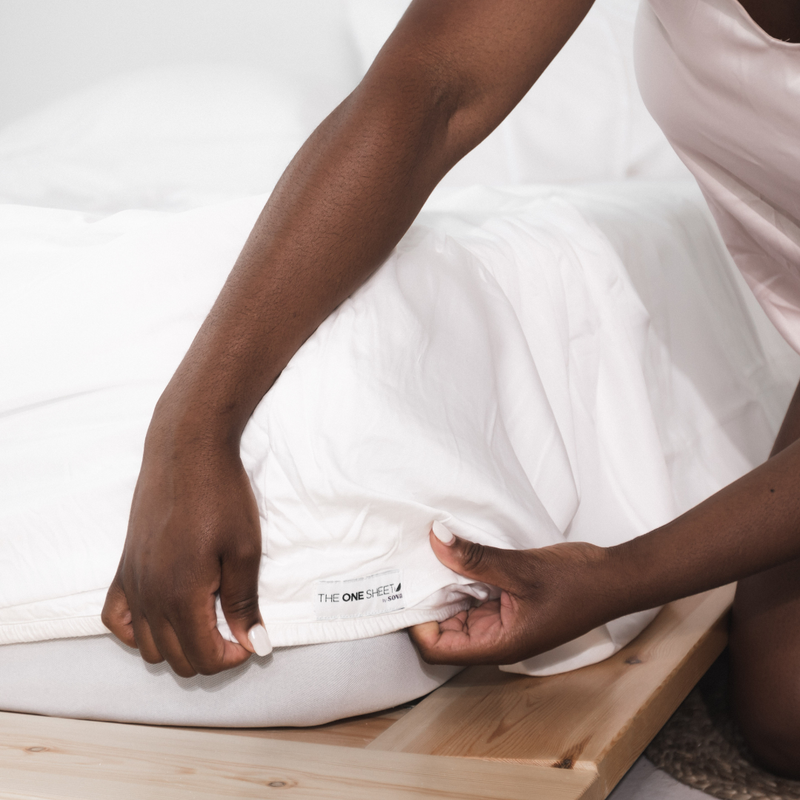
- Seat the fitted sheet corners flat. This is the step that decides whether your bed stays neat, so do it deliberately. Hook the pocket over the corner of the mattress and pull it down and under so the deep pocket wraps the underside, not just the tip. Do all four corners, then run your hands across the surface to chase out wrinkles.
- Align the top sheet. Lay the top sheet finished-side down so the hem shows when you fold it back. Center it left to right, hang it evenly on both sides, and line the top edge up with the head of the mattress.
- Layer the blanket or duvet. Add your blanket, quilt, or duvet on top, centered, and pull it down about 6 to 12 inches from the head of the bed so the top sheet peeks out above it.
- Fold back the top sheet at the head. Fold the top sheet (and the blanket, if you like) back toward the foot in a clean horizontal band near the pillows. This single cuff is what makes a bed read as "made" rather than just covered, and it keeps the blanket off your face.
- Tuck the sides (optional). For a crisp, hotel look, tuck the top sheet and blanket under the sides and foot with hospital corners. For a softer, lived-in look, leave them loose.
- Stack and style the pillows. Stand your sleeping pillows against the headboard, then layer any shams and throw pillows in front, largest to smallest. Finish with a folded throw across the bottom third of the bed.
Here is how the layers stack, bottom to top, so you can see the logic at a glance:
| Layer | What it is | Why it goes here |
|---|---|---|
| 1. Base | Mattress protector or pad | Protects the mattress and smooths the surface |
| 2. Fitted sheet | The bottom sheet with elastic corners | Grips the mattress; corner seating decides neatness |
| 3. Top sheet | Flat sheet, finished-side down | The layer against your skin; folds back into the cuff |
| 4. Blanket or duvet | Your main warmth layer | Sits below the top sheet's fold-back |
| 5. Pillows | Sleeping pillows, then shams | Built largest at the back to smallest in front |
| 6. Throw | Folded blanket across the foot | The finishing detail that adds texture |

The under-three-minute version
On a busy morning you do not need all eight steps. Pull the fitted sheet corners tight, snap the top sheet and blanket up together in one motion and fold the cuff back at the head, then karate-chop the pillows into place and stand them up. Skip the throw and the shams. The two moves that carry a quick-make bed are the fold-back cuff and upright pillows, because the eye reads both as "finished" even when the sides are loose.
The two steps almost everyone gets wrong
Most bed-making guides hand you the same eight steps and move on. But two of those steps quietly cause almost all the frustration, and they are worth slowing down for.
Why your fitted sheet corner keeps popping off
When a fitted sheet pops off in the night, people blame the sheet. Usually it is the technique. The common mistake is pulling the pocket straight down over the tip of the mattress, which tents the fabric into an upside-down U so the elastic only grips the corner point. The fix is to seat each corner flat: hook the pocket over the corner and pull it under the mattress so the deep pocket grabs the underside, where the weight of the mattress holds it.
Depth is the second cause. A correctly seated corner still fails if the pocket is too shallow to reach under a thick mattress. A mattress 15 inches or taller usually needs a 16 to 22 inch pocket, so check the pocket depth before you blame yourself.
Why the top sheet never stays put
The top sheet is the layer that ruins the morning. It twists, bunches, slides toward one side, and migrates to whoever does not hog the covers. You can tuck it tight with hospital corners and it will still work loose by 2 a.m., because a flat sheet has nothing holding it in place except friction and tucking.
This is where it helps to know that the most failure-prone parts of bed-making are structural, not personal. A loose top sheet and a popped corner are problems traditional bedding creates and then asks you to manage every single morning.
A bed that mostly makes itself
This is the problem The One Sheet by Sova was built to remove. The One Sheet is a connected sheet system: the top sheet is permanently sewn to the fitted sheet at the foot of the bed, so there is no loose flat sheet to wrestle, no cuff to re-fold, and nothing to twist, bunch, or slide off your partner's side. Two of those failure points, the top sheet and the daily re-tuck, simply stop existing. Making the bed becomes pulling one connected piece up and smoothing it.
It is made from organic bamboo viscose, which is soft and breathable for people who run warm, and the deep pockets are built to fit standard, thick, and adjustable mattresses, so the corner-seating problem above gets easier too. It is OEKO-TEX Standard 100 certified, ships with a 100-night sleep trial, and comes in White, Olive Green, Light Blue, Steel Gray, and Gingham. None of that replaces good technique, but it removes the two steps that were never really yours to fix.
How to make your bed look like a hotel
Once the function is handled, a few styling moves do the rest:
- Steam or smooth the wrinkles. A quick pass with a handheld steamer, or just firm hands on the duvet, reads as expensive. Wrinkles read as rushed.
- Use the fold-back cuff. Folding the top sheet back over the blanket is the single most "hotel" move you can make, and it costs nothing.
- Layer pillows largest to smallest. Sleeping pillows stand at the back, shams in front of them, decorative pillows last. Odd numbers tend to look more deliberate than even.
- Add one throw. A single folded throw across the bottom third adds texture and finishes the frame. More than one starts to look cluttered.
- Mind the overhang. Let the blanket hang evenly on both sides. Uneven drape is what makes a bed look homemade.
Keeping it made (and keeping it fresh)
A made bed only stays nice if the sheets behave between washes, and that comes back to how they are built and how you care for them. With a connected set there is no top sheet to re-tuck, so "making it" each morning is one motion, and there is no cover-stealing to undo.
Care matters too. The One Sheet ships with a free mesh wash bag in every order, and because the top and fitted sheet are sewn together, the whole set washes as one piece inside the bag without tangling around your other laundry or wrapping the agitator. Wash on a gentle cycle, skip the fabric softener, and tumble dry low. Sheets you wash and remake every week last longer when they are not getting beaten up in the machine.
Key takeaways
- Work in order, bottom layer to top. The sequence does half the work of making a neat bed.
- Air the bare mattress out for 30 to 60 minutes before remaking it to let overnight moisture evaporate.
- Seat fitted sheet corners flat and under the mattress, not tented over the tip, and match pocket depth to your mattress height.
- The fold-back cuff and upright pillows are the two moves that make any bed look finished, even a quick one.
- The top sheet and the daily re-tuck are the steps most likely to fail. A connected design like The One Sheet removes them instead of managing them.
Frequently asked questions
What is the correct order to make a bed?
The correct order to make a bed is protector or pad first, then the fitted sheet, then the top sheet finished-side down, then the blanket or duvet, then the fold-back cuff at the head, and pillows and a throw last. Working bottom to top keeps each layer smooth.
How do hotels make beds look so crisp?
Hotels get a crisp bed mostly from technique, not luxury linens. They smooth out every wrinkle, tuck the sides with hospital corners, fold the top sheet back over the blanket in a clean band, and stand the pillows upright. The fold-back cuff and wrinkle-free surface do most of the visual work.
Should I tuck in the top sheet or leave it loose?
Tuck the top sheet for a crisp, hotel-style look, or leave it loose for a softer, lived-in feel. Either is correct. If your top sheet works loose every night no matter how you tuck it, that is the flat sheet itself, not your tucking.
How long should it take to make a bed?
A full, styled bed takes about two to five minutes once you know the sequence, and a quick daily make takes under three. Speed comes from the order you work in, not from rushing.
Why does my fitted sheet keep coming off when I make the bed?
A fitted sheet usually pops off because the pocket was pulled straight down over the corner tip instead of seated flat under the mattress, or because the pocket is too shallow for a thick mattress. Seat each corner under the mattress and match the pocket depth to your mattress height to fix it.