Quick answer: To stop stealing the covers, fix the bed instead of blaming the sleeper. Size your top layer up (a king comforter on a queen bed), give each partner their own duvet using the Scandinavian sleep method, or anchor the layer that travels most, the top sheet. Cover-stealing is a byproduct of the 10 to 30 position changes the average adult makes each night, so structural fixes work where willpower fails.
Nobody plans to steal the covers. One of you falls asleep fair and square, and by 3 a.m. the other is curled up like a shrimp with six inches of sheet and a grudge. If this is a nightly event in your house, the good news is that cover-stealing is one of the most fixable sleep problems a couple can have. The bad news is that most of the standard advice treats the symptom, not the cause.
This guide covers why blanket theft happens, the five fixes that actually hold up night after night, and the one layer of your bedding you can make structurally impossible to steal.
Why do you or your partner steal the covers at night?
Cover-stealing is almost never intentional, and it is not a character flaw. Sleep studies that videotaped adults overnight found that the average sleeper changes position roughly 10 to 30 times a night, and each roll takes a little bedding along for the ride. String twenty small tugs together in one direction and by morning the whole top layer has migrated to one side of the bed.
Temperature drives the rest. In a 2025 survey by the American Academy of Sleep Medicine, 37 percent of adults said they overheat when sharing a bed. An overheating sleeper kicks the covers off; a cold sleeper reels them back in. Two people with different thermostats under one shared blanket are running a slow tug-of-war whether they mean to or not.
So the honest answer to "why does my partner steal the blanket?" is: their body is turning, their temperature is swinging, and your shared bedding is following the person who moves the most. That framing matters, because it points at fixes that change the bed rather than the sleeper.

Talk about it first (and figure out who runs cold)
Before buying anything, compare notes. Many blanket thieves have no idea they are doing it, and a two-minute conversation sorts out the pattern: who wakes up cold, who wakes up sweating, and who ends up wearing the comforter like a burrito. If one of you runs hot and one runs cold, no single shared layer will ever suit you both, and that diagnosis alone tells you which fix below to start with.
How do you stop stealing the covers? 5 fixes that actually work
1. Size your top layer up
The simplest fix: put a king comforter or duvet on a queen bed, or an oversized king on a king. The extra 12 to 16 inches of width means a normal night of rolling no longer pulls the layer off either sleeper. This helps most couples immediately, though it manages the problem rather than ending it; a determined roller can out-travel any amount of extra fabric.
2. Give each sleeper their own cover (the Scandinavian sleep method)
The Scandinavian sleep method replaces one shared duvet with two twin duvets side by side, one per sleeper. It is the standard setup in Denmark, Norway, and Sweden, and it ends duvet theft outright because there is nothing shared left to steal. Each partner also gets to pick their own warmth level, which solves the hot-sleeper-cold-sleeper mismatch at the same time. The tradeoffs are aesthetic (a two-duvet bed is harder to style crisply) and habitual; per the American Academy of Sleep Medicine, only about 10 percent of Americans have tried it.
3. Close the temperature gap
Since overheating starts many cover wars, cooling the hot sleeper often calms the whole bed. Breathable bedding helps here: fabrics like organic bamboo viscose move heat and moisture away from the body better than heavy microfiber or flannel, so the hot sleeper is less driven to kick free. Layering works too. A lighter shared blanket plus a personal throw for the cold sleeper lets each of you adjust without dragging the other's covers around.
4. Anchor the layer that travels most: the top sheet
Comforters get the blame, but the top sheet is usually the first casualty of a restless night. It is the lightest layer, so it travels farthest, twists around legs, and ends up balled at the foot or on the floor. A deep tuck at the foot of the mattress slows it down, but a tucked sheet comes loose the same way a fitted corner pops: the fabric works free a little with every position change until there is nothing holding it.
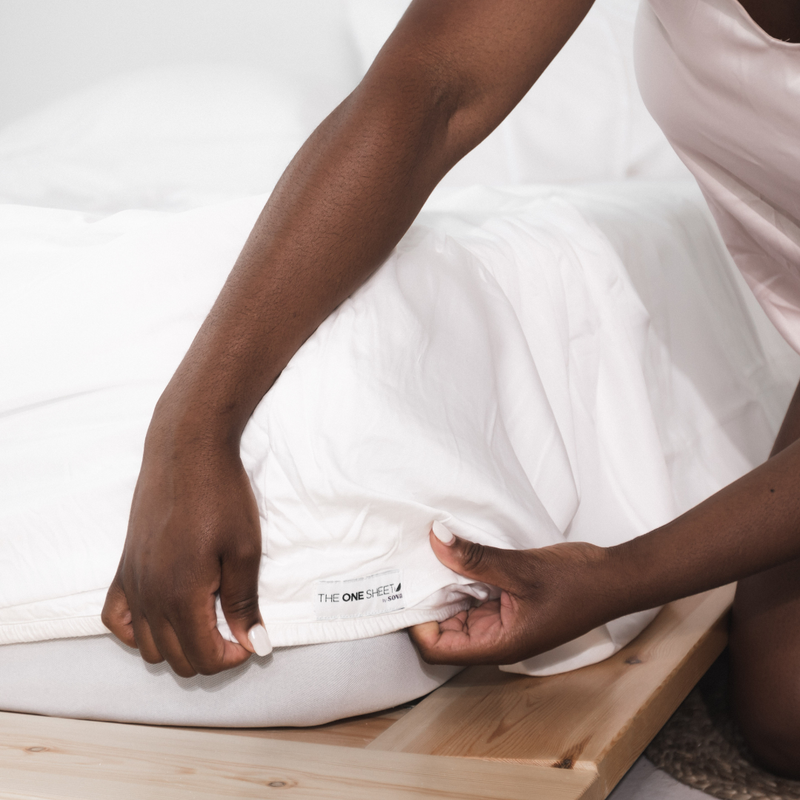
The structural version of this fix is a connected sheet. The One Sheet sews the top sheet directly to the fitted sheet at the foot of the bed, so the top sheet physically cannot migrate to one side, ball up, or land on the floor. Each sleeper can still lift their own side to slide in or vent heat, but there is no free edge for a sleeping partner to drag away. One layer of the nightly tug-of-war simply stops existing.
5. Give the serial thief a backup layer
If one partner is a confirmed blanket burrito, put a folded throw or spare blanket on their side of the foot of the bed. When they cocoon at 2 a.m., the other sleeper pulls up the backup instead of starting a recovery mission. It is a low-tech fix, and couples who love a shared duvet often prefer it to splitting into two covers.
Which cover-stealing fix is right for you?
| Fix | Best for | Cost | Fixes or manages? |
|---|---|---|---|
| Connected sheet (The One Sheet) | Couples whose top sheet twists, balls up, or disappears | One sheet set | Fixes the sheet layer for good |
| Two duvets (Scandinavian method) | Duvet thieves and mismatched thermostats | Two twin duvets | Fixes duvet theft |
| Oversized top layer | Mild, occasional cover creep | One larger comforter | Manages it |
| Backup throw for the thief | One confirmed blanket burrito | A spare throw | Manages it |
| Cover clamps and clips | Light tugging, gadget-friendly couples | A few dollars | Manages it nightly |
Do cover clamps and blanket clips work?
Clamps, clips, and sheet suspenders grip the bedding and fight the pull all night, and they do reduce migration. Treat them honestly for what they are: ongoing management of the symptom. The clips need repositioning, they can lose grip against a strong roller, and hard plastic under a mattress edge is easy to knock loose on adjustable bases. They fight the failure point every night, whereas an oversized layer, two duvets, or a connected sheet removes the failure point altogether. If you like gadgets they are cheap to try, but most couples get further changing the bedding itself.
Is a sleep divorce the only real fix?
It is not, and it should be the last resort rather than the first. In the American Academy of Sleep Medicine's 2025 survey, about 31 percent of U.S. adults said they sleep apart from their partner at least some of the time, a setup often called a sleep divorce. It works for chronic snoring or wildly mismatched schedules, but for plain cover-stealing it is overkill. Separate covers in a shared bed, or a top sheet that cannot be stolen, gets you the sleep without giving up the closeness. Keep the bed; divorce the shared blanket instead.
Where The One Sheet fits for couples
Full disclosure, this is our blog and we make the thing, but the fit here is real. The One Sheet was designed around exactly this failure: the top sheet is permanently sewn to the fitted sheet at the foot of the bed, a connected design covered by two utility patents, so no amount of rolling can pull it loose, sideways, or onto the floor. The fabric is organic bamboo viscose, which breathes well enough to keep the overheating partner from kicking free in the first place, and it is OEKO-TEX Standard 100 certified. Deep pockets keep the fitted anchored on thick and adjustable mattresses, where restless-couple bedding usually fails first. And because sharing a bed is the whole point, you can test it together on a 100-night sleep trial.
Key takeaways
- Cover-stealing is mechanical, not personal: adults change position 10 to 30 times a night and the bedding follows the mover.
- Temperature mismatch fuels the fight; 37 percent of adults say they overheat when sharing a bed (AASM, 2025).
- The fastest fixes are structural: size the top layer up, or give each sleeper their own duvet (the Scandinavian sleep method).
- Clips and clamps manage the symptom nightly; changing the bedding removes the failure point.
- The top sheet is the most-stolen layer, and a connected design like The One Sheet makes stealing it structurally impossible.
- A sleep divorce is a last resort; separate covers in a shared bed solve most cover wars.
FAQ: stealing the covers
How do I keep my partner from stealing the covers?
Start with the bed, not the partner. Upsize the comforter one size beyond your mattress, or switch to two individual duvets (the Scandinavian sleep method) so there is no shared layer to steal. If the top sheet is the layer that keeps disappearing, a connected sheet such as The One Sheet anchors it at the foot of the bed so it cannot be dragged to one side.
Why do I always steal the blanket?
Blanket-stealing is usually biology rather than habit. The average adult shifts position 10 to 30 times a night, and each turn drags a little bedding toward the side you roll to. If you also run cold, your sleeping body pulls covers in to warm up without ever waking you. An oversized top layer or your own separate duvet compensates for both.
What is the Scandinavian sleep method?
The Scandinavian sleep method is the practice of dressing one shared bed with two twin duvets, one per sleeper, instead of a single shared duvet. Standard across Denmark, Norway, and Sweden, it eliminates cover-stealing entirely and lets each partner choose their own warmth level. Couples who prefer a single styled look can pair the two duvets with one connected sheet layer underneath.
Does a bigger blanket stop cover-stealing?
A bigger blanket helps immediately and is the cheapest fix: a king comforter on a queen bed adds enough width that normal rolling no longer strips either sleeper. It reduces the problem rather than removing it, though. A dedicated roller can still wind up any amount of extra fabric, which is why serial cases do better with two duvets or an anchored, connected top sheet.
Do cover clamps actually work?
Cover clamps and sheet suspenders reduce blanket migration, but they are nightly maintenance rather than a cure. They grip fabric against the pull of a rolling sleeper, and they can slip, snap, or need repositioning, especially on adjustable bases. They are worth a try at low cost, but structural fixes (oversized layers, two duvets, or a sewn-together sheet system) hold up better long term.
If the nightly tug-of-war is the reason you are reading this at 3 a.m., the fix is one decision, not a negotiation. Anchor the layer that keeps escaping and you both get to keep the bed, the closeness, and the covers.