Quick answer: Sheets that stay on the bed do it by gripping the underside of the mattress, not just the corner tip. Most sheets pop off because the corner pocket gets tented straight down over the corner like an upside-down U, so the elastic only catches the point. Seat each corner flat, choose a pocket 2 to 3 inches deeper than your mattress, and look for all-around (360-degree) elastic. The only design that cannot shift at all is a connected set like The One Sheet, where the top sheet is sewn to the fitted sheet so there is no loose edge to come untucked.
You make the bed in the morning. By the second night, a corner has let go, the fitted sheet has crept toward the middle, and the top sheet is somewhere down by your knees. If you have searched for sheets that stay on the bed, you have probably been told to buy clips, straps, or a bungee that wraps the whole mattress. Some of that helps. But most of the problem is not the sheet at all. It is how the corner is seated, how deep the pocket is, and how the elastic is built. Get those three right and a good fitted sheet stays put on its own.
Here is what actually keeps sheets on the bed, in the order that matters.
Why won't my sheets stay on the bed?
The single most common reason a fitted sheet keeps coming off is a seating problem, not a sheet problem. When you grab the pocket and pull it straight down over the tip of the mattress corner, the fabric tents into an upside-down U. In that position the elastic is only hooked over the point of the corner, so the first time you roll over, the slack tugs the pocket back up and over the tip, and the corner pops.
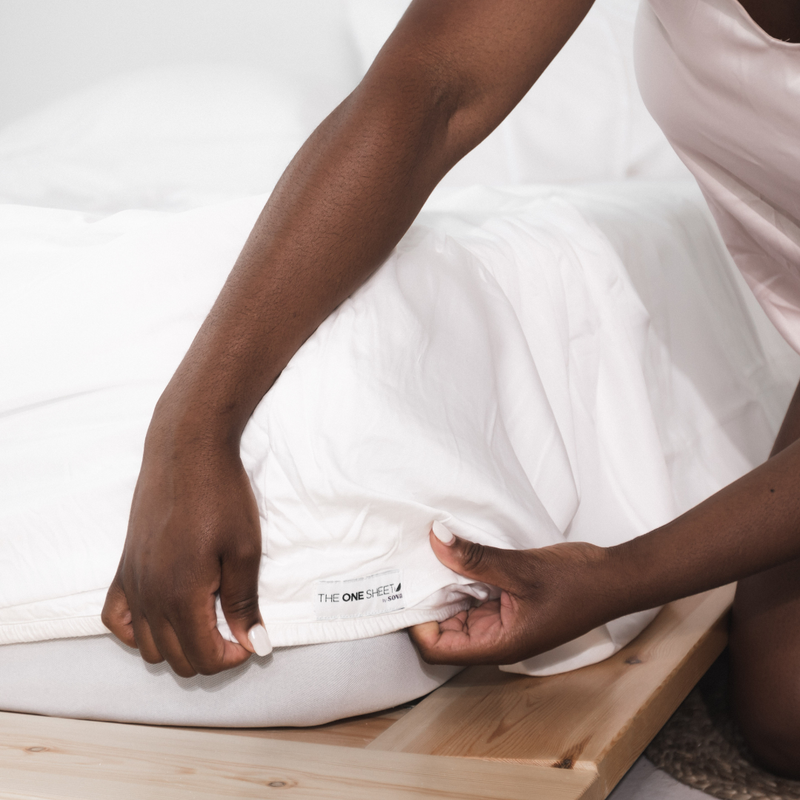
A sheet that is seated correctly wraps the corner and then pulls the deep part of the pocket under the mattress, so the elastic grips the flat underside on two sides at once. That is what holds. The corner is anchored beneath the mattress instead of balanced on top of it.
Two other things make corners fail, and they come after seating, not before it. The first is pocket depth: even a perfectly seated corner will slip if the pocket is too shallow to reach under a thick mattress. The second is the elastic and the fabric: four-corner-only elastic and slippery synthetic weaves give up faster than all-around elastic on a fabric with some grip. We will take each of these in turn.
How do you get a fitted sheet to stay on the bed?
Before you buy anything, try re-seating the sheet you already own. This fixes a surprising number of "my sheets never stay on" cases for free.
- Find the foot of the bed. Start with the two corners you do not climb into, so the sheet is anchored before you reach the head.
- Hook the corner, do not tent it. Place the pocket over the mattress corner so the seam runs along the edge, then pull the deep part of the pocket down and under the mattress rather than straight down over the tip.
- Pull on the diagonal. Tug each corner toward the opposite corner so the fabric is taut across the top and the elastic seats flat underneath.
- Do the head corners last, the same way, then run a hand along each side to pull any all-around elastic snug under the rails.
- Check the gap. Lift each corner. If you can see daylight under the elastic, the pocket is too shallow for your mattress, and you have moved from a technique problem to a sizing problem.
If the corners still ride up after a correct seating, the sheet is genuinely too small for the bed. That is the next thing to fix.
Does pocket depth matter for sheets that stay on?
Pocket depth matters a lot, because mattresses have quietly gotten taller. A standard mattress used to sit around 9 to 12 inches. Today hybrids commonly run 12 to 14 inches and pillow-tops reach 16 to 18 inches, and that is before you add a mattress pad or topper. A pocket built for a 10-inch bed simply cannot reach the underside of a 15-inch one, so the elastic never gets to grip where it counts.
A simple way to size sheets that stay on the bed: measure your mattress at its tallest point, including any topper or protector, then choose a pocket that is 2 to 3 inches deeper than that number. As a rough map:
- A 10 to 12 inch mattress fits standard sheets.
- A 13 to 17 inch mattress needs deep-pocket sheets (commonly 14 to 16 inch pockets).
- An 18 inch or taller mattress needs extra-deep sheets (17 to 22 inch pockets).
To measure, set a straightedge flat across the top of the mattress so it overhangs the edge, then measure straight down to the bottom of the mattress. Include the topper if you use one. Buying a pocket that is too shallow is the most common sizing mistake, and no clip will save a sheet that physically cannot reach under the bed.

All-around elastic versus four-corner elastic
Two fitted sheets can look identical on the shelf and behave completely differently on the bed, and the reason is usually the elastic. Sheets with elastic only at the four corners leave the long sides free to lift, which is exactly where a thick mattress pushes the fabric up. Sheets with all-around (360-degree) elastic hug every side, so the whole hem stays tucked under the rails instead of just the corners.
Fabric plays a supporting role. Slippery microfiber and low-grade synthetics slide against the mattress and tend to loosen within a few dozen washes as the elastic tires. Natural and natural-derived fibers with a bit of texture, like cotton and organic bamboo viscose, grip the mattress better and hold their shape longer. When you are comparing sheets that stay on the bed, check the spec for "all-around" or "360-degree" elastic and a fabric that is not pure slick synthetic.
Do sheet clips, straps, and grippers actually work?
They work, with an honest caveat: accessories treat the symptom, not the cause. If you love the sheets you already have and the corners only need a little help, fasteners are a reasonable fix.
- Sheet suspenders and bed garters are adjustable straps with clips that cross diagonally under each corner and pull the fabric tight.
- A bed band or "scrunchie" is a single bungee-style loop that clips around the whole perimeter and cinches excess fabric inward.
- Grippers and non-slip pads add friction between the sheet and the mattress so the fabric slides less.
The tradeoff is that every one of these is something extra to clip on, re-tension, and replace, and they all assume the sheet keeps trying to come off. They manage a fight that never fully ends. That is fine if you want to rescue a favorite set. It is worth knowing, though, that the shifting itself is a design problem, and design problems can be removed rather than managed.
The sheets that simply cannot shift
Most "stay on the bed" products tackle the fitted sheet. They do very little for the other half of the nightly mess: the top sheet that twists, bunches, and ends up stolen to one side. The reason is that a traditional top sheet is a separate loose layer with no anchor, so it goes wherever the sleeper drags it.
The One Sheet takes a different route. The top sheet is permanently sewn to the fitted sheet at the foot of the bed, so the two move as one connected set. There is no loose top-sheet edge to untuck and no separate layer to kick down or fight over, which removes the failure point instead of clipping around it. The connected design is covered by two utility patents, and the deep pockets are built to fit standard, thick, and adjustable mattresses, so the fitted side seats and stays the way a well-sized fitted sheet should.
There is a practical bonus for anyone who has watched cheap sheets loosen up after a few months of laundry. The One Sheet is made from breathable organic bamboo viscose that is OEKO-TEX Standard 100 certified and uses FSC certified materials, and because the set is connected, it ships with a free mesh wash bag so the whole thing washes as one piece without tangling or twisting around other laundry. Keeping the fabric and elastic in good shape is part of how any sheet keeps staying put, and a gentler wash helps it last. If you want to try it without committing, there is a 100-night sleep trial.
Here is how the common approaches compare for sheets that stay on the bed.
| Approach | What it fixes | The tradeoff |
|---|---|---|
| Re-seating the corners | Most "won't stay on" cases, for free | Has to be redone every time you change sheets |
| Deep-pocket sizing | Corners that pop on tall mattresses | You must measure and match the depth |
| All-around elastic | Sides lifting, not just corners | Quality varies; check the spec |
| Clips, straps, grippers | Rescuing sheets you already own | Extra parts to attach, tension, and replace |
| Connected design (The One Sheet) | The fitted and top sheet shifting at all | It is a full set, not a single fitted sheet |
Key takeaways
- Most sheets pop off because the corner is tented over the tip in an upside-down U instead of seated flat under the mattress, so re-seating the corners fixes many cases for free.
- Match pocket depth to your mattress: choose a pocket 2 to 3 inches deeper than the mattress height, including any topper.
- All-around (360-degree) elastic holds far better than elastic only at the four corners.
- Clips, straps, and grippers work, but they manage the symptom rather than removing the cause.
- A connected set like The One Sheet sews the top sheet to the fitted sheet so neither layer can shift, bunch, or get stolen.
Frequently asked questions
What are the best sheets that stay on the bed?
The best sheets that stay on the bed combine the right pocket depth for your mattress with all-around elastic and a fabric that grips rather than slides. For people who also want the top sheet to stay put, a connected design like The One Sheet removes the shifting entirely because the two layers are sewn together.
How do you get sheets to stay on the bed?
Seat each corner flat by hooking the pocket over the mattress corner and pulling the deep part under the mattress, rather than tenting it over the tip. Then confirm the pocket is deep enough for your mattress and that the elastic runs all the way around.
Why do my sheets never stay on my bed?
Usually one of three things: the corners are seated over the tip instead of under the mattress, the pocket is too shallow for a tall mattress, or the elastic is only at the four corners. Work through them in that order before buying accessories.
Do fitted sheet clips really work?
Yes, clips, suspenders, and bands keep a loose sheet tighter, but they are ongoing symptom management. They assume the sheet will keep trying to come off, so you re-tension and replace them over time.
What size pocket do I need for a deep mattress?
Measure the mattress at its tallest point including any topper, then add 2 to 3 inches. A 15-inch mattress, for example, is happiest in a pocket of at least 17 to 18 inches.
If you are tired of re-tucking corners and chasing the top sheet, the simplest fix is a set that cannot come apart in the first place. The One Sheet is built around that idea, and the 100-night sleep trial means you can see if it ends the nightly tug-of-war for you.