Quick answer: A top sheet, also called a flat sheet, is the flat rectangle of fabric that lies between you and your comforter or duvet. Its job is to act as a thin, washable barrier that keeps your heavier bedding cleaner from sweat, oil, and dead skin cells. You do not strictly need one if you sleep under a washable duvet cover, but many people keep a top sheet for the clean layer and the lighter summer cover it provides.
A top sheet is the flat, rectangular sheet that lies between you and your comforter or duvet. It is the most argued-about piece of bedding in the house right now, with older sleepers calling it essential and younger sleepers calling it pointless. Here is the plain version of what it does, why the debate exists, and how to make a top sheet behave instead of ending the night in a knot at your feet.
What is a top sheet?
A top sheet, also called a flat sheet, is a single flat rectangle of fabric that sits on top of the fitted sheet, between your body and your comforter, blanket, or duvet. It is not shaped or elasticized like a fitted sheet. It is just a clean panel of cloth that you lie under, usually a few inches wider and longer than the mattress so the edges can be tucked in or folded back at the head of the bed.
In a traditional sheet set you get three pieces: a fitted sheet that wraps the mattress, a top sheet that covers you, and pillowcases. The fitted sheet protects the mattress. The top sheet protects everything above it.
What is a top sheet used for?
The top sheet has one main job: it creates a washable barrier between you and your heavier bedding. According to the Sleep Foundation, a top sheet shields a comforter or duvet against sweat, body oil, dead skin cells, and dust mites, which keeps the bulkier layer cleaner for longer. That matters more than it sounds. The average person sheds roughly 500 million skin cells a day and sweats year round, even in cool weather, and a lot of that lands in the bed.
Because a top sheet is thin and easy to launder, you can wash it every week along with your fitted sheet and pillowcases, while washing a bulky comforter far less often. A top sheet also adds a light, breathable layer of temperature control. In summer you can sleep under just the top sheet and kick the comforter off. In winter it adds a thin extra layer of warmth without much weight.
So the top sheet does three useful things: it keeps your comforter clean, it gives you an easy-to-wash layer against your skin, and it lets you fine-tune how warm you are.
Top sheet vs flat sheet vs fitted sheet
The words get mixed up constantly, so here is the difference in one place. A top sheet and a flat sheet are the same thing: "flat sheet" describes the shape, and "top sheet" describes where it goes. A fitted sheet is the different one, with sewn-in elastic corners that grip the mattress.
| Sheet type | What it is | Where it goes | Stays put? |
|---|---|---|---|
| Fitted sheet | A shaped sheet with elastic corners | Wrapped around the mattress, under you | Designed to, but corners often pop off |
| Top sheet (flat sheet) | A flat rectangle of fabric, no elastic | On top of you, under the comforter | Not on its own, it shifts and bunches |
| Duvet cover | A fabric envelope for a duvet or comforter | Around the duvet itself | It covers the duvet, not you |
The takeaway: a flat sheet and a top sheet are one and the same, and the only sheet built to stay in place is the fitted sheet. Even the fitted sheet struggles, which is the root of most bedding frustration.
Why are people not using top sheets anymore?
This is where the internet fight lives. A Casper survey of 1,000 Americans found a clear generational split. Overall, 58 percent of Americans agree or strongly agree that a top sheet is essential, and 67 percent of people aged 55 and older feel that way. But usage drops with age: about 43 percent of people 55 and up use a top sheet, compared with roughly 26 percent of 18 to 34 year olds. And 18 percent of people aged 18 to 24 said they feel strongly against using one, versus just 3 percent of those 65 and older.
The reasons younger sleepers give are remarkably consistent. They say the top sheet tangles at night, bunches up at the foot of the bed, and adds an extra step to making the bed in the morning. Many prefer to sleep directly under a duvet inside a washable duvet cover, then just wash the whole cover often. That habit comes from Europe, where bedding has long skipped the flat sheet in favor of a fitted sheet plus a duvet in a cover. The duvet cover grew popular in 1970s Europe and reached the United States later, which is part of why younger Americans tend to see the top sheet as old fashioned.
Here is the honest read: people are not really rejecting the idea of a clean barrier. They are rejecting a piece of fabric that will not stay where they put it. The complaint is about behavior, not hygiene.
Do you actually need a top sheet?
You do not strictly need a top sheet if you use a duvet inside a duvet cover and you wash that cover often. The cover becomes your washable barrier, so the comforter stays clean without a separate flat sheet.
You probably do want a top sheet if you sleep under a comforter or blanket that is a pain to wash, if you run warm and like a light layer you can sleep under alone in summer, or if you simply like the made-bed look and feel of a tucked layer. The choice is genuinely personal. The trouble is that the most common reason people quit the top sheet, the constant shifting and bunching, is a design problem with a real fix.

The real reason your top sheet never stays put
Before you blame yourself, understand the mechanism. A standard top sheet is a loose rectangle with nothing holding it to the bed except whatever you tuck under the mattress at the foot. Every time you roll, sit up, or pull the comforter, that tuck loosens. By 2 a.m. the sheet has worked free, slid toward the middle, and twisted into the rope of fabric everyone complains about.
It is the same story one step down with the fitted sheet. Fitted sheets pop off the corners mostly because of how they are put on. People pull the pocket straight down over the tip of the mattress corner, tenting it into an upside-down U so the elastic only grips the very point. Seated that way, the corner lifts off the moment you move. The fix is to hook each corner pocket over the mattress corner and pull it flat under the mattress, so the deep pocket wraps the underside and grips there. Pocket depth is the second cause: a correctly seated corner still fails if the pocket is too shallow for a thick mattress, so a 15 inch or deeper mattress needs a 16 to 22 inch pocket.
Clips, sheet suspenders, straps, and corner grippers can help, but they treat the symptom. You are adding hardware to fight a sheet that was never connected to anything in the first place.
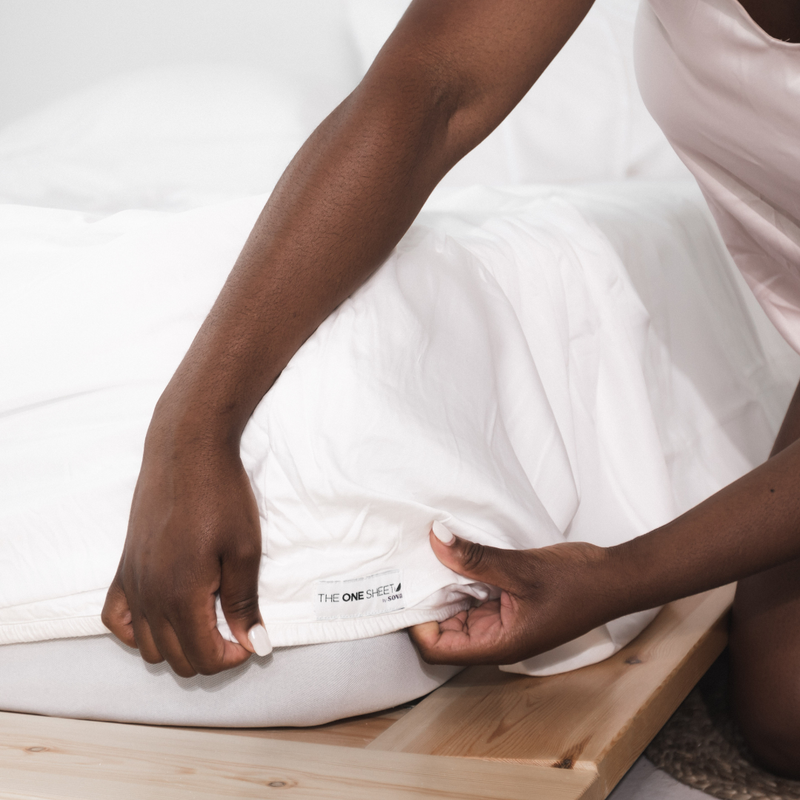
The One Sheet by Sova takes a different route. It is a connected sheet system: the top sheet is permanently sewn to the fitted sheet at the foot of the bed, so there is no loose flat sheet to twist, slide, or get kicked to the bottom. You still get the washable barrier a top sheet is supposed to provide, but it physically cannot bunch off the bed, because it is anchored. For couples, that also ends the nightly cover tug-of-war, since neither person can drag the shared layer to their side. The connected design removes the failure point instead of managing it.
How to put a top sheet on a bed so it stays put
If you are using a traditional top sheet, here is the way to set it for the best chance of staying in place.
- Put your fitted sheet on first, seating each corner flat under the mattress as described above so your base layer is tight.
- Spread the top sheet over the bed wrong side up, so the finished hem faces down. This way the nice side shows when you fold it back.
- Line up the top edge of the sheet with the head of the mattress, leaving equal overhang on both sides.
- Tuck the bottom edge firmly under the foot of the mattress, then tuck the sides if you like a crisp, hotel-style finish.
- Fold the top edge back over your blanket or comforter to create the neat band you see on a made bed.
Tucking buys you a tidier start, but on a loose flat sheet it will still work free over the night. If you are tired of redoing this every morning, a connected design like The One Sheet skips the steps entirely, because the top layer is already attached and stays where it belongs.
Caring for your sheets
Whatever you sleep under, wash the layer that touches your skin about once a week to keep skin cells, oil, and dust mites from building up. Top sheets and fitted sheets are easy to launder; comforters and duvets are not, which is exactly why the barrier layer earns its keep.
The One Sheet is made from organic bamboo viscose, a breathable fabric that helps wick moisture for warm sleepers, and it ships with a free mesh wash bag in every order. Because the top and fitted layers are connected, the whole set goes into the bag and washes as one piece without tangling or wrapping around everything else in the machine, then comes out ready to go back on the bed. It is OEKO-TEX Standard 100 certified and made with FSC certified materials, with deep pockets that fit standard, thick, and adjustable mattresses.
Key takeaways
- A top sheet, also called a flat sheet, is the flat rectangle that lies between you and your comforter, and "top sheet" and "flat sheet" mean the same thing.
- Its main purpose is to act as a washable barrier that keeps your comforter clean from sweat, oil, and the roughly 500 million skin cells you shed each day.
- A Casper survey of 1,000 Americans found 58 percent call a top sheet essential, but usage falls sharply among younger sleepers who say it tangles and bunches.
- You can skip a top sheet if you use a washable duvet cover, but the most common reason people quit is shifting, which is a fixable design problem.
- Most stay-put problems come from technique and shallow pockets first, and accessories only manage the symptom.
- The One Sheet by Sova sews the top sheet to the fitted sheet at the foot, so the barrier stays put, washes as one piece in its included mesh bag, and comes backed by a 100-night sleep trial.
Frequently asked questions
What is the purpose of a top sheet?
The purpose of a top sheet is to create a thin, washable barrier between your body and your comforter or duvet. It keeps the heavier bedding cleaner from sweat, body oil, and dead skin cells, and it gives you a light layer you can sleep under on its own when it is warm.
Why are people not using top sheets anymore?
Many younger sleepers have dropped the top sheet because it tangles and bunches at the foot of the bed and adds a step to making the bed. They tend to sleep under a duvet in a washable cover instead, an approach common in Europe, and wash that cover frequently rather than relying on a flat sheet.
Why don't Europeans use a top sheet?
European bedding traditionally uses a fitted sheet plus a duvet inside a removable cover, with no flat sheet in between. The duvet cover became the washable barrier, so the top sheet was never part of the standard setup, and many people find sleeping under a single duvet less constricting.
Is a top sheet the same as a flat sheet?
Yes. A top sheet and a flat sheet are the same item. "Flat sheet" describes the shape, a plain rectangle with no elastic, and "top sheet" describes where it goes, on top of you and under the comforter.
How do I keep my top sheet from bunching up?
On a traditional top sheet, tuck the foot and sides tightly and start with a well-seated fitted sheet, though it will still loosen over the night. The only way to fully stop the shifting is a connected design like The One Sheet, where the top sheet is sewn to the fitted sheet so it cannot slide off the bed.
If your real problem with the top sheet is that it never stays where you put it, that is worth fixing rather than giving up on the clean layer it provides. The One Sheet by Sova keeps the barrier and removes the bunching, with a 100-night sleep trial so you can try it on your own bed.